Shipping Container Transport Options and Site Rules
By Outback Shipping Containers · Published July 29, 2026 · Last updated October 18, 2026
Shipping Container Transport Options and Site Rules
Shipping container transport usually means moving an ISO container by tilt-bed truck, side-loader, flatbed with crane or forklift support, or intermodal rail. The right option depends on container size, empty or loaded weight, route limits, unloading equipment, and site access. Most 20ft containers can be delivered by tilt-bed truck. Larger 40ft, 40ft high cube, container homes, and custom builds often need more clearance, better ground, or a planned lift.
Quick Answer: For most home, farm, and job-site deliveries, choose the transport method based on how the container will be unloaded, not just how far it must travel. Measure straight-line access, overhead clearance, ground firmness, turning room, and final door orientation before the truck arrives.
Key Takeaways
- Most 20ft conex box deliveries use a tilt-bed truck, while 40ft and high cube units often need longer clearance or a side-loader.
- A standard ISO container is 8 ft wide, but the truck, trailer, stabilizers, and turning path need much more space than the container itself.
- Site rules matter as much as road rules. Firm ground, safe overhead clearance, and a level landing area prevent delays.
- Permits can apply to road transport, temporary placement, storage use, or a shipping container home. Rules vary by state, county, and city.
- Get the delivery method, access needs, placement direction, wait-time policy, and offload plan in writing before you schedule.
Shipping Container Transport Options Compared
Shipping containers are built as intermodal containers. That means they can move by ship, rail, and truck when handled with the right equipment. But the best method for a port, rail yard, warehouse, ranch, or backyard is not always the same.
For a first-time buyer, the main question is simple: how will the container come off the truck? If the delivery vehicle cannot unload at your site, you may need to rent a crane, forklift, or telehandler. That changes the schedule and the cost structure.
| Transport method | Best use | How the container is unloaded | Typical site needs | Watch-outs |
|---|---|---|---|---|
| Tilt-bed or roll-off truck | 10ft and 20ft storage containers, some 40ft deliveries | Truck tilts the bed and slides the container off | Long straight approach, firm ground, clear overhead space | Cannot lift over fences or rotate the unit in place |
| Side-loader truck | 20ft and 40ft units where parallel placement helps | Hydraulic arms lift the container off the side | Room beside the truck for stabilizers and landing area | Needs firm, level ground and may not be available in every market |
| Flatbed or step-deck trailer | Long-haul moves, high cube containers, depot transfers | Crane, forklift, reach stacker, or telehandler unloads it | Separate lift equipment at pickup and drop-off | Good road option, but not a complete site delivery plan by itself |
| Crane or boom truck support | Tight sites, container homes, pools, offices, lifts over obstacles | Container is rigged and lifted from the trailer | Certified lifting plan, stable crane pad, clear swing radius | Reach, weight, and site conditions drive feasibility |
| Rail or intermodal move | Long-distance bulk moves between terminals | Rail yard cranes or reach stackers handle the container | Trucking still needed for first and last mile | Good for volume, less useful for a single rural delivery |
Tilt-bed delivery
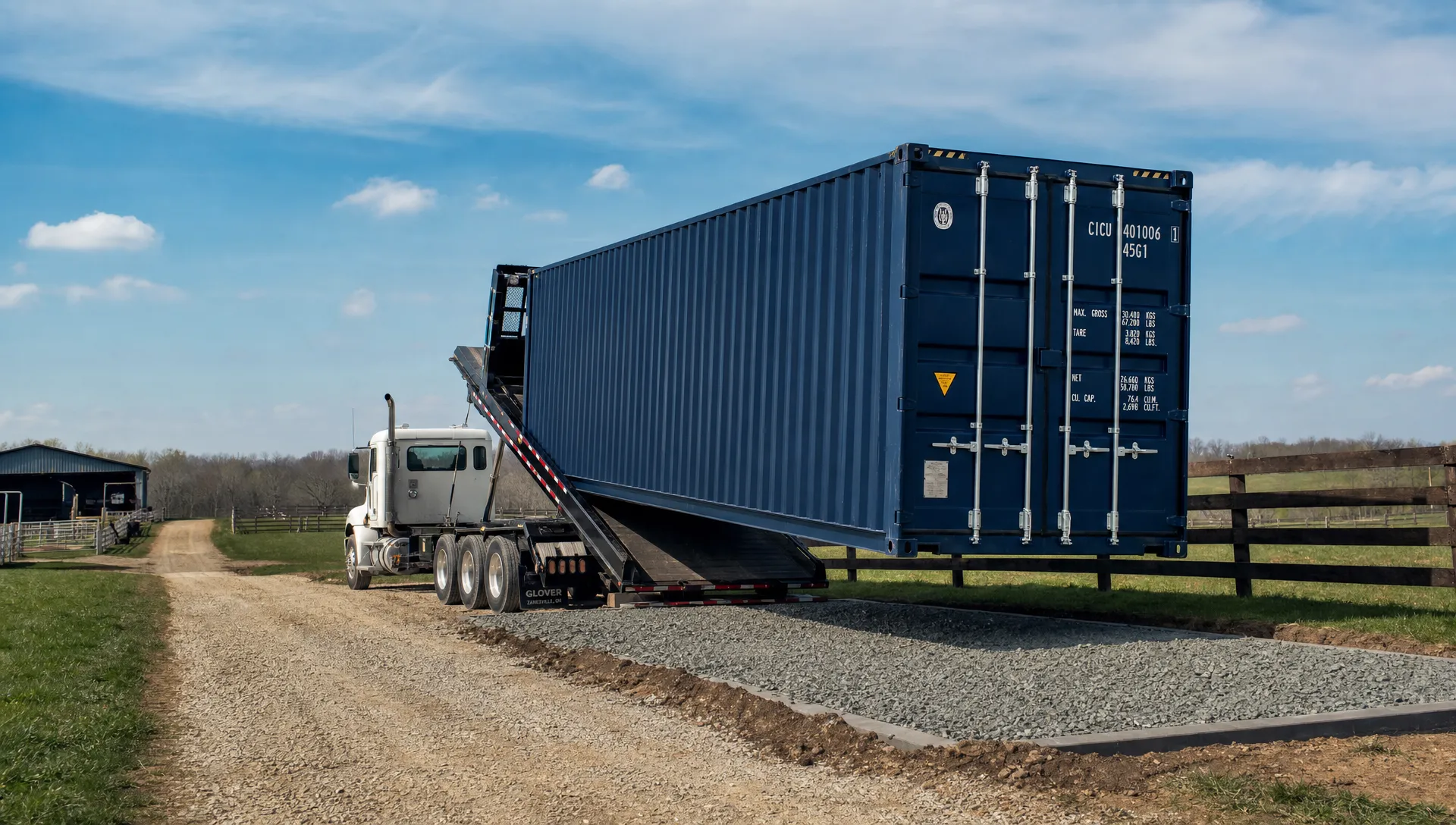
A tilt-bed truck is common for residential and small business deliveries. The driver backs into position, raises the bed, and lets the container slide down until it rests on the ground. The truck then pulls forward as the container lands.
This method works well when you have enough straight clearance. As a rule of thumb, plan for 100 ft of straight space for a 20ft container and 120 ft for a 40ft container. Exact needs vary by truck, slope, and driver approach.
Tilt-bed delivery does not lift the container over obstacles. If your pad sits behind a fence, retaining wall, ditch, or tight turn, ask about a side-loader or crane plan before delivery day.
Side-loader delivery
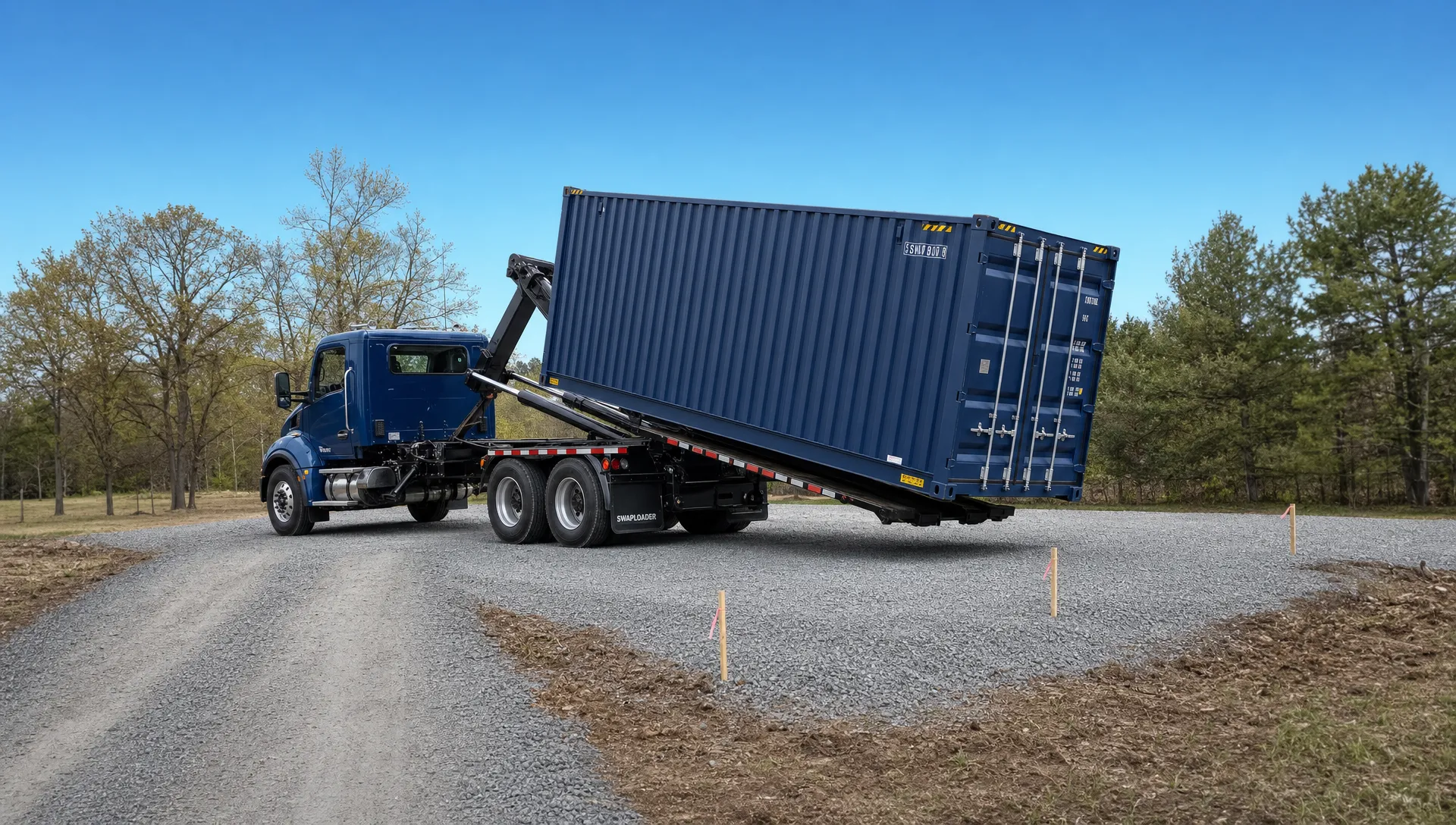
A side-loader uses hydraulic arms to lift the cargo container off the trailer and set it beside the truck. This can help when the driver cannot pull straight forward after unloading. It also helps when you want the container placed parallel to a driveway, lane, or building.
The tradeoff is side clearance. The truck needs room for stabilizers, lift arms, and the container footprint. Soft soil, steep slopes, and narrow lanes can make side-loader delivery unsafe.
Flatbed, step-deck, and Landoll-style trailers
Flatbeds and step-decks work well for highway transport, especially for long routes and high cube containers. A step-deck keeps the overall load height lower than a standard flatbed, which can matter when moving a 9 ft 6 in high cube unit.
These trailers usually do not unload by themselves. You need a forklift, crane, reach stacker, or other lift equipment on-site. A small warehouse forklift will not lift a full-size container safely. Confirm rated capacity, fork length, ground conditions, and operator availability.
Crane-assisted transport
A crane can solve placement problems that trucks cannot. It may lift a container over a fence, rotate it into a tight pad, or set a container conversion onto piers. Crane work is common for container homes, modular offices, container pools, and stacked units.
Crane planning must account for weight, radius, ground bearing, overhead utility lines, and rigging points. A container that weighs 8,500 lb on the trailer may require a much larger crane if the operator must reach far from the setup point.
Rail and intermodal transport
Rail can make sense for bulk moves or depot-to-depot shipping over long distances. It is less common for one residential container because rail still needs truck transport at both ends. You also need terminal access, handling windows, and coordination between carriers.
If you are buying one container for a home, farm, or job site, the final delivery truck is usually the main planning point. For a deeper look at buying around the delivery route, see Outback Shipping Containers guide on choosing shipping containers for local delivery.
Know Your Container Size, Weight, and Handling Points
Before any container move, confirm the exact size and condition. A 20ft one-trip dry van, a used WWT container, a CWO unit, a reefer, and a custom office may all transport differently.
Most dry ISO containers are 8 ft wide. Heights are usually 8 ft 6 in for standard units and 9 ft 6 in for high cube units. Tare weight means the empty container weight. Payload capacity means the rated weight the container can carry, but road moves also depend on truck axle limits, state rules, and lift equipment.
| Container type | Common exterior size | Approx. empty tare weight | Transport note |
|---|---|---|---|
| 10ft dry container | 10 ft x 8 ft x 8 ft 6 in | 2,800 to 3,300 lb | Often moved with smaller tilt-bed or flatbed equipment, but dimensions can vary |
| 20ft dry container | 20 ft x 8 ft x 8 ft 6 in | 4,800 to 5,200 lb | Usually the easiest full-size unit for residential tilt-bed delivery |
| 40ft dry container | 40 ft x 8 ft x 8 ft 6 in | 8,000 to 8,800 lb | Needs more straight clearance and careful turning room |
| 40ft high cube | 40 ft x 8 ft x 9 ft 6 in | 8,500 to 9,300 lb | Extra height can affect route planning and trailer choice |
| 45ft high cube | 45 ft x 8 ft x 9 ft 6 in | 10,000 to 10,800 lb | Often requires more route and site planning due to length |
These are typical ranges, not a substitute for the container data plate or supplier paperwork. Tare weight can change with manufacturer, floor type, doors, refrigeration equipment, insulation, windows, framing, and other modifications.
A CSC plate helps identify key container ratings for intermodal use. CWO means cargo-worthy, which can matter for freight use. WWT means wind and watertight, which is common for storage. A container can be suitable for secure storage even if it is not the right choice for loaded international freight.
Site Rules for Safe Container Delivery
The delivery site can make or break the job. A skilled driver can do a lot, but they cannot ignore physics, utility hazards, or unstable ground. If the site is unsafe, the driver may refuse placement or choose the nearest safe drop point.
Use a real tape measure or measuring wheel. Photos help, but measurements decide what equipment can fit. For a full preparation list, compare your site against this shipping container site prep checklist before you book delivery.
Access width and turning room
The container is 8 ft wide, but the truck is wider and longer. Gates, posts, trees, mailboxes, parked vehicles, and tight corners reduce usable space.
Good planning targets include:
- 12 ft minimum clear gate width for many truck deliveries, with more preferred for turns
- 14 ft overhead clearance for many standard deliveries, with more needed near tilt-bed unloading
- 100 ft of straight approach for many 20ft tilt-bed drops
- 120 ft of straight approach for many 40ft tilt-bed drops
- Clear space for the driver to exit without crossing lawns, septic areas, or soft shoulders
These numbers are planning guides. Your carrier may require different clearances based on truck type, trailer length, slope, and final placement angle.
Ground firmness and slope
A loaded delivery truck can weigh far more than the empty container. Wet clay, fresh fill, sand, snowmelt, and soft pasture can stop a delivery fast. A driveway that handles a pickup truck may still fail under a tractor-trailer or side-loader.
Gravel pads work well for many storage containers because they drain water and spread weight. Concrete piers, slabs, and engineered footings may be needed for offices, workshops, container homes, pools, or stacked units. If the unit will become occupied space, talk to your local building department and a qualified design professional.
Overhead hazards
Overhead hazards include power lines, low branches, roof eaves, signs, and telecom cables. Tilt-bed trucks raise the container during unloading, so overhead room matters along the approach and at the drop point.
Never ask a driver to work close to power lines. If lines cross the route, contact the utility provider before delivery day. Trimming trees before the truck arrives is cheaper than paying for a failed delivery attempt.
Door orientation and final placement
Container doors need swing space. Standard cargo doors can need several feet of clear room in front of the opening. If doors face a fence, slope, snow drift area, or building wall, daily use becomes frustrating.
Mark the four corners of the final position with stakes, paint, cones, or flags. Also mark which end gets the doors. Measure the route, not just the pad, because the truck must reach the spot safely.
Permits, Road Rules, and Delivery Paperwork
Transport rules and property rules are separate. A carrier may have authority to move the container on public roads, but you may still need approval to place it on your property. Storage, construction use, and residential conversion can trigger different rules.
On major truck routes, federal size rules help shape what carriers can move. The Federal Highway Administration explains commercial vehicle size and weight rules, including the 102-inch width limit on the National Network, in its truck size and weight overview. Standard 8 ft wide ISO containers usually fit width rules, but total vehicle height, length, axle weight, and route limits still matter.
Carriers also need to secure the container correctly. The Federal Motor Carrier Safety Administration publishes cargo securement rules that apply to commercial vehicle loads. A container should be secured with rated equipment that prevents shifting, sliding, or falling during transport.
For local placement, check zoning, building, floodplain, fire access, HOA, and temporary storage rules. Requirements vary widely by city and county. A rural farm may have fewer placement limits than a residential subdivision, while a shipping container home may need full building review.
If you are unsure where to start, use Outback Shipping Containers state-focused guide to shipping container permit requirements as a planning aid, then confirm with your local authority.
How to Plan Shipping Container Transport Step by Step
Good delivery planning starts before you pay for the container. A lower container price can become expensive if the delivery method does not match your property.
- Choose the right size and condition: Decide whether you need a 10ft, 20ft, 40ft, high cube, one-trip, used WWT, CWO, reefer, office, or custom unit.
- Confirm empty or loaded transport: Moving an empty container is different from moving one full of tools, hay, inventory, or building materials.
- Ask how it will unload: Get the truck type in writing, such as tilt-bed, side-loader, flatbed with crane, or customer-supplied forklift.
- Measure the full route: Include public road approach, driveway width, gate width, turn radius, tree limbs, overhead lines, and the landing area.
- Check ground conditions: Avoid wet days, soft fill, septic fields, buried tanks, irrigation lines, and fresh asphalt that may not support heavy trucks.
- Mark the final position: Stake the corners and mark the door end so the driver does not have to guess.
- Confirm permits and approvals: Check local rules before delivery, especially for long-term storage, commercial use, or a container conversion.
- Plan for weather: Rain, snow, mud, wind, and freeze-thaw conditions can delay safe placement.
- Be present on delivery day: The person on-site should have authority to approve the exact placement or choose an alternate safe spot.
Empty is not the same as light. A 40ft dry container can weigh more than 8,000 lb before you add cargo. If you plan to move a loaded container, tell the carrier what is inside and provide an honest weight estimate. Overweight moves can violate axle limits and damage lift equipment.
If you are still comparing sizes, grades, and delivered options, review the new, used, and custom shipping containers available from Outback Shipping Containers before you lock in your transport plan. Matching the container to the delivery site early is easier than changing equipment later.
Special Transport Rules for Homes, Offices, Reefers, Pools, and Farms
A plain storage container is simple compared with a finished container build. Once you add windows, doors, insulation, plumbing, HVAC, decks, pool liners, or interior walls, transport becomes more sensitive.
Shipping container homes and tiny homes
A shipping container home may no longer behave like a basic freight box. Cutouts can change rigidity. Interior finishes can crack if the unit twists. Exterior cladding, roof systems, and utility penetrations can add width, height, and fragile components.
For container homes, ask about lifting points, bracing, weather protection, and whether the unit can travel as a standard ISO container or as an oversized modular load. Local permits and inspections also matter because occupied structures face stricter rules than storage units.
Modular offices and workshops
Container offices and workshops often include personnel doors, windows, electrical panels, insulation, and HVAC units. These features can affect handling and placement. The final site should also allow safe steps, ramps, drainage, and emergency access.
If the office will sit on a construction site, coordinate delivery with site traffic. Trucks need a clear staging area away from excavations, cranes, concrete pours, and overhead work.
Reefers and insulated containers
Reefer containers are heavier than standard dry vans because they include refrigeration machinery and insulated walls. They also need careful placement for airflow, service access, and power connection. The delivery team should know if the unit has working machinery, a generator set, or special handling needs.
Container pools
Container pools need a level, properly prepared foundation. Transport damage can affect fittings, coatings, and integrated equipment. Final placement often needs crane support because the pool may need to land in a precise location.
Rural, ranch, and remote sites
Farm and ranch deliveries bring their own rules. Watch for cattle guards, narrow culverts, low bridges, irrigation ditches, soft pasture, steep lanes, and private roads with no turnaround. GPS may send a driver to the wrong gate, so provide written directions and a phone contact.
Outback Shipping Containers serves all 50 states, including remote and rural locations, but remote delivery still depends on safe truck access. If a site is not ready, a driver may need to drop the container at the closest safe point.
Common Delivery Problems and How to Avoid Them
Most delivery problems are preventable. The key is to find them before the truck is already in the driveway.
| Problem | Why it happens | How to prevent it |
|---|---|---|
| Driver cannot turn around | Driveway, trees, parked cars, or narrow road block the truck path | Walk the route, move obstacles, and share photos before dispatch |
| Container lands facing the wrong way | Door end was not marked or the truck could not approach from the planned direction | Mark door orientation and confirm truck approach before loading |
| Truck sinks or gets stuck | Soil is wet, loose, or recently filled | Use compacted gravel, choose a dry weather window, and avoid soft areas |
| Overhead line blocks unloading | Tilt-bed or crane needs more height than expected | Check overhead hazards and call the utility if needed |
| Lift equipment is too small | Forklift or telehandler lacks rated capacity or fork length | Confirm equipment rating and container weight before delivery |
| Extra charges appear | Carrier waits, re-routes, or makes a failed attempt | Ask about wait time, redelivery, permit, escort, and difficult-access policies |
A good seller will ask questions about access and placement. That is not red tape. It is how you avoid damage, delay, and unsafe unloading.
Frequently Asked Questions
How much space do you need to deliver a shipping container?
For many tilt-bed deliveries, plan for 100 ft of straight clearance for a 20ft container and 120 ft for a 40ft container. You also need gate width, turning room, firm ground, and overhead clearance. Exact needs depend on the truck and site angle.
What truck is used to move a shipping container?
Common trucks include tilt-bed trucks, roll-off trailers, side-loaders, flatbeds, step-decks, and trailers supported by cranes or forklifts. A tilt-bed is common for 20ft site deliveries. A side-loader or crane may be better when the driver cannot pull straight forward during unloading.
Can you move a shipping container yourself?
Most buyers should not move a full-size container themselves. Even an empty 20ft unit weighs around 5,000 lb, and a 40ft unit can exceed 8,000 lb. Safe transport needs rated trailers, securement gear, proper insurance, and equipment that can lift or unload the container.
Do I need a permit to place a shipping container on my property?
Maybe. Permit rules vary by state, county, city, zoning district, HOA, and use. Temporary storage may be treated differently than a workshop, office, or shipping container home. Always confirm local requirements before delivery, especially if the container will be visible, occupied, wired, plumbed, or permanent.
How are 40-foot shipping containers transported?
Most 40ft containers move by tractor-trailer, tilt-bed trailer, side-loader, flatbed, step-deck, rail, or intermodal chassis. The main challenge is site access. A 40ft tilt-bed delivery often needs 120 ft of straight clearance so the truck can slide the unit off and pull forward safely.
Can a shipping container be delivered on gravel or dirt?
Yes, if the ground is firm, level, and able to support the truck and container. Compacted gravel is often a strong choice for storage units because it drains well. Dirt can work in dry conditions, but mud, soft fill, and steep slopes can stop delivery or cause the container to settle.
Get the Right Container and Delivery Plan
Shipping container transport works best when the container, truck, route, and site all match. Before you schedule delivery, confirm the unit size, condition, offload method, road access, permit needs, and final placement rules.
If you are buying a storage container, high cube, container office, container pool, or custom modular build, Outback Shipping Containers can help you plan around nationwide delivery, certified inspected units, and clear delivered pricing. Start by reviewing shipping containers for sale from Outback Shipping Containers and ask for a delivery plan that fits your site.
About Outback Shipping Containers
This guide was prepared by the Outback Shipping Containers team, based on the questions our customers ask us most when buying, modifying and taking delivery of shipping containers. Learn more about us.
Ready to find your container?
Browse our in-stock shipping containers, container homes and custom builds, or ask our team for a free quote with delivery to your site.