What Affects Container Transport Price in 2026?
By Outback Shipping Containers · Published July 23, 2026 · Last updated October 18, 2026
What Affects Container Transport Price in 2026?
Container transport price in 2026 depends most on distance, delivery equipment, container size, total weight, site access, fuel, and permits. A standard empty 20ft or 40ft ISO container moved from a nearby depot to an easy-access site costs far less than a long-distance delivery to rural land with narrow roads, soft soil, or crane placement. The best way to avoid surprises is to quote the container, trucking, and placement details together before you buy.
Quick Answer: For planning, simple local moves often start with a minimum delivery charge, while regional and long-distance hauls are usually priced by loaded mile plus equipment and access fees. In many 2026 quotes, standard empty container transport commonly falls in the broad range of about $300 to $900 for local delivery, or about $3 to $7 per loaded mile for longer moves. Specialty equipment, permits, remote routes, and failed delivery attempts can raise the final price.
Key Takeaways
- Distance and depot location usually create the largest price swing because trucks are priced by time, miles, fuel, and return trip.
- Equipment matters because tilt-bed, flatbed, step-deck, Landoll, crane, and side-loader deliveries have different costs and placement limits.
- Container size and height affect trailer choice, legal route planning, and whether a 40ft high cube needs extra planning.
- Site access can make or break the quote because soft ground, slopes, fences, low branches, and tight turns add time or require special gear.
- A clean quote should list delivery method, mileage, permits, wait time, placement limits, and failed delivery terms.
Container transport price factors in 2026
The base container transport price is not just a mileage number. A carrier prices the job around the full move from pickup to placement. That includes the deadhead miles to reach the container, the loaded miles to your site, unloading time, road limits, and the time needed to get the truck back to its next job.
For standard empty cargo containers, the simplest moves are usually depot-to-site deliveries near a major metro area. A 20ft conex box going 40 miles to a wide gravel pad is routine. A 40ft high cube going 350 miles to a mountain property is not.
Most 2026 quotes have three layers:
| Quote layer | What it covers | Why it changes |
|---|---|---|
| Base transport | Truck, driver, loaded miles, dispatch | Distance, lane demand, fuel, return load availability |
| Equipment and placement | Tilt-bed, flatbed, step-deck, crane, side-loader, Landoll | Container size, height, drop direction, site access |
| Accessorial charges | Permits, tolls, wait time, failed delivery, escorts, storage | Route limits, scheduling, road conditions, customer site readiness |
If a quote looks too low, ask what is not included. Some low offers leave out placement, waiting time, permits, or rural delivery surcharges. That can turn a cheap quote into an expensive problem on delivery day.
If you want a deeper mile-by-mile breakdown, Outback Shipping Containers covers the delivery math in its shipping container delivery cost per mile guide.
Major cost drivers: distance, size, equipment, and access
Distance, depot location, and route complexity
Distance is the most obvious driver, but it is not as simple as multiplying miles by a flat rate. A trucker also cares about where the container starts, where the driver can go next, and whether the route is easy to service.
A 100-mile delivery from a busy container depot can be cheaper than a 60-mile delivery from a remote yard. That happens because busy lanes have more trucks, better return loads, and less wasted time. Remote lanes often include deadhead miles, which are miles the truck drives empty before or after your delivery.
Route complexity also matters. Mountain roads, islands, ferry crossings, low bridges, toll roads, and urban delivery windows can raise the price. So can weather delays or limited access hours at the pickup depot.
For first-time buyers, this is why a container price without delivery is incomplete. A used WWT container may look cheap at the yard, but the delivered cost may not beat a slightly higher-priced unit staged closer to your property.
Container size, height, and weight
Shipping containers are standardized, but each size affects transport differently. A 10ft or 20ft container gives the carrier more trailer options. A 40ft or 45ft unit needs more room, more careful turning, and a trailer that can support the length.
High cube containers add another issue: height. A standard container is 8 ft 6 in tall. A high cube is 9 ft 6 in tall. On some trailers, that extra foot can push the overall loaded height into a permit or route-planning concern. A step-deck or low-height trailer can help, but it may cost more than a basic flatbed.
Here are common ISO container dimensions and approximate empty weights. Actual tare weight varies by manufacturer and condition.
| Container type | Exterior size | Approx. tare weight | Transport impact |
|---|---|---|---|
| 10ft standard | 10 ft x 8 ft x 8 ft 6 in | About 2,800 to 3,000 lb | Easier local delivery, but not every depot stocks them |
| 20ft standard | 20 ft x 8 ft x 8 ft 6 in | About 4,800 to 5,100 lb | Often easiest and most flexible to transport |
| 40ft standard | 40 ft x 8 ft x 8 ft 6 in | About 8,000 to 8,800 lb | Needs more turning room and longer truck setup |
| 40ft high cube | 40 ft x 8 ft x 9 ft 6 in | About 8,500 to 9,200 lb | Extra height can affect trailer choice and routing |
| 45ft high cube | 45 ft x 8 ft x 9 ft 6 in | About 9,500 to 10,500 lb | Longer unit, fewer trailer options, more planning |
Weight becomes a bigger issue if the container is loaded. Empty tare weight is usually manageable. A loaded container can approach payload capacity and may exceed road or axle limits, especially if the weight is not balanced.
Do not assume a carrier will move a loaded container. Many delivery quotes are for empty containers only. If you need to move contents inside the box, say so before you accept the quote. The carrier may need a different trailer, proof of weight, different insurance, or may decline the move.
Delivery equipment changes the final price
The equipment used to unload the container can affect the final bill as much as the mileage. A cheap delivery method is not always the right delivery method. The truck must be able to reach the site, unload safely, and leave without getting stuck.
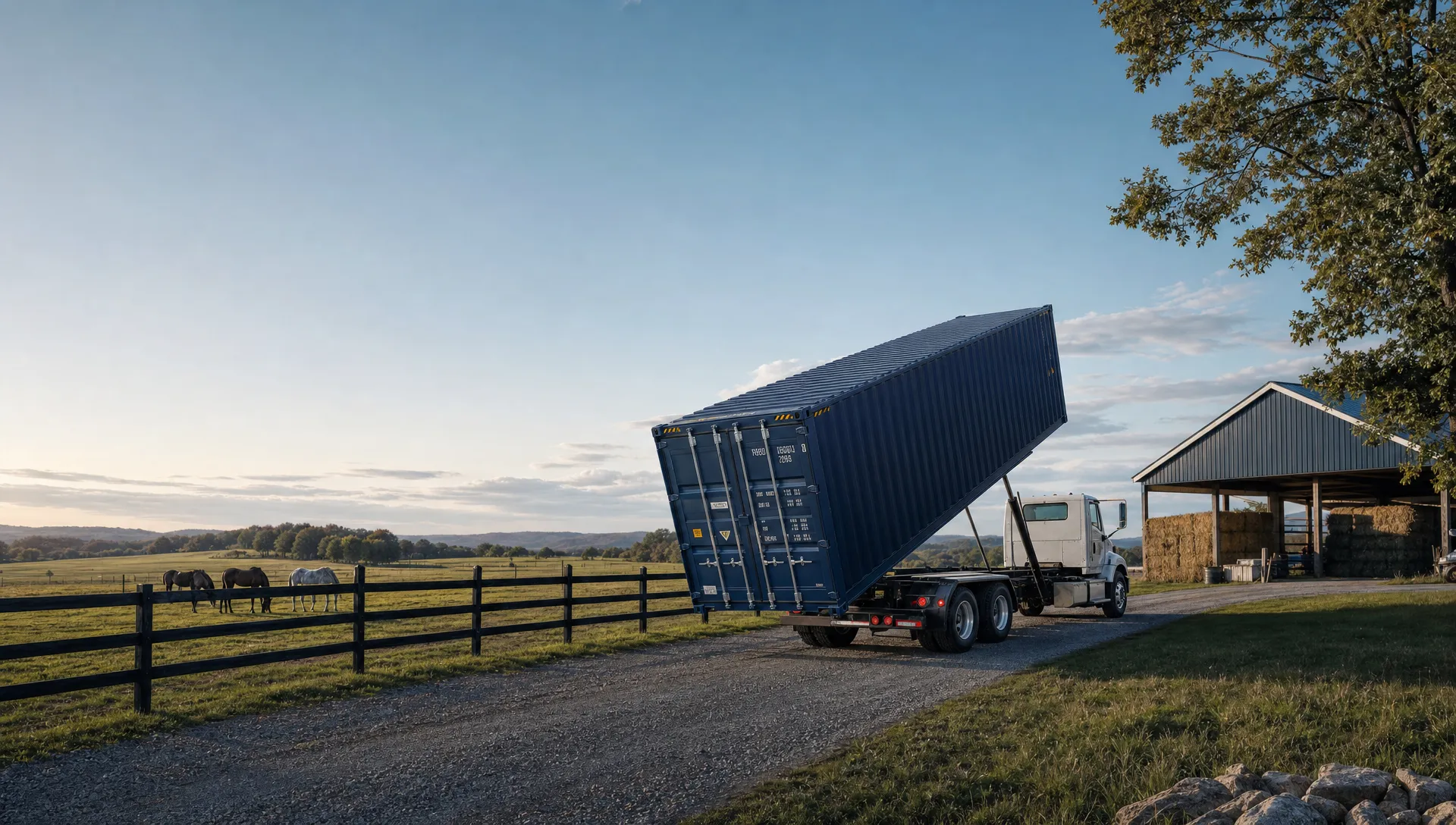
Tilt-bed delivery is common for local empty container moves. The truck tilts the bed and slides the container down onto the ground. It works well when there is enough straight-line room in front of the final placement area.
Flatbed delivery can work when you have your own forklift, crane, or rigging crew. The carrier brings the container, but the customer handles the lift. This can be efficient on commercial sites, but it is not ideal for homeowners without equipment.
Step-deck trailers help with taller loads, such as high cube containers. A Landoll or hydraulic trailer can offer more controlled loading and unloading. Crane or side-loader delivery can place a container with more precision, but it usually costs more and needs more planning.
| Delivery method | Best fit | Price effect | Placement notes |
|---|---|---|---|
| Tilt-bed truck | Local empty 20ft or 40ft delivery | Often lower for simple drops | Needs long, straight clearance to slide the box off |
| Flatbed trailer | Commercial sites with lifting equipment | Can be efficient if unloading is ready | Customer usually needs crane, forklift, or rigging |
| Step-deck trailer | High cube or taller loads | Often higher than basic flatbed | Helps reduce loaded height on some routes |
| Landoll or hydraulic trailer | Controlled loading and unloading | Usually higher | Useful when tilt-bed access is limited |
| Crane or side-loader | Tight placement, over obstacles, precise set | Usually specialty pricing | Needs clear setup area and site safety planning |
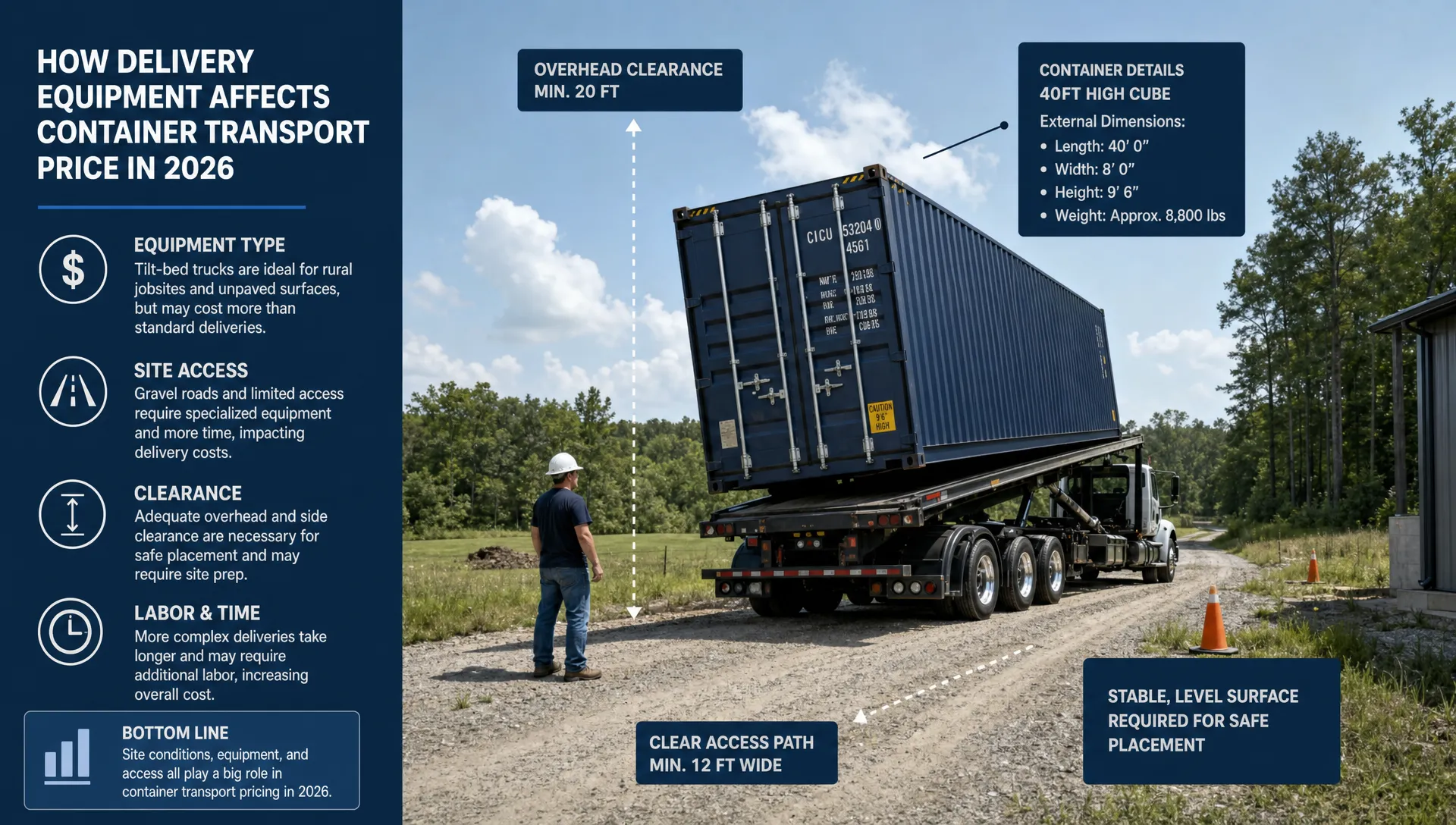
Good dispatchers ask about the delivery direction. Container doors may need to face a driveway, building, dock, pasture, or job-site entrance. If the truck arrives from the wrong direction or cannot turn around, the driver may not be able to place the container as requested.
Site access and placement conditions
Site access is one of the most common reasons a container delivery price changes after the first quote. The truck is large, heavy, and limited by turning radius. It also needs a stable surface. A normal pickup truck path is not always enough.
Before delivery, inspect the route from the public road to the exact placement area. Look for narrow gates, steep grades, low wires, soft ground, septic fields, culverts, tree limbs, parked vehicles, and sharp turns. A 40ft container on a tilt-bed may need 120 ft of straight clearance to unload safely, depending on the truck and site.
Ground prep matters too. A level gravel pad, compacted road base, concrete piers, or proper foundation can save money by reducing driver time and failed delivery risk. Mud, snow, sand, wet grass, and loose fill can stop a truck or make unloading unsafe.
For container homes, cabins, offices, workshops, and pools, access planning is even more important. Modified containers may include windows, doors, insulation, framing, plumbing, or other work that can make damage more expensive. A finished container conversion should be handled with more care than a basic storage box.
If you are still deciding between container conditions, remember that condition affects value, not just looks. A one-trip container, CWO unit, WWT container, or refurbished box may need different handling expectations. Outback explains these terms in its shipping container condition grades guide.
Permits, fuel, and 2026 market conditions
Permits, escorts, and road regulations
Permits can affect container transport price when the load is over legal size or weight, or when the route has special limits. The most common triggers are height, weight, and route restrictions.
A standard ISO container is 8 ft wide, which fits common U.S. highway width rules when loaded correctly. But the total loaded height depends on both the container and the trailer. A 40ft high cube on a tall trailer may require a different trailer or permitted route.
Federal rules set broad commercial vehicle size and weight frameworks, but states control many permit details. The Federal Highway Administration explains federal size and weight rules for commercial motor vehicles, including the common 80,000 lb gross vehicle weight limit on the Interstate System. Local roads, bridges, and counties can be stricter.
Cargo securement also matters. The Federal Motor Carrier Safety Administration publishes cargo securement rules that carriers must follow to keep freight from shifting, leaking, or falling. Containers need proper lock points, chains, twist locks, or securement methods based on the trailer and load.
For buyers, the practical point is simple. If your delivery involves a high cube, loaded container, long rural route, narrow county road, or bridge concern, get the permit answer in writing before the truck rolls. Do not assume the driver can solve it at the gate.
Permit and zoning rules for placing a container on land are separate from road transport permits. Requirements vary by city, county, and state. Always confirm local rules before using a container as a storage unit, office, home, cabin, or commercial build.
Fuel, labor, seasonality, and market capacity
Fuel is a direct cost in container transport. Diesel swings show up quickly in delivery quotes because container trucks are heavy and often run one-way routes. Longer hauls feel this more than short local drops.
Labor and driver availability also matter. Busy construction seasons can push up pricing, especially in spring and summer. Disaster recovery, port congestion, agricultural peaks, and major infrastructure projects can tighten trucking capacity in some regions.
Seasonality affects site access too. A delivery that is easy in July may be risky in February if snow, frozen ground, or spring thaw limits access. In farm and ranch areas, wet fields can delay delivery. In coastal areas, storm season can affect scheduling and road availability.
This is why quotes often have expiration dates. A quote given today may not hold if fuel, truck capacity, or inventory location changes next month.
Hidden charges and quote checklist
A good quote is clear. It should not leave you guessing about what happens if the truck waits, the site is blocked, or the road needs a permit.
Ask about these items before you pay a deposit:
- Wait time or detention: Extra charges may apply if the driver waits at a depot, gate, job site, or security check-in.
- Failed delivery: If the truck cannot access the site or unload safely, a redelivery fee may apply.
- Tolls, ferries, and restricted roads: These can be billed separately on some routes.
- Permits and escort vehicles: Oversize, overweight, or route permits can add cost and lead time.
- Crane, forklift, or rigging: Lifting services are often separate from basic trucking.
- Storage or layover: If the schedule changes after dispatch, the unit or truck may need to be held.
- Residential delivery limits: Some carriers charge more for tight neighborhoods, HOA areas, or delivery windows.
- Door orientation changes: Turning the truck around to face the doors the right way may require extra space or time.
The cheapest quote is not always the lowest final cost. The better quote is the one that matches the real site and spells out the limits.
If you want to compare carriers, collect the same details from each one. A short phone quote can be fine for a simple move, but a written quote is better for long-distance, rural, high cube, or modified container delivery.
| Quote item | What to confirm | Why it matters |
|---|---|---|
| Container size and condition | 20ft, 40ft, high cube, one-trip, WWT, CWO | Affects trailer choice and handling |
| Pickup point | Depot, seller yard, port, rail yard, private property | Adds deadhead, gate rules, loading needs |
| Delivery method | Tilt-bed, flatbed, step-deck, crane, side-loader | Determines placement and cost |
| Site access | Road width, gate width, overhead clearance, surface | Prevents failed delivery |
| Mileage and route | Loaded miles, tolls, bridges, restricted roads | Controls line-haul and permits |
| Included fees | Fuel, tolls, permits, wait time, redelivery terms | Prevents surprise charges |
For homeowners, add local placement questions. Ask whether a temporary or permanent container is allowed on your property. For container homes and offices, ask about building permits, zoning, setbacks, foundation requirements, inspections, and utility connections. These rules vary, so use local authorities as the final source.
For contractors and farm owners, ask about delivery timing, gate hours, equipment access, and whether the container can be placed near loading zones, barns, or job trailers. A few minutes of planning can save hours on delivery day.
If you are deciding between common container sizes, compare the delivered cost before you choose the unit. Outback Shipping Containers breaks down size-related pricing in its 20ft vs 40ft container price guide for 2026.
How to lower container transport price
The safest way to save money is to reduce uncertainty. Carriers price risk. If your site details are clear, the dispatcher can choose the right truck the first time.
Start by choosing the closest suitable container, not just the cheapest listed unit. A container staged 300 miles away can erase any savings. If two containers are similar in condition, the closer unit often wins on delivered cost.
Prepare the site before the truck arrives. Trim branches, measure gates, move vehicles, mark the pad, and confirm the ground can hold a heavy truck. If the driver needs to spend 45 minutes solving problems on site, your quote may increase.
Be flexible with timing when you can. A carrier may price better if delivery can fit an existing lane or return trip. Tight appointment windows often cost more because they reduce dispatch options.
Share photos and measurements. Good photos of the entrance, driveway, turns, overhead wires, and placement pad help avoid wrong equipment. For rural deliveries, GPS pins are helpful, but drivers still need clear written directions because cell service may be weak.
For container homes, tiny homes, offices, and pools, coordinate the transport plan with site prep. A finished modular unit may need a crane, wider staging area, or more careful handling. That cost is worth planning before the build is complete.
When container transport gets expensive
Some jobs cost more because they are no longer simple container deliveries. That does not mean they are bad projects. It means the quote needs the right equipment and risk plan.
Transport costs can rise quickly when the container is modified, finished, loaded, oversized, or delivered to a hard-to-reach site. A container pool, tiny home shell, modular office, or retail unit may require more careful handling than a plain cargo container. Windows, doors, interior framing, utilities, and exterior finishes make placement accuracy more important.
Multiple containers can also change the price. Bulk delivery may lower the per-unit cost if containers travel together on an efficient route. But several drops across a large property or job site can add handling time. Stacked containers may need a crane or heavy forklift.
The same is true for remote deliveries. Outback Shipping Containers serves all 50 states, including rural areas, but remote delivery takes more planning. The truck may need longer lead time, better directions, and a more detailed access review.
A higher transport quote may be the right quote if it prevents damage, failed delivery, or unsafe placement. The wrong truck is always more expensive than the right truck.
FAQs about container transport price in 2026
How much does it cost to transport a shipping container in 2026?
For planning, many simple local empty-container deliveries fall around $300 to $900, while longer standard hauls often price around $3 to $7 per loaded mile. Actual cost depends on distance, container size, fuel, equipment, site access, permits, and whether the truck can unload safely at your site.
Is it cheaper to move a 20ft or 40ft shipping container?
A 20ft container is often easier and cheaper to move because it gives carriers more trailer options and needs less placement room. A 40ft container may cost more to deliver, but it can offer better storage value per square foot. Compare delivered cost, not only purchase price.
Can you transport a loaded shipping container?
Sometimes, but you must confirm before booking. A loaded container changes weight, balance, insurance, securement, and road legality. Some carriers only move empty containers. Others may require a certified weight, special trailer, or different quote. Never load a container after receiving an empty-container delivery quote without approval.
Do I need a permit to deliver a shipping container?
Road permits may be needed if the truck and container exceed legal height, weight, or route limits. Land-use permits may also apply when placing a container on private property. Rules vary by state, county, and city, so confirm with the carrier and local authorities before delivery.
Why is rural container delivery more expensive?
Rural delivery often costs more because of deadhead miles, limited return loads, narrow roads, weak bridges, steep driveways, and longer driver time. Remote sites may also need better scheduling and more detailed directions. Good site photos and access details can help control the price.
What is the cheapest way to transport a container?
The cheapest safe option is usually a standard empty container, picked up from a nearby depot, delivered by tilt-bed or standard trucking to a level, easy-access site. Avoid last-minute scheduling, unclear placement, loaded moves, and remote routing when possible. Do not choose a quote that skips permits or safe unloading.
Get a clearer delivered price before you buy
A container is only a good deal if the delivered price still makes sense. Before you compare units, confirm the distance, equipment, site access, permits, and placement plan. That gives you a real cost, not a rough guess.
Outback Shipping Containers supplies new, used, WWT, CWO, high cube, office, home, pool, and custom modular containers nationwide. If you want help comparing container options with delivery in mind, request a quote through Outback Shipping Containers and get expert support from purchase through delivery.
About Outback Shipping Containers
This guide was prepared by the Outback Shipping Containers team, based on the questions our customers ask us most when buying, modifying and taking delivery of shipping containers. Learn more about us.
Ready to find your container?
Browse our in-stock shipping containers, container homes and custom builds, or ask our team for a free quote with delivery to your site.