Used 20ft Reefer Containers: What to Inspect First
By Outback Shipping Containers · Published September 6, 2026 · Last updated October 21, 2026
Used 20ft Reefer Container for Sale: What to Inspect First
If you are comparing a used 20ft reefer container for sale, inspect the refrigeration unit first, not the paint. A clean exterior means little if the compressor is weak, the controller shows alarms or the container cannot hold temperature. Start with a live power-up test, door seal check, floor and drain inspection, then verify paperwork, power needs and delivery access before you pay.
Quick Answer: Inspect cooling performance first. Ask for a recent PTI, run the reefer, confirm it reaches and holds the set temperature, then check door gaskets, drains, T-floor condition, insulation, frame rust, CSC plate and electrical requirements.
Key Takeaways
- A used 20ft reefer is part cargo container and part refrigeration machine, so mechanical condition matters most.
- Ask for a PTI, or pre-trip inspection, plus a live temperature pull-down test before buying.
- Reefer units run on single-phase 220/240V power, so confirm your site can support it.
- Check door seals, drains, floors and insulation because small air leaks can create big cooling problems.
- Buy from a supplier that can explain unit condition, delivery logistics, certification and support after purchase.
Why Reefer Inspection Is Different From a Dry Cargo Container
A standard 20ft dry cargo container is mostly steel. You inspect the doors, roof, floor, frame and rust. A refrigerated container, also called a reefer, adds a refrigeration unit, insulated walls, an aluminum T-floor, drains, electrical parts and temperature controls.
That means a used reefer has more ways to fail. It may look like a normal conex box from 20 feet away, but its value depends on whether it can cool reliably. A weak compressor, damaged condenser coil or bad door gasket can turn a low-price unit into a repair project.
A typical 20ft ISO refrigerated container has an outside footprint close to 20 feet long, 8 feet wide and 8 feet 6 inches high. Interior dimensions vary by manufacturer because insulation and the cooling unit take up space. Many 20ft reefers offer roughly 1,000 cubic feet of usable cold storage, but always verify the data plate for the exact unit.
The international container system uses standardized dimensions and ratings. The ISO 668 freight container standard covers classification, dimensions and ratings for Series 1 freight containers. For buyers, that standardization helps with trucking, lifting and site planning, but it does not tell you whether a used refrigeration unit is healthy.
Refrigerant work is also regulated. In the United States, the EPA Section 608 program requires certified technicians for many refrigerant service tasks. If a seller says the unit “just needs freon,” treat that as a warning sign and get a qualified refrigeration technician involved.
Used 20ft Reefer Container for Sale: First Inspection Checklist
When time is limited, inspect the most expensive failure points first. Paint scratches, dents and small cosmetic rust spots matter less than cooling performance, air leakage and electrical safety.
Use this table as your first-pass inspection order:
| Inspection item | What to check first | Why it matters |
|---|---|---|
| Refrigeration unit | PTI report, compressor start-up, controller alarms, temperature pull-down | Repairs can be costly and may require a certified technician |
| Power requirements | Voltage, phase, plug type, breaker size, site power availability | Reefers run on single-phase 220/240V power on a dedicated 50A circuit |
| Door seals | Gasket cracks, compression, daylight around doors, latch pressure | Air leaks make the unit work harder and can cause icing |
| Interior floor | Aluminum T-floor, corrosion, crushed sections, debris in channels | Air must move under cargo for even cooling |
| Drains | Clear drain lines, no blockage, no standing water | Blocked drains cause ice buildup, odor and floor damage |
| Insulated panels | Bulges, punctures, water stains, repairs | Damaged insulation reduces efficiency |
| Frame and roof | Corner posts, crossmembers, roof dents, heavy rust | Structural damage affects delivery, stacking and service life |
| Paperwork | CSC plate, serial number, condition grade, bill of sale | Confirms identity, rating and transport history |
Start with a live run test
Never rely on photos alone for a reefer container. Ask the seller to power up the unit and show the controller. The display should turn on cleanly, the fan should run and the compressor should start without harsh noises, repeated restarts or active alarms.
A cold storage buyer should ask for a pull-down test. That means setting the container to a target temperature and confirming it can move toward that temperature within a reasonable time. The exact speed depends on outside temperature, starting interior temperature, unit age and whether the container is empty.
Ask for the PTI
A PTI, or pre-trip inspection, is a standard reefer check used before refrigerated cargo service. It tests key refrigeration and electrical functions. A recent PTI does not guarantee years of trouble-free use, but it gives you a better baseline than a verbal promise.
If there is no PTI, ask why. Some stationary storage units may not have a current marine-service PTI, but the seller should still be able to explain how the reefer was tested, what temperature it reached and whether any repairs were done.
Confirm power before delivery
Many first-time buyers miss this step. Most 20ft marine reefer containers are not plug-and-play on a normal household outlet. They run on single-phase 220/240V power, though some sites use a dedicated 240V generator.
Check the unit nameplate and ask your electrician before buying. If your property only has single-phase service, the container may still work with the right electrical setup, but you need to price that before the truck arrives.
Check Cooling Performance Before Cosmetic Condition
A used reefer’s cooling system is the heart of the unit. If it cannot hold temperature, it is just an insulated box with expensive hardware attached.
Start with the controller. Look for a readable display, working buttons and stored alarm codes. Some alarms are minor. Others point to sensor faults, high pressure problems, compressor issues or defrost trouble.
Listen when the unit starts. A normal reefer has fan noise and compressor vibration, but it should not bang, squeal, grind or cycle on and off every few seconds. Repeated short cycling can point to electrical problems, pressure issues, sensor faults or refrigerant problems.
Inspect the condenser coil on the outside refrigeration unit. Bent fins, heavy dirt, oil stains or physical damage reduce heat rejection. A dirty coil can often be cleaned, but oil residue near fittings may point to a leak.
Inside the container, inspect the evaporator area. Look for frost patterns, damaged fan guards, missing panels, ice buildup and blocked air paths. Frost in the wrong place can mean door leaks, drain problems, bad defrost operation or airflow restrictions.
Temperature matters, but context matters too. A reefer set to 0°F on a hot afternoon will not instantly reach 0°F if it starts warm and empty. What you want to see is steady progress, no serious alarms and the ability to hold the target once reached.
For chilled storage, many buyers test around 35°F. For frozen storage, they may test lower. Do not assume every used reefer is right for ice cream, meat, flowers, produce, pharmaceuticals or events. Each use has different tolerance for temperature swings.
Inspect the Box: Floors, Walls, Roof, Frame and Drains
Once the machinery checks out, inspect the container body. Reefer walls are insulated panels, not just corrugated steel. A puncture, bad patch or waterlogged panel can hurt performance even if the compressor is strong.
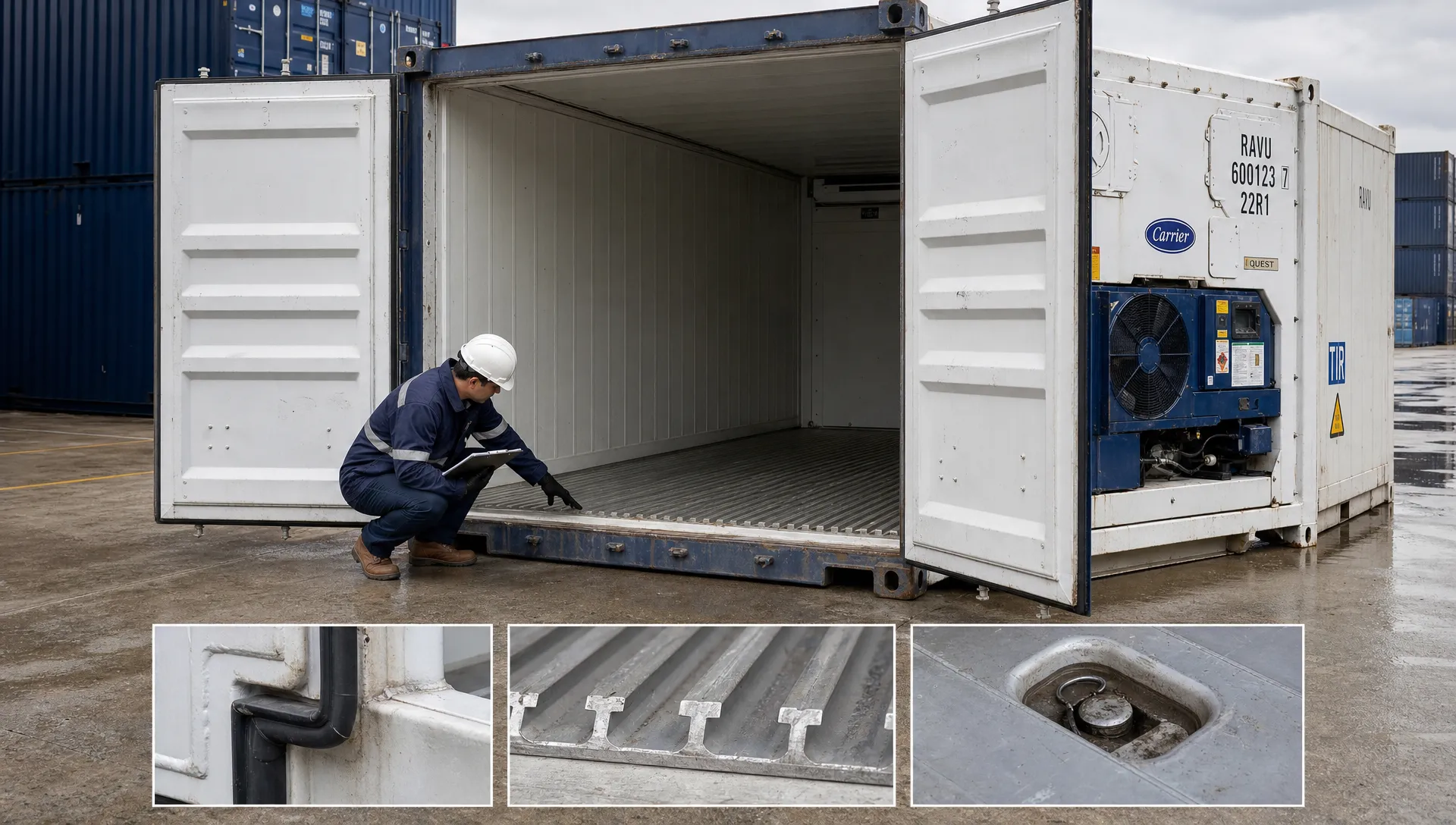
The interior floor is usually an aluminum T-floor. It allows cold air to move under pallets and boxes. Check that the channels are not crushed, clogged or packed with debris. If the T-floor is heavily damaged, airflow will be uneven and some cargo may run warm.
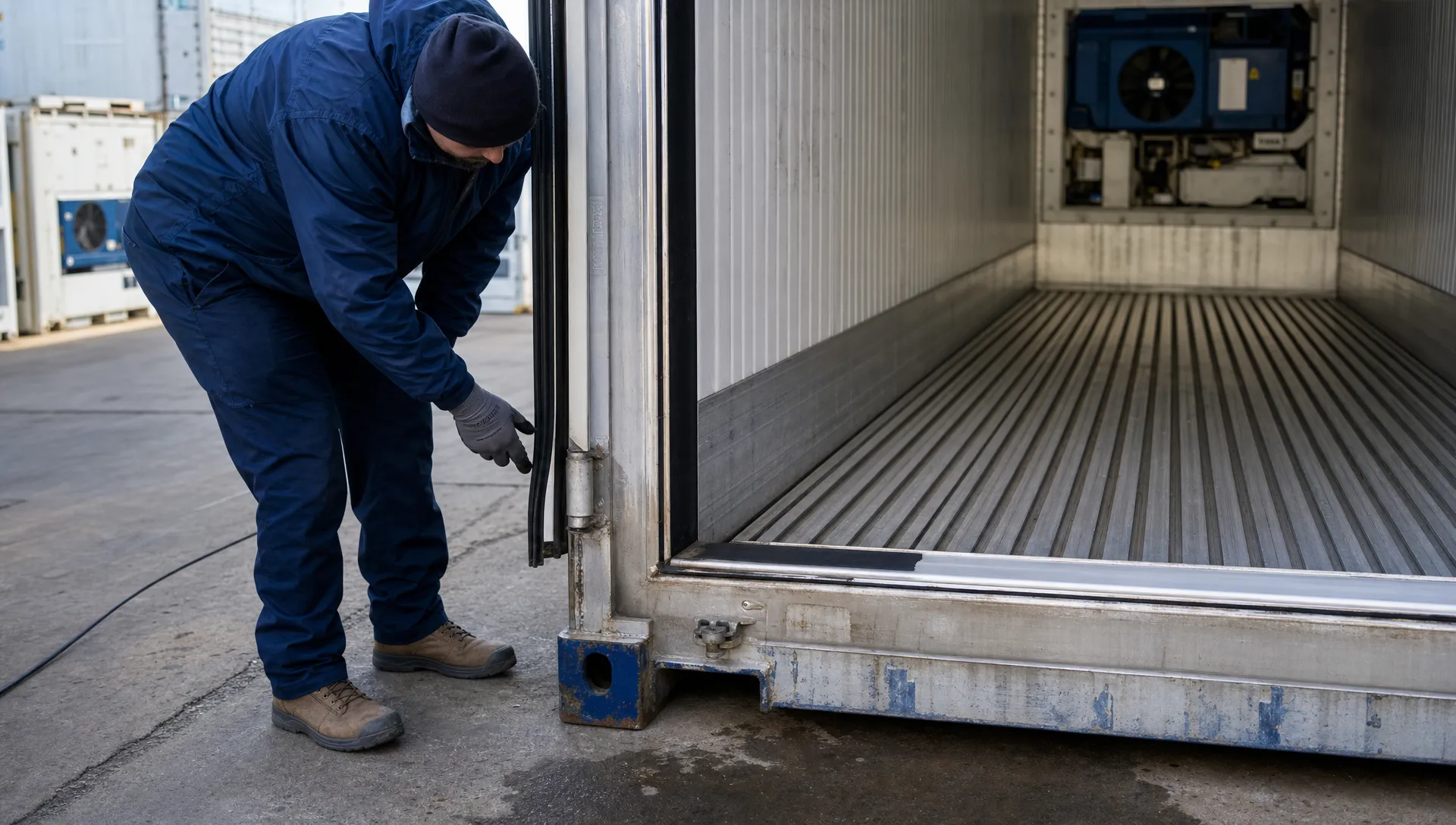
Door gaskets deserve close attention. Close the doors from inside if safe to do so with another person outside, or inspect in bright daylight. You should not see light around the gaskets. Check the bottom sweep area because forklifts and pallets often damage it.
Open and close each door. The locking bars should rotate without extreme force. Hinges should not be torn away from the frame. If the doors do not seal under normal latch pressure, the reefer will waste power and may ice up.
Drains are easy to overlook. A reefer container should move condensation out of the box. Blocked drains can cause standing water, bad odors, ice buildup and corrosion. Pour a small amount of water near the drain area only if the seller allows it and the site is safe.
The roof and frame still matter. Look for roof dents that can hold water, patched holes, severe rust around corner castings and bent crossmembers. Some surface rust is normal on used shipping containers. Heavy scale, holes or distorted corner posts are not normal wear.
If you want a broader structural checklist for dry and refrigerated units, Outback’s guide on how to inspect a used shipping container for sale covers roof, doors, flooring, rust and frame checks in more detail.
Verify Paperwork, Certification and Delivery Needs
A used refrigerated ISO container should have a serial number and data plates. The CSC plate is especially important for intermodal transport. CSC stands for Convention for Safe Containers, and the plate shows key rating information such as maximum gross weight, stacking rating and inspection status.
If you are using the reefer only for stationary storage, an expired CSC inspection may not matter as much as it would for international shipping. Still, the plate helps confirm the unit’s identity and original rating. Match the number on the plate to the seller’s invoice or bill of sale.
You may see condition terms such as CWO and WWT. CWO usually means cargo-worthy, which suggests the unit is suitable for cargo use when properly certified. WWT means wind and watertight, which is common for storage containers. For a reefer, you also need to know whether the refrigeration system is tested and operational.
Ask the seller for these details before you schedule delivery:
- Unit year, make and model of the refrigeration machine
- Serial number and container ID
- Recent PTI or service record if available
- Voltage, phase and plug type
- Confirmed operating temperature range
- Delivery method, offload method and site requirements
- Warranty, guarantee or return terms in writing
Delivery planning matters because a 20ft reefer is heavier than a 20ft dry container. Many 20ft reefers weigh around 6,500 to 7,500 pounds empty, depending on build and machinery. The final number is on the container plate.
A tilt-bed truck often needs straight, firm access to slide the container into place. The driver may need 100 ft for a 20ft (120 ft for a 40ft) of clear space, plus overhead clearance and stable ground. Requirements vary by truck, site and state, so confirm details before the delivery date.
If you are comparing ready-to-buy units, Outback Shipping Containers lists 20ft used reefer containers with online product details and nationwide delivery support. You can use the listing details to compare unit type, availability, checkout options and delivery planning before calling in electrical work.
Compare Used 20ft Reefers With Other Container Options
A 20ft reefer is not always the right container. It is a strong choice when you need cold storage in a compact footprint, but it costs more to buy, power and maintain than a dry cargo container.
Here is a plain comparison:
| Container type | Typical outside size | Power needed | Best use | Main tradeoff |
|---|---|---|---|---|
| 20ft dry container | 20 ft x 8 ft x 8 ft 6 in | None | Tools, furniture, equipment, general storage | No temperature control |
| Used 20ft reefer | 20 ft x 8 ft x 8 ft 6 in | Single-phase 220/240V | Frozen or chilled storage, food, flowers, events, farms | Higher purchase price, power needs and mechanical upkeep |
| 40ft reefer | 40 ft x 8 ft x 8 ft 6 in | Single-phase 220/240V | Larger cold storage volume | Needs more space, more delivery access and more power planning |
| 40ft high cube reefer | 40 ft x 8 ft x 9 ft 6 in | Single-phase 220/240V | Tall palletized cold storage | More height, but not always ideal for tight sites |
A 20ft unit is easier to place on farms, small commercial lots, restaurants, event sites and construction projects. It can also serve as a backup cold room during renovations or seasonal demand. For businesses that need more volume, a 40ft reefer may offer better cost per cubic foot.
If you are not sure whether you need a reefer or a dry cargo container, focus on the product you plan to store. If temperature swings will damage it, price the reefer and the power setup together. If temperature does not matter, a WWT dry container may be the simpler and cheaper choice.
Outback also offers broader refrigerated storage containers and reefers for buyers comparing cold storage options beyond one specific listing.
Common Red Flags That Should Slow Down the Purchase
A low price can be real, but it should never replace inspection. Used reefers vary widely by age, service history, brand, machinery hours, condition and location. A unit that was fine for dry warehouse storage may not be suitable for frozen food or medical inventory.
Be careful if the seller cannot power the unit. There may be honest reasons, such as no compatible 240V power at the yard, but you still need proof that the refrigeration system works. A video can help, but a recent PTI or live test is better.
Watch for mismatched explanations. If the seller advertises the unit as cargo-worthy but cannot provide plate details, photos of the serial number or delivery terms, pause. If they say it is WWT but the doors show daylight, pause again.
These red flags deserve extra caution:
- No PTI, no service record and no live run test
- Active controller alarms that the seller cannot explain
- Compressor starts, then shuts down repeatedly
- Oil residue around refrigeration fittings or hoses
- Door gaskets cracked, flattened or missing sections
- Heavy interior odor, mold or standing water
- Crushed T-floor channels or loose floor sections
- Bulging insulated panels or large unsealed punctures
- Severe frame rust near corner posts, crossmembers or lifting points
- Seller avoids written terms, delivery details or serial number verification
Scams are also common in the shipping container market. Be cautious with sellers who demand unusual payment methods, refuse to provide real photos or use prices far below the local market without explanation. A real supplier should be able to discuss condition, inspection, delivery and payment clearly.
If you want a specific machinery brand or model year, compare unit-level listings. For example, Outback’s Thermo King 20ft 2021 reefer container is the kind of product page where buyers can review equipment details before asking deeper inspection questions.
Questions to Ask Before You Buy
Before you send a deposit, get answers in writing. Clear answers protect both sides and reduce delivery-day surprises.
Ask these questions:
- What is the container number and refrigeration unit serial number?
- What year is the box and what year is the reefer machine?
- Has the unit passed a recent PTI?
- What temperature did it reach during testing and how long did it hold?
- Are there any active or stored alarm codes?
- What voltage, phase, plug and breaker setup does it require?
- Are the door gaskets, drains and T-floor in serviceable condition?
- Is the unit sold as operational, WWT, CWO or as-is?
- What delivery truck will be used and what site access is required?
- What warranty, guarantee or support is included after delivery?
For permits and zoning, do not guess. Some counties treat containers as temporary storage. Others regulate them as accessory structures, commercial equipment or building components. Rules vary by city, county and state, so check with your local building department or zoning office before delivery.
If the reefer will be wired into a property, involve a licensed electrician. If the refrigeration system needs repair, use a qualified refrigeration technician. That may add cost up front, but it is cheaper than losing product or replacing major components after purchase.
Frequently Asked Questions
What should I inspect first on a used reefer container?
Inspect the refrigeration unit first. Ask for a PTI, power up the unit, check for controller alarms and confirm it can move toward the target temperature. After that, inspect door gaskets, drains, T-floor airflow channels, insulated panels, roof, frame and paperwork.
How much power does a 20ft reefer container need?
These 20ft marine reefers run on single-phase 220/240V power, requiring a dedicated 50A breaker and 250V/50A connection. Requirements vary by unit, so check the machine nameplate before buying. No 3-phase service or phase converter is needed; ask an electrician about a dedicated 240V single-phase circuit or generator setup.
Can I use a used reefer container without running the cooling unit?
Yes, but it will function as an insulated storage container, not a true refrigerated unit. That may work for tools, event supplies or products needing some temperature buffering. For food, flowers or frozen goods, you need verified cooling performance and a reliable power source.
How long does a used 20ft reefer container last?
Service life depends on age, corrosion, machinery hours, maintenance and environment. The steel box may last many years as storage if kept drained and sealed. The refrigeration unit needs regular service, and major components such as compressors, fans and sensors can fail over time.
Do I need a permit for a reefer container on my property?
Maybe. Permit and zoning rules vary by city, county and state. Some areas allow temporary storage with few restrictions, while others regulate containers by size, use, foundation, setbacks or electrical connection. Always check local requirements before scheduling delivery.
What is the difference between WWT, CWO and CSC on a reefer?
WWT means wind and watertight, often used for storage condition. CWO means cargo-worthy, which relates to suitability for cargo use. CSC refers to the container safety plate used for intermodal transport. For reefers, also confirm the refrigeration system is tested and operational.
Buy the Unit You Can Verify
A used reefer can be a smart cold storage solution, but only if the cooling system, seals, structure, paperwork and power needs check out. Do not let fresh paint distract from compressor health, air leaks or missing test records.
Outback Shipping Containers supplies new, used and custom containers nationwide, including inspected refrigerated units, dry storage containers, modular offices and specialty builds. When you are ready to compare availability, start with Outback’s 20ft used reefer container options and ask for the inspection details that match your site, product and budget.
About Outback Shipping Containers
This guide was prepared by the Outback Shipping Containers team, based on the questions our customers ask us most when buying, modifying and taking delivery of shipping containers. Learn more about us.
Ready to find your container?
Browse our in-stock shipping containers, container homes and custom builds, or ask our team for a free quote with delivery to your site.