Standard Shipping Container Size Guide for 2026
By Outback Shipping Containers · Published July 18, 2026 · Last updated October 18, 2026
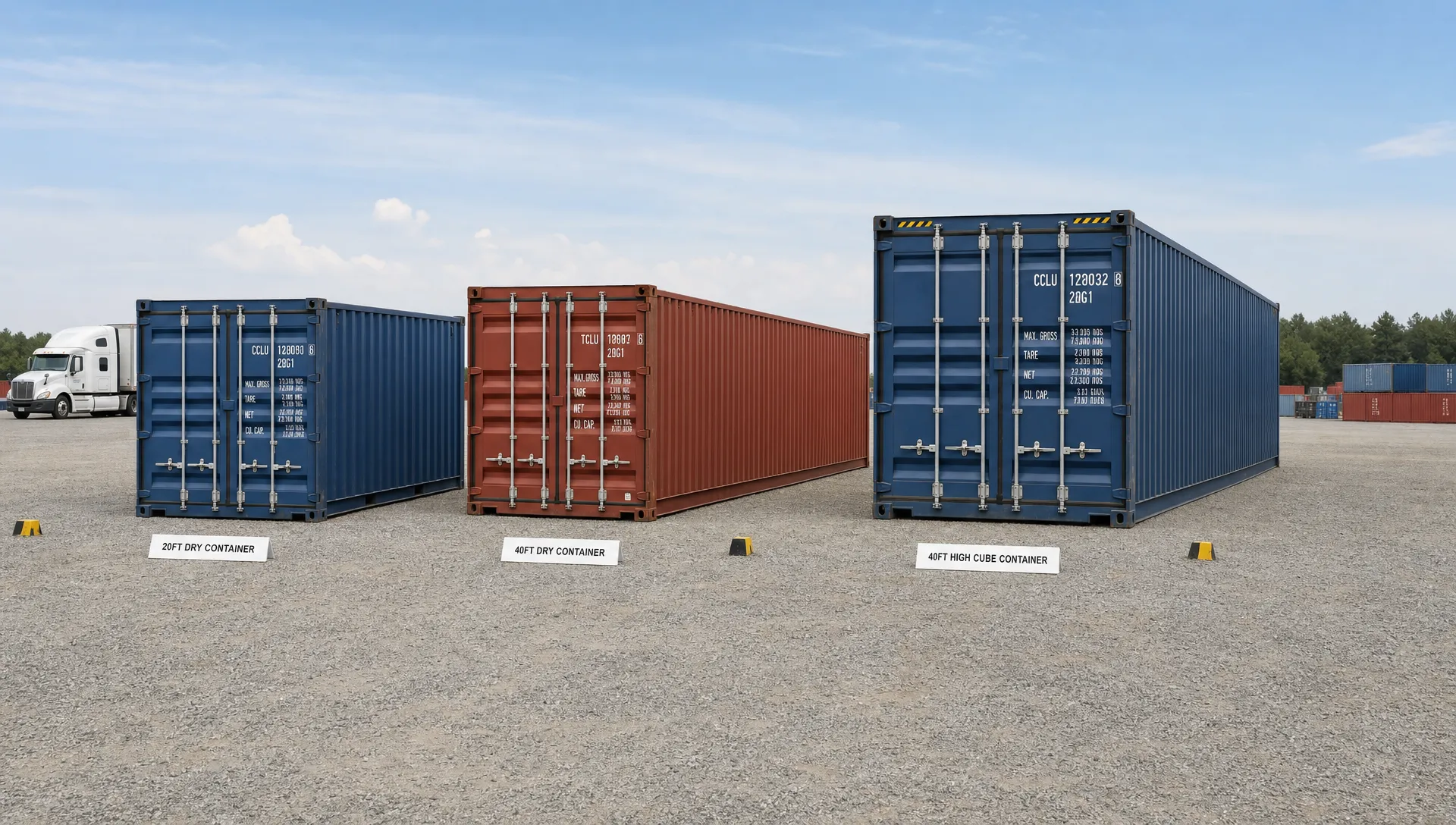
If you are shopping for a container in 2026, the first decision is not price, color, or condition. It is size. The standard shipping container size you choose affects where the unit can be placed, what delivery truck is needed, how much usable storage you get, and whether your project leaves enough room for doors, shelving, insulation, or equipment.
For most buyers, the decision comes down to 20ft, 40ft, or 40ft high cube. All three are common, widely available, and easy to modify compared with less common specialty units. Smaller 10ft containers and larger 45ft containers can be useful too, but availability and delivery requirements vary more by market.
The measurements below are typical industry dimensions. Always confirm the exact spec sheet for the container you are buying, since interior measurements can vary slightly by manufacturer, floor thickness, door design, insulation, and modifications.
Quick reference: standard shipping container sizes in 2026
| Container type | Exterior dimensions | Typical interior dimensions | Typical door opening | Approx. interior volume | Common use |
|---|---|---|---|---|---|
| 10ft dry container | 10' L x 8' W x 8'6" H | 9'3" L x 7'8" W x 7'10" H | 7'8" W x 7'5" H | 560 cu ft | Small storage, tools, tight sites |
| 20ft dry container | 20' L x 8' W x 8'6" H | 19'4" L x 7'8" W x 7'10" H | 7'8" W x 7'5" H | 1,170 cu ft | Residential storage, job sites, dense cargo |
| 40ft dry container | 40' L x 8' W x 8'6" H | 39'5" L x 7'8" W x 7'10" H | 7'8" W x 7'5" H | 2,390 cu ft | Large storage, inventory, equipment |
| 40ft high cube container | 40' L x 8' W x 9'6" H | 39'5" L x 7'8" W x 8'10" H | 7'8" W x 8'5" H | 2,690 cu ft | Container homes, workshops, tall shelving |
| 45ft high cube container | 45' L x 8' W x 9'6" H | 44'5" L x 7'8" W x 8'10" H | 7'8" W x 8'5" H | 3,000+ cu ft | High-volume storage, specialty projects |
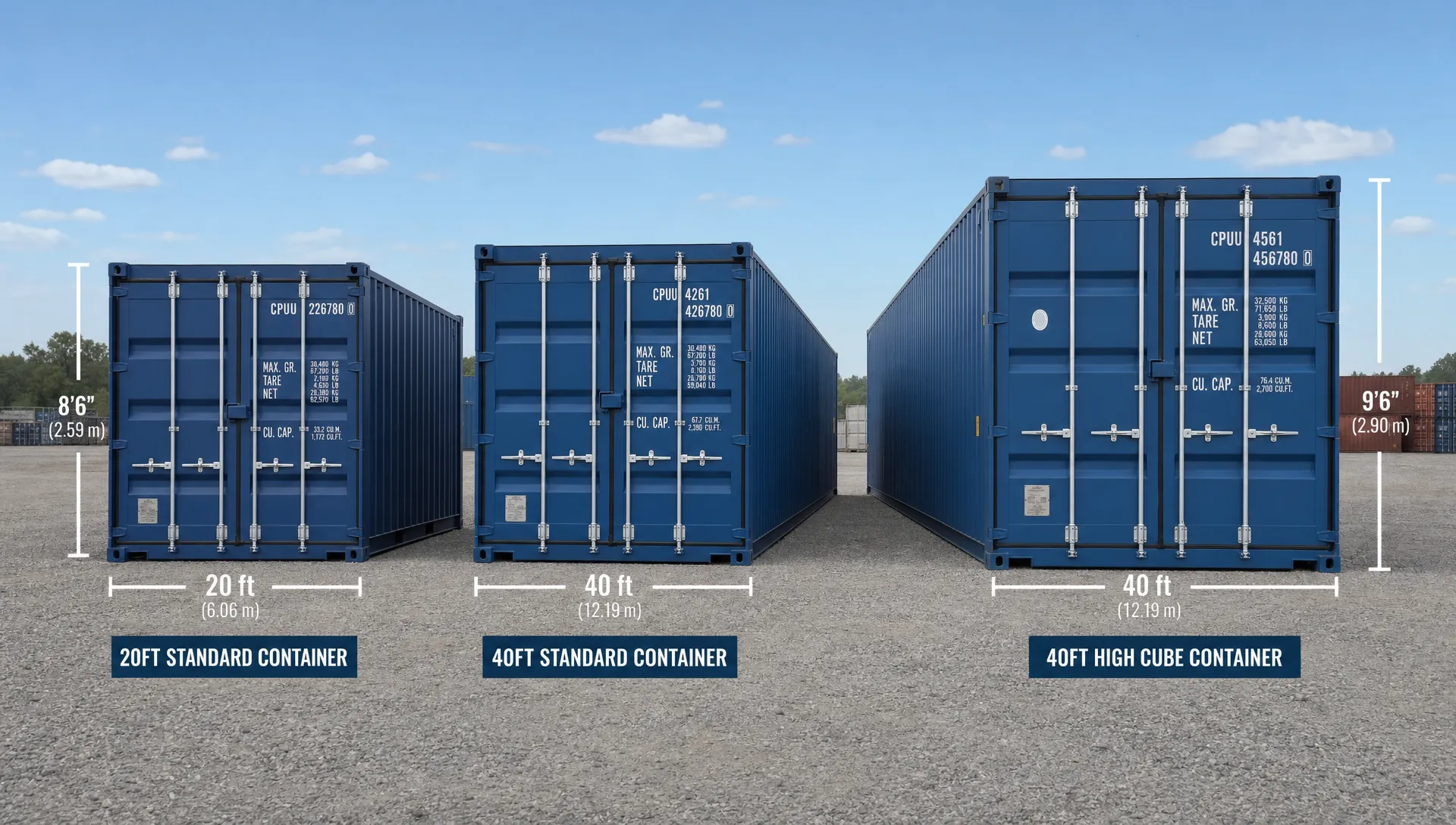
The key takeaway is simple: a standard dry container is usually 8 feet wide and 8 feet 6 inches tall, while a high cube container is usually 9 feet 6 inches tall. Interior width is closer to 7 feet 8 inches because the steel walls, corrugation, and structure take up space.
What “standard” means for shipping containers
When people say “standard shipping container,” they usually mean an ISO-style intermodal dry freight container. These containers are designed for transport by ship, rail, and truck, with standardized corner castings, structural ratings, and exterior dimensions.
The most common standard sizes are:
- 20ft standard dry container
- 40ft standard dry container
- 40ft high cube dry container
The length in the name is the exterior length, not the interior length. A 20ft container is 20 feet long on the outside, but the usable interior length is typically about 19 feet 4 inches. The same logic applies to a 40ft container, which has about 39 feet 5 inches of usable interior length.
This matters because many buyers plan around the container’s advertised length, then discover that shelving, pallets, appliances, vehicles, or building materials need a few extra inches of clearance. For storage and conversion projects, interior dimensions are often more important than exterior dimensions.
Exterior dimensions vs. usable interior space
There are four measurements to understand before choosing a container size.
Exterior dimensions tell you how much physical room the container occupies on your property. This is what matters for site layout, setbacks, driveway clearance, and delivery planning.
Interior dimensions tell you how much usable space is available inside the container. These measurements matter for storage, pallet layout, shelving, furniture, machinery, and conversion floor plans.
Door opening dimensions tell you what can actually fit through the doors. A piece of equipment may fit inside the container once loaded, but it still has to pass through the door opening unless you add a roll-up door, side door, or custom access point.
Weight ratings tell you how much the container itself weighs and how much cargo it can legally or safely carry when used for transport. For stationary storage, weight still matters because the ground, foundation, and floor need to support the load.
20ft containers: the most flexible standard size
A 20ft shipping container is often the best starting point for homeowners, contractors, farms, schools, and small businesses. It is large enough for serious storage but easier to deliver and place than a 40ft unit.
A typical 20ft dry container offers about 1,170 cubic feet of interior volume. It can usually hold around 10 standard 48" x 40" pallets on the floor, depending on loading pattern and pallet overhang. It is also a popular size for tools, seasonal equipment, motorcycles, building materials, retail inventory, and compact workshops.
The biggest advantage of a 20ft container is site flexibility. It can fit in many driveways, job sites, rural properties, and commercial yards where a 40ft container would be difficult to maneuver. If you expect to move the container again later, the 20ft size can also be more convenient.
A 20ft container is especially useful when the cargo is heavy. While a 40ft container gives you much more volume, the maximum gross weight rating is often similar, so the 20ft format can be better for dense items such as tile, metal parts, tools, or machinery.
40ft containers: the best value for maximum storage volume
A 40ft standard dry container gives you roughly twice the length of a 20ft container and about 2,390 cubic feet of interior volume. It is a strong fit for businesses storing inventory, homeowners between moves, farms with seasonal supplies, and contractors who need longer material storage.
In many cases, the cost difference between a 20ft and 40ft unit is smaller than the difference in usable space. That is why 40ft containers are often attractive for buyers who have enough room for delivery and placement. If you are evaluating the financial side of that decision, Outback’s 20ft vs 40ft container price guide breaks down the cost comparison in more detail.
The main tradeoff is access. A 40ft container needs 120 ft of straight-line delivery space, more turning room, and a larger level pad. It can also be less convenient if you only need to access small items stored near the back. For frequent access, many buyers use shelving, aisle layouts, lighting, or custom doors to make the space easier to use.
40ft high cube containers: extra height for storage and conversions
A 40ft high cube container has the same 40ft length and 8ft exterior width as a standard 40ft dry container, but it is one foot taller. That extra height makes a bigger difference than many buyers expect.
The typical interior height of a high cube is about 8 feet 10 inches, compared with about 7 feet 10 inches in a standard dry container. This extra clearance is valuable if you want to add insulation, ceiling framing, lighting, HVAC, overhead storage, taller shelving, or finished flooring.
For container homes, offices, studios, and workshops, high cube containers are often the preferred starting point because the finished interior can feel less compressed. If you are planning a residential build, it is worth reviewing the broader budget factors in Outback’s shipping container home prices guide, since size is only one part of the total project cost.
10ft and 45ft containers: useful, but less universal
A 10ft container can be a smart choice when space is tight. It is popular for small tool storage, schools, parks, residential properties, and job sites where a full 20ft container would be too large. However, 10ft containers are not always as widely available as 20ft and 40ft units. Some are manufactured as 10ft units, while others are cut down and reconfigured from larger containers.
A 45ft high cube container offers more volume than a 40ft high cube, but it is more specialized. It may be harder to source, harder to deliver, and less practical for smaller properties. If your goal is simply to maximize storage volume, a 45ft unit can make sense, but always confirm local availability, route access, and placement requirements before planning around it.
Reefer, open-top, flat rack, and office container sizes
Not every container follows the same usable interior dimensions as a dry storage container. Specialty containers may share a similar exterior footprint, but the interior space can change significantly.
Refrigerated containers, often called reefers, have insulated walls and refrigeration machinery. That means a 40ft high cube reefer has less usable interior width, height, and length than a 40ft high cube dry container. This is normal and should be expected when planning cold storage.
Open-top containers are useful when cargo needs to be loaded from above by crane or when the load is too tall for a standard roofline. Flat rack containers are designed for oversized cargo that cannot fit inside standard walls and doors. Office containers and custom modular builds may include framing, insulation, electrical systems, windows, doors, interior walls, and HVAC, all of which reduce open interior space.
If you are buying a modified container, ask for the finished interior dimensions, not just the original container size. A 40ft container with insulation, wall panels, and a framed utility area will not have the same usable space as an empty 40ft storage container.
Container weight, payload, and floor capacity
Container weight ratings vary, but the following numbers are useful for planning. Always verify the rating on the container’s data plate if the unit will be used for transport or loaded heavily.
| Container type | Typical tare weight | Typical max gross weight | Typical payload capacity |
|---|---|---|---|
| 20ft dry container | 4,800 lb | 67,200 lb | 62,000 lb |
| 40ft dry container | 8,200 lb | 67,200 lb | 59,000 lb |
| 40ft high cube container | 8,700 lb | 67,200 lb | 58,500 lb |
Tare weight is the empty weight of the container. Max gross weight is the container plus cargo. Payload is the cargo weight the container is rated to carry.
For stationary storage, floor loading is often the bigger practical concern. Containers are designed to carry cargo, but heavy point loads such as safes, machinery feet, pallets of stone, or concentrated equipment can stress the plywood floor. Use blocking, steel plates, pallets, or engineered support where needed, and keep very heavy loads distributed.
Choosing the right container size by use case
The best size depends on what you are storing or building, how often you need access, and how much room you have for delivery.
| Use case | Best starting size | Why it works | Watch out for |
|---|---|---|---|
| Backyard storage | 10ft or 20ft | Easier placement and enough room for tools or seasonal items | Local restrictions, driveway slope, door swing |
| Construction site storage | 20ft | Secure, movable, practical for tools and materials | Forklift access and frequent loading paths |
| Large business inventory | 40ft | Strong volume-to-footprint ratio | Long aisle access and site space |
| Workshop or studio | 40ft high cube | Extra height for lighting, insulation, and comfort | Ventilation, electrical, permits |
| Container home or ADU | 40ft high cube | Better finished ceiling height | Engineering, insulation, code compliance |
| Cold storage | 20ft reefer or 40ft high cube reefer | Temperature control for perishable goods | Reduced interior space and power needs |
| Oversized cargo | Flat rack or open-top | Easier loading for tall or wide items | Tie-downs, transport rules, weather exposure |
If you are unsure between two sizes, think beyond total cubic feet. Consider how you will move inside the container, whether you need a center aisle, whether items will be palletized, and how often you need to reach the back.
Delivery space can matter more than container size
A container may fit on your property but still be difficult to deliver. Delivery trucks need room to approach, turn, tilt, unload, and exit safely.
For tilt-bed delivery, many sites need 100 feet of straight-line space for a 20ft container and 120 feet for a 40ft container. The truck also needs overhead clearance from trees, wires, rooflines, and gates. Soft ground, steep slopes, tight corners, and narrow driveways can all affect delivery.
Before ordering, measure the placement area and the delivery path. Confirm:
- The container footprint plus extra working room around the doors
- The width and height of gates, entrances, and driveways
- The turning radius for the delivery truck
- Overhead obstacles such as branches and utility lines
- Whether the surface is level, compacted, and accessible in wet weather
A good pad does not have to be complicated, but it should be stable and level. Gravel, concrete, asphalt, railroad ties, and properly placed blocks can all work depending on the site and use. For a step-by-step planning list, use Outback’s shipping container site prep checklist before your delivery date.
Size, permits, and long-term placement
A shipping container used temporarily for storage may face different rules than a container used as a permanent structure, office, workshop, home, or accessory dwelling unit. In some areas, even storage containers require permits, setbacks, screening, anchoring, or time limits.
The container size can affect these rules. A 10ft or 20ft container may be easier to approve for temporary use, while a 40ft high cube used as a studio or home will likely trigger more review. Local zoning, building codes, HOA rules, fire access, flood zones, and utility connections can all matter.
Before preparing a foundation or ordering modifications, check your local requirements. Outback’s shipping container permit requirements by state is a helpful starting point, but city and county rules should always be confirmed directly.
How to measure before buying a container
Start with the exterior footprint. Mark the container dimensions on the ground with flags, chalk, stakes, or tape. Add room for the doors to swing open, usually about 4 feet beyond the end doors, plus walking or equipment access around the sides.
Next, measure what must fit inside. If you are storing pallets, confirm pallet size and stacking height. If you are storing equipment, measure the width, height, length, and turning clearance. If you are building out an interior, subtract the thickness of insulation, framing, flooring, ceiling materials, and wall finishes.
Finally, measure the delivery route. A container that fits perfectly on the pad still needs a truck path to get there. Send photos or site details to your container supplier if you are unsure. It is better to solve access issues before the truck arrives than to reschedule delivery.
Frequently Asked Questions
What is the most common standard shipping container size? The most common standard sizes are 20ft dry containers, 40ft dry containers, and 40ft high cube containers. For general storage, 20ft and 40ft units are the most widely used. For modifications, offices, and homes, 40ft high cube containers are especially popular because of the extra height.
Are all shipping containers 8 feet wide? Most standard ISO-style shipping containers are 8 feet wide on the outside. Interior width is typically closer to 7 feet 8 inches. Some specialty or domestic containers may differ, so always confirm the exact dimensions before buying.
Is a 40ft container exactly twice as large as a 20ft container? It is close to twice the interior volume, but not exactly in every measurement. A 40ft standard dry container has about 2,390 cubic feet of space, while a 20ft container has about 1,170 cubic feet. Payload capacity is not doubled, since both sizes often have similar max gross weight ratings.
What size container is best for a workshop? A 40ft high cube is usually the best starting point for a comfortable workshop because it provides more length and extra ceiling height. A 20ft container can work for a compact tool room or hobby workspace, especially if site space is limited.
Do high cube containers require special delivery? High cube containers are one foot taller than standard containers, so overhead clearance is more important. They are commonly delivered nationwide, but your site still needs enough height, turning room, and level unloading space.
Can I place a shipping container on a residential driveway? Sometimes, but it depends on driveway strength, slope, local rules, HOA restrictions, and delivery access. A loaded container can be very heavy, so confirm the surface can support the weight and check local regulations before placement.
Ready to choose the right container size?
The right size saves money, prevents delivery problems, and gives you space that actually works for your storage, business, or build. Outback Shipping Containers supplies new, used, and custom containers nationwide, including dry storage containers, offices, container homes, pools, and modular builds.
If you already know your preferred size, or if you want expert help comparing options, visit Outback Shipping Containers to explore available containers, request support, and plan delivery to your site.
About Outback Shipping Containers
This guide was prepared by the Outback Shipping Containers team, based on the questions our customers ask us most when buying, modifying and taking delivery of shipping containers. Learn more about us.
Ready to find your container?
Browse our in-stock shipping containers, container homes and custom builds, or ask our team for a free quote with delivery to your site.