Shipping Container Financing Options for Buyers in 2026
By Outback Shipping Containers · Published October 19, 2026
Shipping Container Financing Options for Buyers in 2026
Shipping container financing lets buyers spread the cost of a container across scheduled payments instead of paying the full price upfront. Options include seller-arranged financing, personal loans, business equipment loans and rent-to-own agreements. Financing a container home requires a different approach because the lender must evaluate the finished building, land and construction plan.
Quick Answer: Start with an itemized delivered quote. Then compare the down payment, APR, fees, repayment term and ownership rules. A smaller monthly payment does not necessarily mean a cheaper purchase.
For buyers in 2026, the key distinction is what you are buying: movable storage equipment, a modified workspace or a permitted home. That choice affects which lenders will consider the purchase and what documents they require.
Key Takeaways
- Match the financing to the container’s intended use, not just its purchase price.
- Include delivery, taxes, site preparation and modifications in your budget.
- Compare total ownership cost alongside the monthly payment.
- Confirm when ownership transfers and what happens if you pay early or miss payments.
Compare shipping container financing options
No single financing method fits every buyer. A homeowner buying backyard storage has different needs from a contractor purchasing several job-site units or a developer building rental cabins.
| Financing option | Best fit | Main advantage | Main issue to check |
|---|---|---|---|
| Seller-arranged financing | Buyers who want to coordinate purchasing and funding | Can simplify the buying process | Who provides credit and which costs qualify |
| Personal loan | Individuals buying storage or a small conversion | May not require the container as collateral | APR, fees and personal repayment obligation |
| Equipment loan | Businesses buying containers for operations | May match funding to a business asset | Collateral, guarantees and eligible expenses |
| Rent-to-own | Buyers seeking a payment-based ownership path | Ownership may transfer after contract requirements are met | Total payments, purchase options and default rules |
| Home equity financing | Homeowners with sufficient equity | May fund a broader property project | Your home secures the debt |
| Construction financing | Buyers building a permitted container home | Can support approved construction stages | Lender acceptance, plans, appraisal and draw requirements |
Seller-arranged financing and personal loans
Outback Shipping Containers offers financing options, but buyers should request current written terms. Do not assume the advertised container price determines the financed payment. The approved amount, fees and repayment period all affect the final offer.
With any seller-arranged shipping container financing, confirm whether the seller extends credit directly or works with another lender. Ask who services the account and whether the application triggers a hard credit inquiry.
A personal loan can suit an individual purchasing a conex box for storage. Many personal loans are unsecured, but eligibility and pricing depend on the lender and borrower. Check for origination fees, which can reduce the cash you receive or increase the amount financed.
Equipment loans for business purchases
An equipment lender may consider an ISO container used for tools, inventory or a mobile workshop. However, lender policies differ on used equipment, minimum loan amounts and modified containers.
Eligible businesses can also ask about SBA-backed borrowing. The SBA’s 7(a) loan program permits equipment purchases and other approved business uses. That does not guarantee that a particular container purchase or borrower qualifies.
Rent-to-own and leasing
Rent-to-own can provide a path to ownership, but the contract controls that path. A standard rental or lease does not automatically transfer ownership, even after years of payments.
Before choosing shipping container financing through rent-to-own, compare the cash price with every required payment and fee. Our guide to shipping container rent-to-own programs explains that option in more detail.
LeaseLink Containers is the leasing arm associated with Outback Shipping Containers. Ask which agreement you are being offered and whether it includes any purchase option.
Build a complete purchase budget before applying
A loan approval is useful only if it covers the right costs. Financing the steel box while overlooking delivery or site work can leave you short before the container arrives.
Request a total delivered cost for a specified container size, condition and delivery address. A general product price is not a substitute for a site-specific quote, especially on rural properties or sites with restricted access.
Separate the container from the installed cost
Your budget should identify these expenses individually:
- Container purchase price, including its size and condition grade.
- Delivery, unloading and any separate crane or placement service.
- Applicable sales tax, lender fees and documentation charges.
- Ground preparation, drainage, supports or an engineered foundation where required.
- Modifications such as doors, electrical work, insulation or HVAC.
Ask which costs the lender will finance and which you must pay yourself. Some lenders fund only the asset shown on the invoice. Others may accept approved delivery or modification expenses.
A shipping container financing offer should be compared against the same purchase scope each time. Otherwise, one lender may appear cheaper simply because its quote excludes expenses you still have to pay.
For purchase-price context, use our shipping container cost guide, then obtain a current quote for your ZIP code. There is no reliable nationwide price that applies equally to every size, condition and delivery route.
Choose the right size before borrowing
Common standard containers measure approximately 20 or 40 feet long, 8 feet wide and 8 feet 6 inches tall externally. A high cube is typically 9 feet 6 inches tall. Confirm the exact dimensions and usable interior space of your unit.
A 10-foot container does not necessarily cost half as much as a 20-foot unit. Fabrication, availability and delivery affect pricing. Likewise, a 40-foot container’s larger capacity does not make it the right purchase if the delivery truck cannot access your site.
Calculate the payment and total borrowing cost
Monthly payments are useful for budgeting, but they can hide the cost of a longer repayment term. Compare offers using the same amount financed, down payment and term whenever possible.
Here is a hypothetical shipping container financing example, not an Outback price or financing offer. Assume a $7,500 purchase budget, a $1,500 down payment and a $6,000 loan. The loan has a fixed 12% annual interest rate, monthly payments and no fees.
| Loan term | Approximate monthly payment | Total loan payments | Approximate interest |
|---|---|---|---|
| 24 months | $282.44 | $6,779 | $779 |
| 36 months | $199.29 | $7,174 | $1,174 |
| 60 months | $133.47 | $8,008 | $2,008 |
Figures are rounded. Actual payment schedules may include a slightly different final payment.
Extending this example from 36 to 60 months lowers the payment by about $66 per month. It also adds about $834 in interest. The $1,500 down payment remains additional to the loan payments shown.
Compare APR and the amount you actually receive
The interest rate measures the cost charged on the loan balance. APR reflects interest plus certain finance charges, making it more useful when comparing loans with different fee structures. For business financing, request a complete written cost breakdown even if an APR is not provided.
Use this calculation as a final check:
Total cost to own = down payment + all scheduled payments + mandatory fees + any final purchase payment.
Do not add a fee twice if it is already financed and included in the scheduled payments. Ask for both the amount financed and the total repayment amount.
Prepare your application and container documents
Approval depends on more than the container’s value. Lenders may review your credit, income, existing debt, business history and intended use. A down payment may help an application, but it does not guarantee approval.
Before applying for shipping container financing, check your credit reports for errors. The Consumer Financial Protection Bureau’s credit report guidance explains how to review reports and dispute inaccurate information.
Gather buyer and project information
Individuals may need identification, proof of income and a purchase quote. Business applicants may also need bank statements, tax returns, ownership information and financial records. Ask for the lender’s checklist before submitting documents.
Describe the intended use accurately. Secure storage, a commercial office and a residential conversion present different lending risks. If the project requires permits, explain the approval status rather than assuming the lender will treat it as ordinary equipment.
Document the unit and its condition
Ask for the container’s size, condition description and identifying number when assigned. For a used unit, request inspection details and photos that show the roof, floor, doors and corner posts.
Wind and watertight (WWT) describes a storage condition; it does not establish approval for international cargo service. Cargo-worthy (CWO) condition and any required current CSC examination are separate matters. A one-trip unit can reduce condition concerns, but it still needs suitable delivery access and a proper placement area.
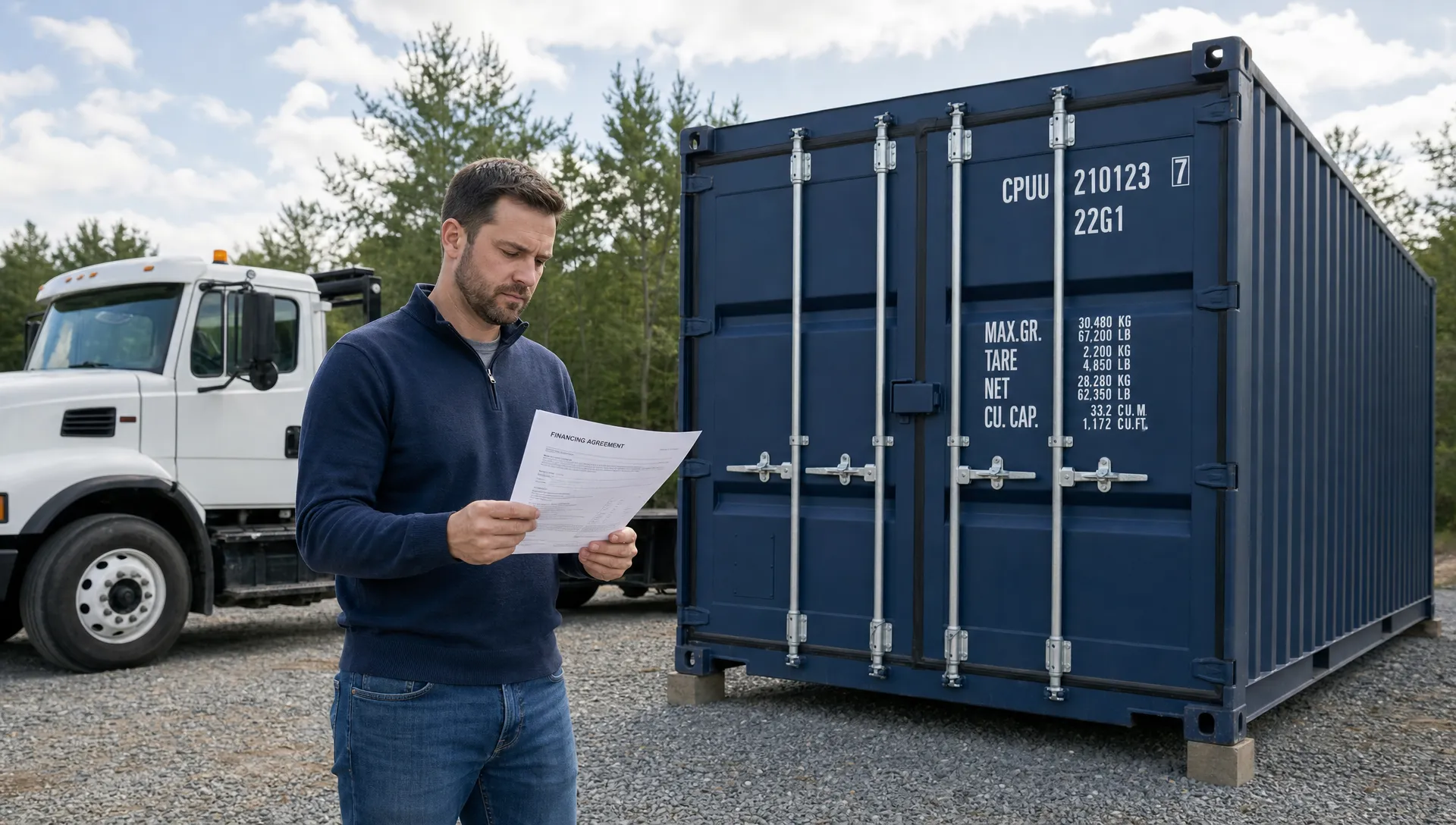
For transport planning, distinguish tare weight, the empty container’s weight, from payload capacity, the allowable cargo load. Use the unit’s markings and the carrier’s instructions rather than a generic weight estimate.
If you are financing housing rather than storage, compare container home options and build costs before requesting a quote for the shell or completed build. The product you choose should match the project your lender has agreed to fund.
Check the contract before paying a deposit
A purchase agreement and a credit agreement may come from different companies. Read both. Confirm that the seller’s payment deadline, the lender’s funding date and the delivery schedule work together.
Do not accept a shipping container financing offer based only on a payment advertised online. Your written agreement should show the actual borrower, asset, charges and repayment obligations.
Review ownership, collateral and early payoff
Ask when legal ownership transfers and whether the lender takes a security interest in the container. Business lenders may file a UCC financing statement. Find out whether the collateral covers only the purchased unit or additional business assets.
A personal guarantee creates an individual repayment obligation even when the business buys the container. A home equity loan creates a different risk because your home secures the borrowing.
Request a sample early-payoff calculation. A loan may allow early payment without a penalty, while a lease-purchase agreement may use a separate buyout formula. Do not assume extra payments automatically reduce principal.
Resolve delivery and cancellation terms
Before signing, get clear answers to these questions:
- Who pays if the truck cannot access the placement area?
- What happens to the deposit if financing is declined?
- When does the first payment become due?
- Who covers insurance, damage, theft and recovery costs?
- Are there balloon payments, renewal charges or end-of-term purchase fees?
For remote sites, discuss road width, overhead clearance, turning space, slopes and soft ground with the delivery team. Nationwide service does not mean every truck can reach every placement point without preparation.
Confirm that the seller’s business identity and payment instructions match the contract. Treat pressure to send money before receiving a clear invoice and written terms as a reason to stop and verify the transaction.
Keep container home financing separate from shell financing
Buying a steel shell does not finance a finished residence. A container home budget can include land, design, engineering, foundations, structural reinforcement, utilities, insulation and interior construction.
Shipping container financing for the shell may close before the rest of the project is approved. That creates risk if zoning prevents residential use or a construction lender later rejects the building method.
Speak with the building department and lender first
Requirements vary by state, county and municipality. Consult local planning and building authorities about permitted uses, setbacks, foundations, energy requirements and inspections before committing to a residential project.
A construction lender may require approved plans, an accepted builder, a detailed budget and an appraisal based on the completed home. Ask whether it accepts container construction before paying for a full application or appraisal.
A permanent mortgage also depends on how the completed property is classified and whether it meets the lender’s requirements. A movable container, an unfinished shell and a code-compliant home attached to real property are not interchangeable collateral.
Match the loan term to the project
Storage needs can change quickly. A temporary job-site container may not justify years of payments unless the business can reuse or sell it afterward.
For a rental cabin or commercial conversion, test the budget without assuming full occupancy or immediate revenue. Keep enough cash for permit delays, site work and repairs. Loan payments may begin before the project earns anything.
Frequently asked questions
Can you finance shipping containers?
Yes. Shipping container financing may be available through seller-arranged programs, personal loans, equipment lenders or rent-to-own agreements. The right option depends on your credit, intended use and purchase size. Ask whether delivery, taxes and modifications qualify, and confirm when you become the legal owner of the unit.
What credit score do you need to finance a shipping container?
There is no universal minimum credit score. Each provider sets its own requirements and may also consider income, existing debt, business history and collateral. Before applying, ask about minimum qualifications, required down payments and whether checking eligibility creates a hard credit inquiry on your report.
How much should I pay for a 20-foot shipping container?
There is no single fair delivered price nationwide. Condition, local inventory, delivery distance and unloading needs affect the total. Compare itemized quotes for the same grade and delivery address. A used WWT storage container should not be compared directly with a one-trip unit or a modified office.
What is the average cost of a 10-foot or 40-foot shipping container?
A national average can mislead because local supply, condition and transport costs vary. A 10-foot unit is not automatically half the price of a 20-foot container. For a 40-foot purchase, specify standard height or high cube and request delivery pricing before comparing the complete cost.
Can you finance a used shipping container?
Some providers finance used containers, but age, condition, value and minimum transaction size may affect eligibility. Ask what inspection records they require. For used-unit shipping container financing, confirm that the seller’s condition description matches your intended use and that the lender accepts the specific unit before paying a nonrefundable deposit.
Can you get a mortgage for a shipping container home?
Potentially, but financing depends on the completed property, not simply the container shell. The lender must accept the construction method and property classification. Local approvals, permanent foundations, appraisal support and other underwriting requirements may apply. Speak with local authorities and a lender familiar with the building type before purchasing.
Start with a quote you can compare
The strongest shipping container financing decision starts with a clear purchase scope. Choose the size and condition, confirm site access and separate the container price from delivery, modifications and financing charges.
When you are ready, explore Outback Shipping Containers’ new, used and custom container options and request an itemized delivered quote with current financing details. That gives you a concrete purchase to compare against outside loan offers, leasing or a cash payment.
About Outback Shipping Containers
This guide was prepared by the Outback Shipping Containers team, based on the questions our customers ask us most when buying, modifying and taking delivery of shipping containers. Learn more about us.
Ready to find your container?
Browse our in-stock shipping containers, container homes and custom builds, or ask our team for a free quote with delivery to your site.