Double Door Shipping Containers for Easy Access Storage
Choose the right double door shipping container with this guide to sizes, access layouts, inspections, delivery planning and total cost.
Double Door Shipping Containers for Easy Access Storage
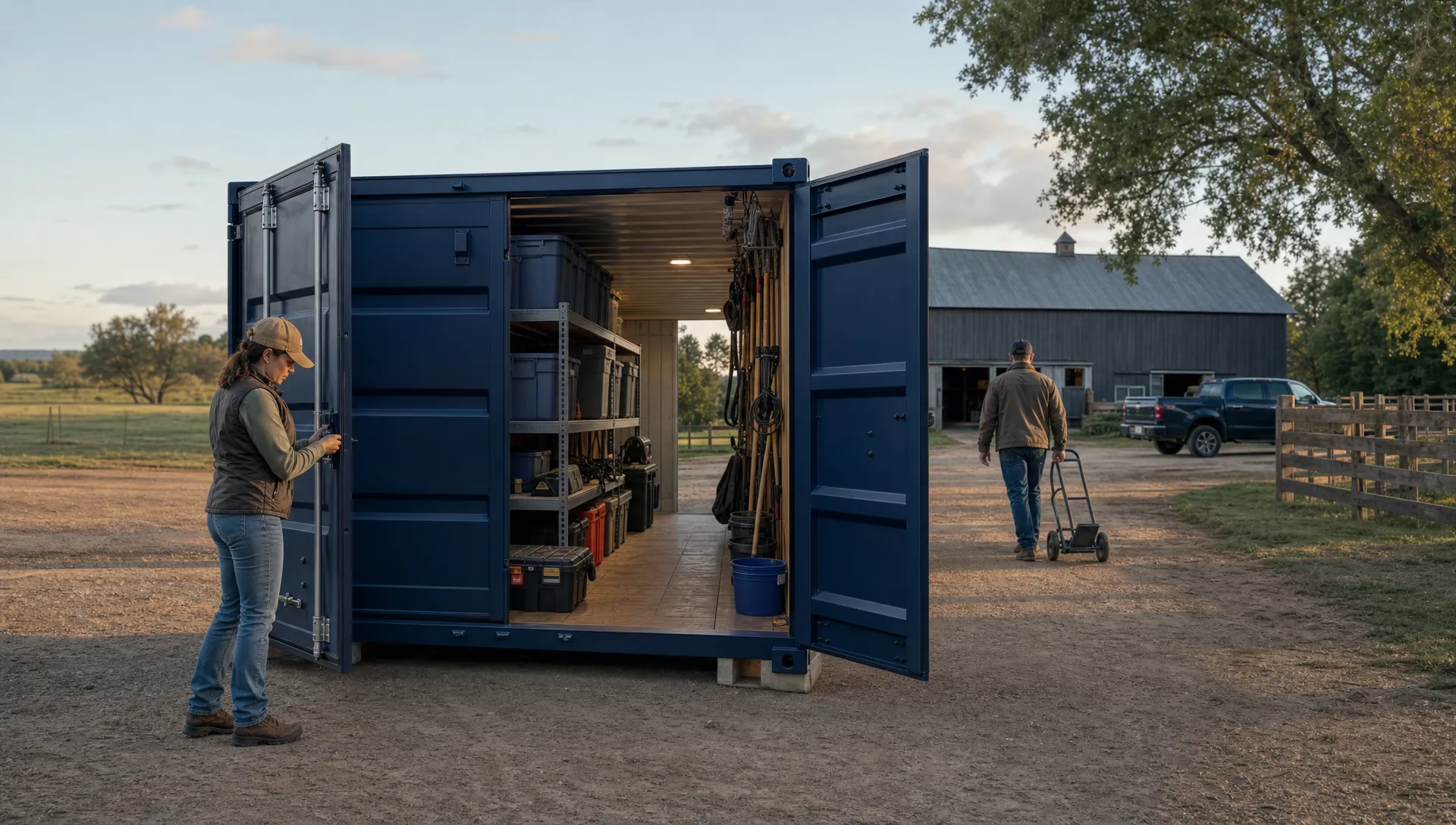
Quick Answer: A double door shipping container, often called a double-end or tunnel container, has cargo doors at both short ends. It lets you reach stored goods from either direction, reducing the need to unload items just to reach something at the back.
This layout works well for job-site tools, farm supplies and business inventory. However, sellers sometimes use “double door” to describe other door arrangements, so confirm the exact configuration before buying.
Key Takeaways
- A true double-end container has a separate set of cargo doors at each short end.
- Open-side containers provide access along a long wall, which suits different loading needs.
- Both entrances need clear approaches, room for door swing and secure locking.
- Compare usable dimensions, condition and total delivered cost, not just the advertised price.
What Is a Double Door Shipping Container?
A standard cargo container usually has two swinging door leaves at one end. A double-end container has that paired-door arrangement at both ends, creating a passage through the unit when both entrances are open.
That distinction matters when requesting quotes. A listing that says “double doors” might describe the two leaves of an ordinary single-end container, not two separate entrances. Ask for photographs showing both short ends and written confirmation of the door layout.
When two entrances make a difference
Two-end access helps when you store items in separate zones. A contractor can keep frequently used tools near one entrance and seasonal equipment near the other, without moving everything through the same doorway.
It can also support a first-in, first-out inventory routine: load through one end and retrieve older stock through the other. This only works if the interior layout and access paths remain clear.
The second entrance does not increase floor area or payload capacity. Its value comes from making the existing space easier to use.
Compare Double-End, Open-Side and Standard Containers
Choose the door arrangement around what you move, how often you move it and which sides of the container your site can accommodate. Extra doors offer little benefit if a fence, slope or parked equipment blocks them.
| Configuration | Where it opens | Best suited to | Main planning concern |
|---|---|---|---|
| Standard end-opening | One short end | General storage with a single access point | Items at the rear may require unloading |
| Double-end or tunnel | Both short ends | Two-zone storage and access from opposite directions | Both ends need working clearance |
| Open-side | Along a long side; end-door arrangements vary | Wide loads and direct access to items along the wall | Side doors need clear space beside the container |
A double door shipping container makes sense when you need access from opposite ends. An open-side model is often a better match when you want to load wide materials or reach several storage bays directly from outside.
For example, the 20ft Open Side New Shipping Container, Wind & Watertight, Gray has full-length side doors for easier loading. It is an open-side option, not a product to assume has cargo doors at both ends.
Before ordering either layout, ask for the clear opening dimensions. The container’s outside width does not tell you whether your equipment will pass through its doors.
Choose the Right Size and Verify the Openings
Common nominal lengths for storage containers are 20ft and 40ft. Standard-height units are typically 8ft 6in tall externally, while high cube units are typically 9ft 6in tall.
| Nominal format | Nominal exterior length | Exterior width | Typical exterior height |
|---|---|---|---|
| 20ft standard | 20ft | 8ft | 8ft 6in |
| 20ft high cube | 20ft | 8ft | 9ft 6in |
| 40ft standard | 40ft | 8ft | 8ft 6in |
| 40ft high cube | 40ft | 8ft | 9ft 6in |
These are common format dimensions, not confirmation that every size and door combination is available. Obtain the specifications for the actual unit being quoted, including its precise exterior length and usable interior measurements.
Measure the load, not just the container
The clear door opening is smaller than the container’s exterior cross-section. Door headers, seals and hardware reduce the space available for loading, and the second end assembly can affect usable interior length.
For a double door shipping container, request measurements for both openings. Check the width and height of your largest load, including its pallet, packaging or handling equipment.
A nominal 20ft container occupies roughly 160 square feet of exterior footprint; a nominal 40ft unit occupies roughly 320 square feet. Usable interior floor area is smaller, and shelving reduces it further.
Understand tare weight and payload capacity
Tare weight is the weight of the empty container. Payload capacity is the permitted cargo weight, subject to the unit’s rating and applicable operating limits.
Do not copy weight figures from a different intermodal container listing. Use the actual unit’s markings and documentation, especially if it has extra doors or modifications. A total payload rating also does not establish whether the floor can support a concentrated machine load or a loaded forklift.
Plan Storage Around Two Working Entrances
The best layout starts with retrieval, not with filling every available inch. Decide which items need daily access, which stay for months and which require a cart or pallet jack to move.
A double door shipping container can reduce the distance to stored items when both ends remain accessible. In a clear 40ft-long layout, an item near the midpoint is roughly 20ft from either end rather than roughly 40ft from a single entrance.
Keep an aisle and assign storage zones
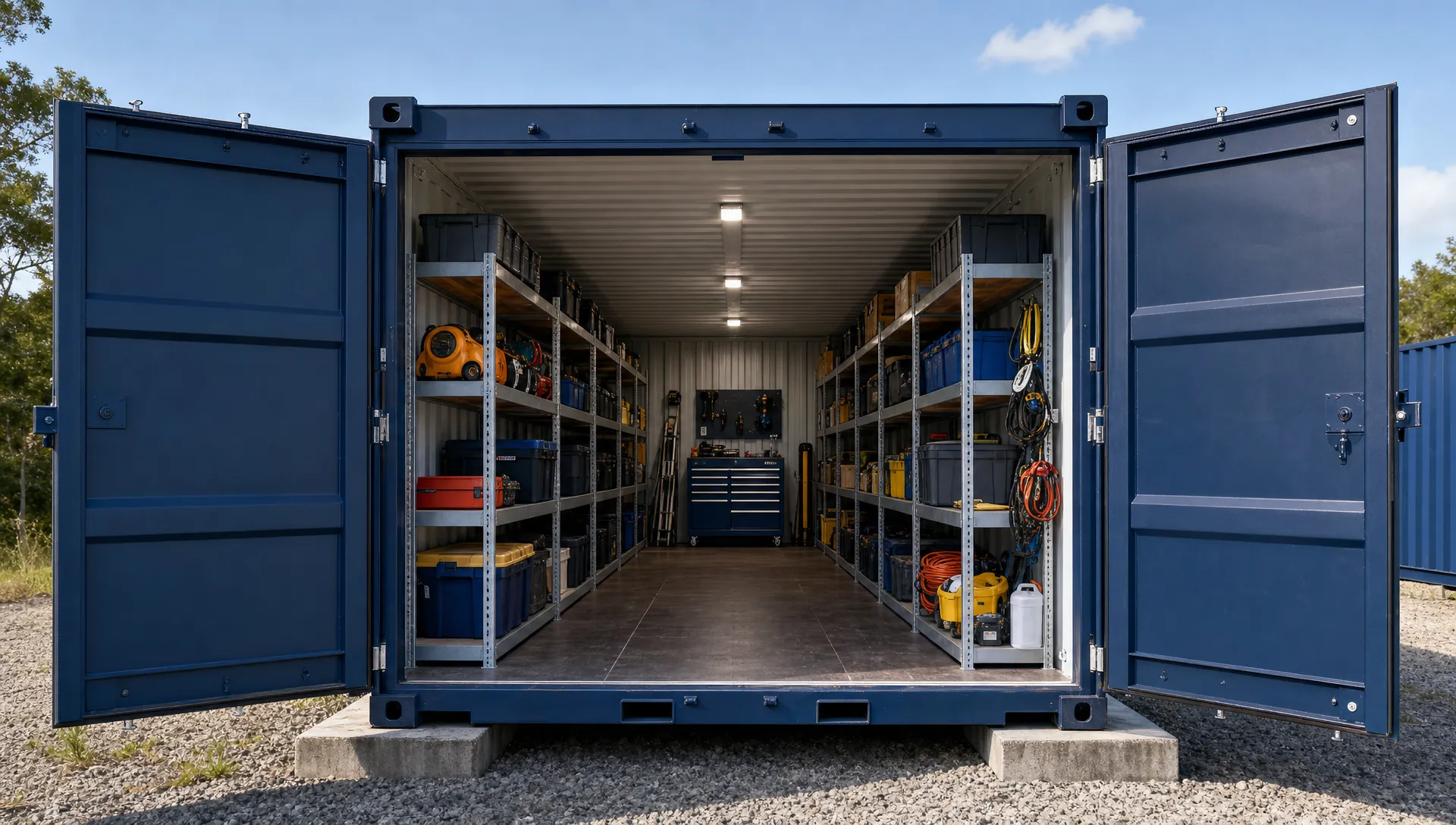
For mixed storage, place shelves along the walls and preserve a central route between entrances. Set aisle width around the load you actually carry, including handles, packaging and room to turn safely.
Mark locations by entrance and shelf position. Labels such as “North Door, Left Shelf 2” prevent workers from opening the wrong end or searching behind unrelated stock.
If you install a partition, plan access to each compartment before fixing it in place. A divided unit can serve two storage functions, but each compartment needs suitable access, security and ventilation.
Secure both ends and control moisture
Two entrances mean two sets of hinges, locking rods and seals to maintain. Use appropriate locks at both ends, and ask whether lock protection is included or must be added.
Wind- and watertight construction does not mean climate-controlled storage. Condensation can still form when temperature and humidity change, particularly around damp equipment or goods stored against cold steel.
Keep moisture-sensitive stock off the floor, leave space for inspection and select ventilation or dehumidification around the contents. Never lock someone inside a storage container or treat an unmodified conex box as an occupied workspace.
Inspect Condition and Compare the Delivered Cost
Door condition deserves extra attention on a unit with two working entrances. A low purchase price offers little value if one end binds, leaks or cannot be secured properly.
Check the doors, floor and condition grade
Operate every door leaf before acceptance when an inspection is possible. Check hinges, locking rods, handles and seals, then look for frame distortion or repairs around the openings.
Use this inspection checklist:
- Confirm that both entrances open, close and latch without excessive force.
- Inspect seals for splits, missing sections and poor contact.
- Check floors for soft areas, damage, staining and unusual odors.
- Look for corrosion, holes and questionable repairs around corner posts and door frames.
- Request recent photographs of the actual unit rather than representative stock images.
A one-trip container has generally made one loaded journey, but it can still have handling marks. Used-condition labels also need context: WWT means wind and watertight, while CWO or cargo-worthy condition relates to suitability for cargo service and should be supported by the seller’s inspection terms.
For a fuller checklist, use Outback’s guide to inspecting a used shipping container before accepting a used unit.
Compare complete quotes, not unsupported price ranges
The price of a double door shipping container depends on size, condition, location, availability and transport requirements. Without a current quote for your delivery address, a generic price range can hide more than it explains.
Compare the total delivered cost, including the container, delivery, applicable taxes, unloading arrangements and any requested modifications. Ask whether difficult access, waiting time or a failed delivery attempt could create additional charges.
If side access better matches your loading plan, consider this separate 20ft Open Side New Shipping Container, Wind & Watertight, Gray listing. Confirm its current price, availability and delivery requirements before ordering.
Separate storage condition from transport approval
A weather-resistant storage unit is not automatically ready for international freight. The International Maritime Organization’s information on the Convention for Safe Containers explains the framework for container safety approval, examination and maintenance.
If you intend to ship loaded cargo, ask about the CSC plate, examination status and carrier acceptance. Do not assume that “ISO container,” “WWT” or an old plate alone proves current suitability for your planned transport.
Prepare the Site, Delivery Access and Permits
Place the container where both entrances will remain useful after delivery. Consider future fences, vehicle parking, snow storage and landscaping, not just the space available on delivery day.
A double door shipping container needs usable ground at both ends. If one entrance faces a property boundary with no room to open the doors or handle goods, the second door set may provide little practical benefit.
Provide level support and loading clearance
The container needs a level, adequately supported base with drainage that carries water away. Uneven support can rack the frame and make doors difficult to operate, even when the container itself is sound.
Support design depends on ground conditions, container loads and intended use. Confirm bearing locations and foundation needs rather than assuming loose blocks or soft soil will be adequate.
Use the shipping container site preparation checklist to plan access, ground preparation and placement. Ask the delivery provider for the truck’s required approach, unloading space and overhead clearance, because these vary by equipment and method.
Check forklift access and local approval
If a forklift will enter the unit, verify floor condition, loading transitions and concentrated wheel loads before operating. For workplace use, OSHA’s powered industrial truck requirements cover operator training and safe operation; a container’s payload number is not a substitute for this assessment.
Permit, zoning and setback requirements vary by state, county and municipality. Temporary storage, permanent commercial use and a container conversion for occupancy may follow different rules.
Review Outback’s shipping container permit requirements guide, then confirm the current requirements with your local planning or building department. Obtain approval before paying for modifications that depend on a particular placement or use.
Frequently Asked Questions
Are double-door containers the same as open-side containers?
No. A double-end or tunnel container has cargo doors at both short ends. An open-side container opens along a long wall, and its end-door configuration depends on the model. Ask for photographs and a door layout drawing because sellers do not always use “double door” consistently.
How much does a double door shipping container cost?
There is no single dependable price without specifying size, condition, location and delivery access. Request a current written quote for the exact unit and address. Compare taxes, transport, unloading and modifications alongside the purchase price, and confirm which charges could change if site conditions differ from your description.
What are the dimensions of a 20ft double-door container?
A typical standard-height model is nominally 20ft long, 8ft wide and 8ft 6in tall externally. A high cube version is typically 9ft 6in tall. Interior dimensions and clear door openings are smaller, so request the actual unit’s specification sheet before planning shelves, equipment placement or loading.
Can you add doors to both ends of an existing container?
It may be possible, but adding an opening is not simply a matter of cutting steel. The work can affect structural strength, weather resistance and transport approval. Have a qualified container fabricator assess the design, reinforcement, door assembly and any required engineering before comparing it with a factory-built option.
What is the maximum height of a shipping container?
For common storage models, standard height is 8ft 6in and high cube height is 9ft 6in externally. However, 9ft 6in is not a universal maximum for every specialized container. Confirm the actual unit’s height, then allow separately for its foundation, delivery equipment and overhead obstructions at the site.
Can a double-door container become a shipping container home?
Yes, but the doors alone do not make it suitable for housing. A conversion needs structural review, insulation, moisture control, utilities and code-compliant access and egress. Requirements vary by jurisdiction, so consult local authorities and qualified designers before selecting the container or removing any structural steel panels.
Match the Doors to the Job
Choose a double door shipping container when access from opposite ends solves a real storage problem. Choose open-side access when wide loading or direct access along the container’s length matters more.
Before buying, confirm the actual door layout, usable measurements, condition and delivery plan in writing. To compare options, contact Outback Shipping Containers with your delivery ZIP code, intended contents and preferred access arrangement, then request a quote for a configuration that fits your site.