20ft Container Dimensions for Delivery and Site Planning
By Outback Shipping Containers · Published July 19, 2026 · Last updated October 20, 2026
20ft Container Dimensions for Delivery and Site Planning
The standard 20ft container dimensions are 20 ft long, 8 ft wide, and 8 ft 6 in tall on the outside. Inside, most standard 20ft dry containers measure about 19 ft 4 in long, 7 ft 8 in wide, and 7 ft 10 in high. That gives you roughly 148 sq ft of floor space and about 1,170 cu ft of storage volume.
Quick Answer: Plan for a container footprint of 20 ft by 8 ft, plus space for the delivery truck. For tilt-bed delivery, a 20ft container usually needs 100 ft of straight clearance, 12 ft of width, firm ground, and no low branches or wires near the drop zone.
Key Takeaways
- A standard 20ft ISO container is 20 ft long, 8 ft wide, and 8 ft 6 in tall outside.
- Interior space is usually about 19 ft 4 in by 7 ft 8 in, with about 148 sq ft of usable floor area.
- Delivery requires more room than the container footprint because the truck must back in, tilt, and pull away.
- A 20ft conex box is often easier to deliver than a 40ft unit on tight driveways, farms, small job sites, and residential lots.
- Actual measurements, tare weight, and payload capacity can vary, so confirm the container’s spec sheet or CSC plate before purchase.
20ft Container Dimensions: Exterior, Interior, and Door Measurements
A 20ft shipping container is an ISO container, also called an intermodal container, cargo container, or conex box. ISO standards help containers fit ships, rail cars, chassis, cranes, and handling equipment around the world. The main reference standard is ISO 668 for Series 1 freight containers, which defines container sizes and ratings.
For site planning, the outside dimensions tell you how much ground space the container occupies. The inside dimensions tell you what can actually fit inside. Door dimensions matter if you plan to store pallets, equipment, motorcycles, ATVs, tools, furniture, or building materials.
| Measurement | Standard 20ft dry container | Planning note |
|---|---|---|
| Exterior length | 20 ft 0 in | Use this for the ground footprint. |
| Exterior width | 8 ft 0 in | Add walking room on both sides if possible. |
| Exterior height | 8 ft 6 in | Add trailer height when checking delivery clearance. |
| Interior length | About 19 ft 4 in | Interior length varies slightly by manufacturer. |
| Interior width | About 7 ft 8 in | Shelving and wall lining reduce this width. |
| Interior height | About 7 ft 10 in | Flooring, insulation, and ceiling panels reduce height. |
| Door opening width | About 7 ft 8 in | Check this before loading wide equipment. |
| Door opening height | About 7 ft 5 in | Tall items may fit inside but not through the doors. |
| Floor area | About 148 sq ft | Similar to a small bedroom or compact workshop. |
| Cubic capacity | About 1,170 cu ft | Useful for storage planning and packing estimates. |
These are typical dimensions for a standard 20ft dry container. A one-trip container, used WWT unit, or CWO container may have small measurement differences. Dents, repairs, floor thickness, wall lining, insulation, and custom modifications can also change the usable interior space.
Standard height vs 20ft high cube
Most 20ft containers sold in the United States are standard height. A standard unit is 8 ft 6 in tall outside. A 20ft high cube is 9 ft 6 in tall outside, giving about one extra foot of interior height.
High cube 20ft containers are less common than 40ft high cube containers. If you need standing room for a container conversion, workshop, or shipping container home, ask for actual interior height before you order. That extra foot can make electrical runs, insulation, ceiling panels, and HVAC placement easier.
Why the door opening matters
The door opening is smaller than the full interior cross-section. This catches first-time buyers by surprise. For example, a cabinet, crate, or machine may fit inside the container on paper but fail to clear the door header.
If you plan to load pallets, check the pallet height and forklift mast height. If you plan to store a compact tractor, UTV, mower, or motorcycle, measure the widest and tallest point with mirrors, roll bars, racks, and attachments included.
Weight, Tare Weight, and Payload Capacity
A 20ft container is heavy even when empty. Most standard 20ft dry containers weigh about 4,800 to 5,100 lb empty. This empty weight is called tare weight. The exact number should be listed on the container data plate.
Payload capacity is the maximum cargo weight the container is rated to carry. For many modern 20ft ISO containers, the maximum gross weight can be up to 67,200 lb, or 30,480 kg. The payload capacity is the max gross weight minus the tare weight. Older containers and modified containers may have different ratings.
| Weight term | Typical planning number | Why it matters |
|---|---|---|
| Tare weight | About 4,800 to 5,100 lb | This is the empty container weight. |
| Maximum gross weight | Varies by container plate | This is the container plus cargo limit. |
| Payload capacity | Gross weight minus tare weight | This is not always the same as road-legal hauling capacity. |
| Modified container weight | Varies widely | Windows, doors, framing, insulation, and fixtures add weight. |
Do not assume you can fill a 20ft container to its listed payload rating and move it by truck. Highway rules, chassis ratings, axle weights, state limits, local roads, and the delivery carrier’s equipment all matter. If you need the container transported while loaded, tell the supplier before pickup or delivery is scheduled.
For static site storage, weight still matters. A container loaded with tile, stone, feed, tools, auto parts, or machinery can put a lot of pressure on the ground. Soft soil can settle. Asphalt can rut. Thin residential concrete can crack, especially near edges.
Delivery Planning for a 20ft Shipping Container
The container footprint is only part of the plan. Delivery is where many site problems show up. A 20ft container may be compact, but the truck still needs room to enter, line up, unload, and leave safely.
Most 20ft deliveries use a tilt-bed truck, rollback truck, landoll trailer, flatbed, or step-deck trailer. The right method depends on your site, road access, container type, and whether the container is empty or modified. For a deeper cost breakdown by truck type and distance, use Outback Shipping Containers’ shipping container delivery cost per mile guide before budgeting your project.
Tilt-bed delivery clearance
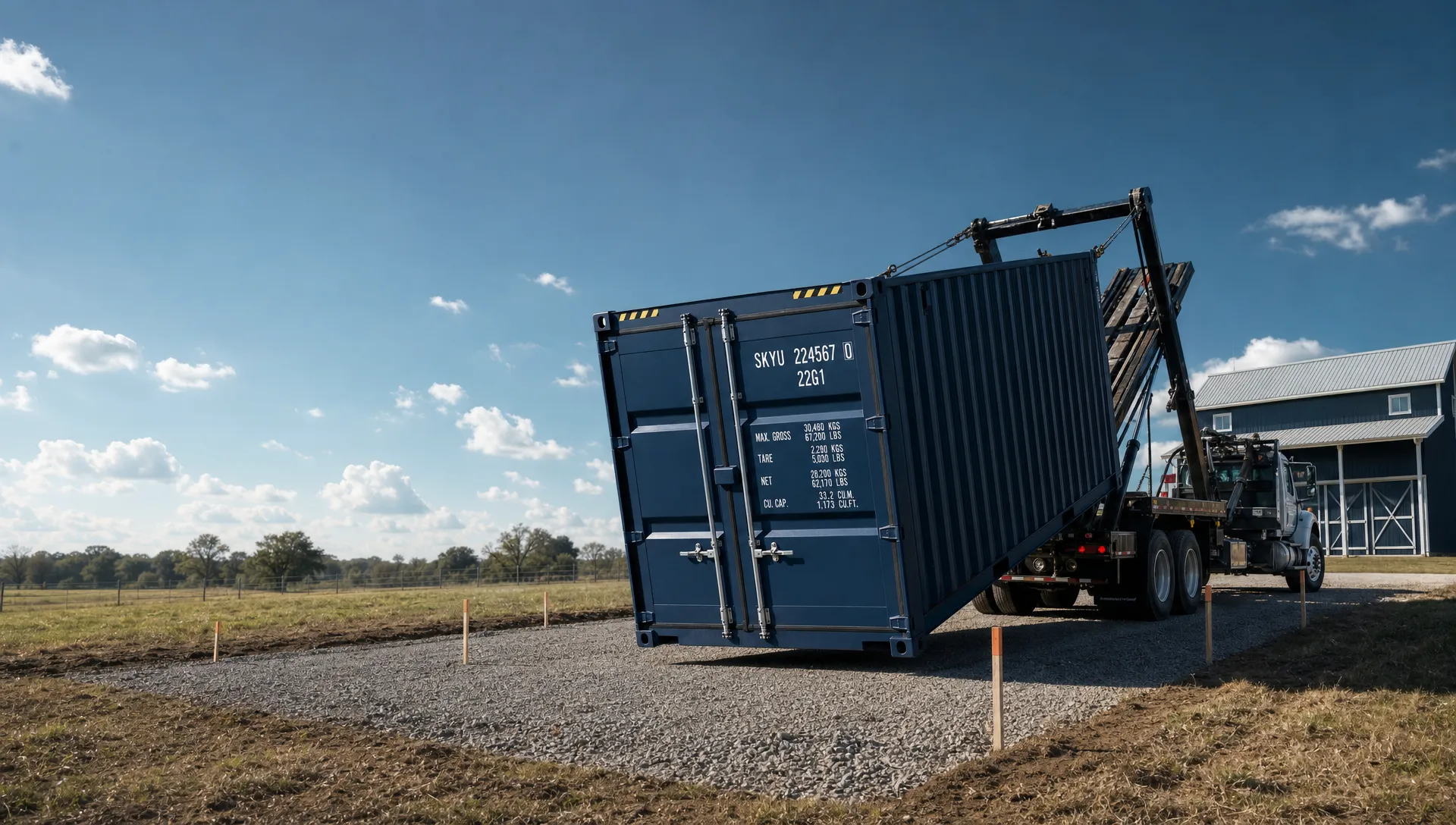
Tilt-bed delivery is common for 20ft containers because it is simple and efficient. The driver backs into position, raises the bed, slides the container to the ground, then pulls forward. The container comes off in a straight line.
For planning, use these common clearance targets:
| Delivery factor | Recommended planning clearance | Notes |
|---|---|---|
| Straight-line length | 100 ft | Includes truck, bed angle, and pull-away room. |
| Access width | 12 ft minimum | Wider is better for gates, turns, and rural lanes. |
| Overhead clearance | 14 to 16 ft or more | Check branches, wires, carports, and roof eaves. |
| Ground condition | Firm and mostly level | Soft soil can trap a loaded truck. |
| Side clearance | 2 to 3 ft each side if possible | Helps with doors, inspection, drainage, and maintenance. |
These numbers are planning guidelines, not a substitute for carrier approval. A steep driveway, tight turn, weak bridge, narrow gate, low wire, or muddy pasture can change the delivery plan.
Truck access is wider than the container
The container is 8 ft wide. The delivery truck may be wider, longer, and less forgiving than a pickup. Federal rules allow commercial motor vehicles up to 102 inches wide on the National Network, according to the Federal Highway Administration truck size and weight overview. Local roads, private drives, bridges, and job-site paths can be more restrictive.
Before delivery, walk the route from the public road to the drop spot. Look for mailbox posts, fences, drainage ditches, tight S-turns, low branches, gate posts, overhead utilities, septic fields, and soft shoulders. If a fire truck or moving truck would struggle to reach the area, a container truck may struggle too.
Placement direction matters
A tilt-bed driver places the container in the direction of travel. If the truck backs in, the doors usually come off last and face the truck’s pull-away direction. If you need the doors facing a road, barn, loading dock, alley, or work area, discuss it before dispatch.
This is one of the most important delivery details: doors first or doors last. Once the container is on the ground, moving it even a few feet can require special equipment. A skid steer, forklift, crane, or wrecker may be needed, and that can add cost.
Site Prep for Storage, Workshops, and Container Builds
A 20ft container does not need a full basement foundation for basic storage. It does need stable, level support. Good site prep protects the container floor, keeps doors working, and reduces moisture problems.
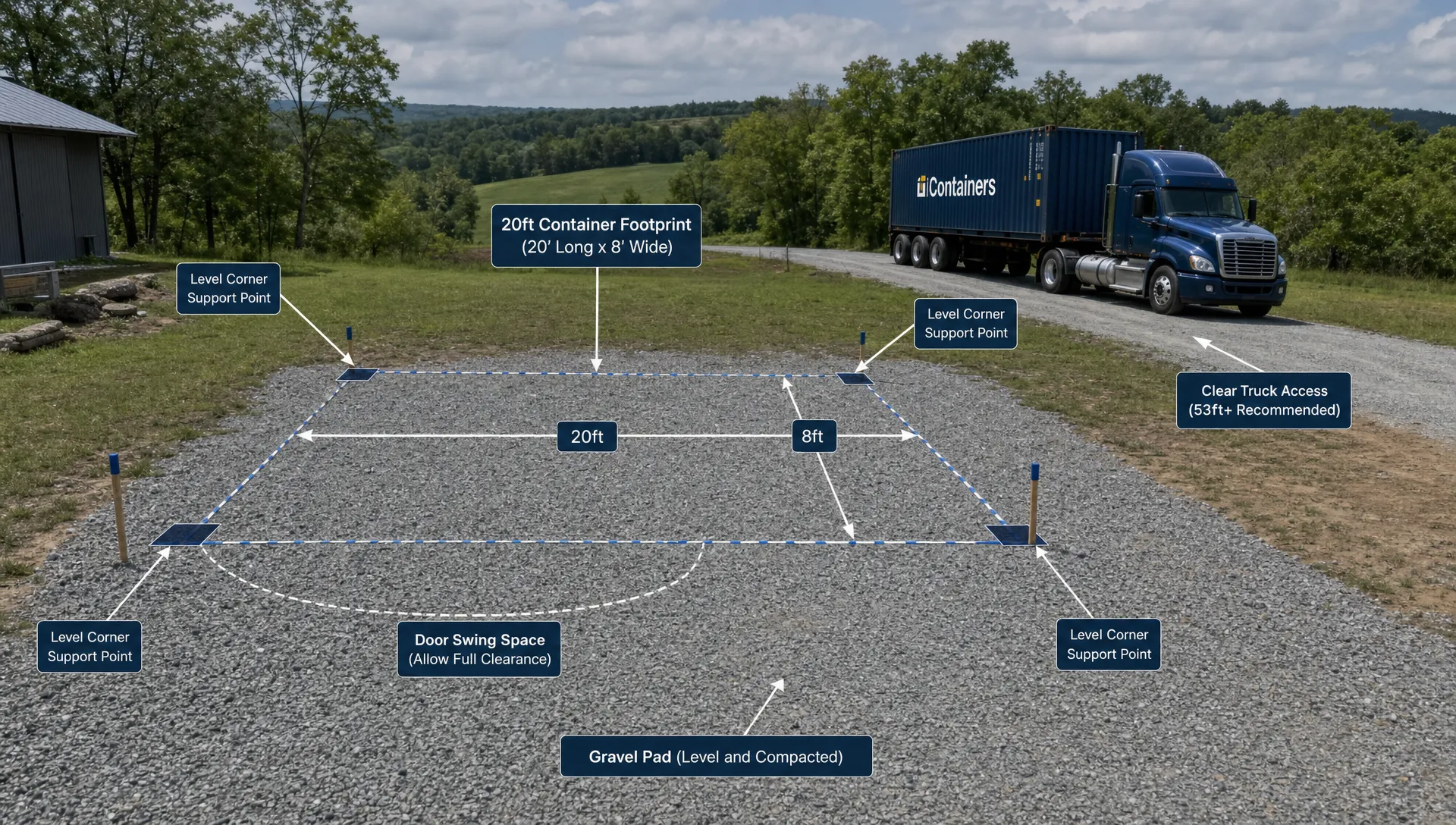
Start by marking a 20 ft by 8 ft rectangle on the ground. Then mark extra working space around it. If possible, leave at least 3 ft along the sides and rear for inspection, cleaning, painting, and airflow. Leave more space at the doors if you plan to load with a pallet jack, forklift, mower, or hand truck.
For a full step-by-step prep process, Outback’s Shipping Container Site Prep Checklist covers grading, drainage, access, pads, and final delivery checks.
Foundation options
Containers are designed to carry load through the corner castings. That means the four corners need solid support. For long-term use, many buyers also support the center line or side rails to reduce floor bounce and settlement.
Common 20ft container foundation options include compacted gravel pads, concrete piers, concrete strip footings, railroad-tie style timbers where appropriate, and engineered foundations for permitted builds. The right choice depends on soil, slope, climate, use, and local code.
A compacted gravel pad is a practical choice for many storage sites. It drains better than bare soil and can be adjusted if minor settlement occurs. For container homes, offices, cabins, and public-facing structures, speak with a local building official or engineer before choosing the foundation.
Drainage and moisture control
Set the container slightly above surrounding grade. Water should drain away from all sides. If water pools under the container, the underside can stay damp and the floor structure can age faster.
Avoid placing the container directly in a low spot. If the site is flat, shape the pad with a slight crown or use gravel to promote drainage. Keep weeds, leaves, and soil from building up against the side rails.
Door swing and daily access
Cargo doors are heavy. They need room to swing, latch, and pin back. Leave at least 8 to 10 ft clear in front of the doors for basic access. Leave 20 ft or more if you want to load long materials, stage pallets, park equipment, or work from the container.
If the container will become a workshop or office, think about the path people will use every day. Mud at the entrance becomes a problem fast. Add gravel, pavers, steps, a small deck, or a ramp where needed.
20ft vs 40ft Container Dimensions for Site Planning
A 40ft container gives you more storage volume, but it also needs more room for delivery. Many buyers start by comparing 20ft vs 40ft containers based only on price and square footage. That is a mistake if the delivery site is tight.
A 20ft unit often works better for residential lots, small farms, urban job sites, remote cabins, and properties with narrow access. A 40ft unit can be a better value when you have plenty of space, need bulk storage, or plan a larger modular build.
| Planning factor | 20ft standard container | 40ft standard container | Practical takeaway |
|---|---|---|---|
| Exterior length | 20 ft | 40 ft | A 40ft unit doubles the length. |
| Exterior width | 8 ft | 8 ft | Width is the same for both. |
| Exterior height | 8 ft 6 in | 8 ft 6 in | High cube versions are 9 ft 6 in tall. |
| Interior floor area | About 148 sq ft | About 305 sq ft | A 40ft unit gives a little more than double the floor area. |
| Empty weight | About 4,800 to 5,100 lb | Often about 8,000 to 8,800 lb | Heavier units need better access and support. |
| Common straight delivery clearance | About 100 ft | About 120 ft | Tight sites often favor 20ft containers. |
| Typical best use | Storage, tools, small workshop, tiny build | Bulk storage, office, larger build | Choose based on access as much as space. |
If you are not sure which size fits, measure the site both ways. Stake the corners. Then walk the truck path. A 40ft container may look fine once placed, but the delivery truck may not have enough room to set it down safely.
Best Uses for a 20ft Container Footprint
A 20ft container is popular because it is large enough to be useful but small enough for many properties. It can serve as secure storage, a farm supply unit, a contractor tool room, a pop-up retail shell, a compact office, or the base for a small container conversion.
For job sites, the 20ft size works well when crews need secure storage near the work area. It can hold tools, fasteners, safety gear, generators, compressors, and materials without taking over the whole site. Contractors also like the shorter footprint because it can fit along fence lines, near temporary power, or beside a building under construction.
For farms and ranches, 20ft containers are useful for feed, tack, fencing supplies, irrigation parts, and seasonal tools. The shorter length helps when placing the unit near barns, corrals, wells, or field entrances.
For homeowners, the 20ft size is often easier to fit beside a garage, behind a shop, or on a gravel pad. It can support remodeling storage, furniture storage, hobby space, or a small workshop. Always check HOA rules, zoning, and local placement limits before ordering.
Planning for a 20ft container home or office
A 20ft shipping container home sounds simple because the box is compact. The real planning starts when you add insulation, framing, plumbing, electrical, windows, doors, HVAC, and interior finishes. Every inch matters.
A bare interior width of about 7 ft 8 in can shrink after framing and insulation. If you add 2 in of wall assembly on each side, the finished interior width may drop to about 7 ft 4 in or less. That is still usable, but layout choices become important.
For container homes and offices, measure the finished space, not just the steel shell. Door placement, window placement, bathroom size, kitchenette depth, bed size, desk clearance, and mechanical equipment all affect comfort.
If you want a compact finished unit rather than a bare cargo container, compare dimensions and layouts on a product page such as Outback’s Custom 20ft Shipping Container House. Use the listed specs as a starting point, then confirm current details, delivery needs, and site requirements before purchase.
New, used, WWT, and CWO considerations
Condition matters for both storage and conversion. A new one-trip container usually has fewer dents, cleaner paint, and less floor wear. A used WWT container is wind and watertight, which is often enough for general site storage. A CWO container is cargo-worthy and suited for cargo use, but if you need export or intermodal shipping, confirm the CSC plate and inspection status.
Here is the plain-language difference:
| Container term | What it usually means | Best fit |
|---|---|---|
| One-trip | Used for one cargo trip after manufacture | Clean storage, homes, offices, retail conversions. |
| WWT | Wind and watertight for ground storage | Tools, equipment, household goods, farm storage. |
| CWO | Cargo-worthy condition | Freight use, heavier storage, buyers needing stronger structural assurance. |
| Refurbished | Used container repaired and repainted | Buyers who want cleaner appearance without buying new. |
If the container will be cut for windows, doors, or large openings, ask how the structure will be reinforced. Cutting steel walls can weaken the box if the work is not planned correctly. This is especially important for container homes, pools, offices, and stacked modular builds.
Permits, Codes, and Final Site Checks
Permit rules vary by city, county, and state. Some areas treat a 20ft storage container as temporary equipment. Others treat it as an accessory structure. If it has electrical, plumbing, HVAC, a foundation, or living space, it may need building permits and inspections.
Before delivery, contact your local building department or zoning office. Ask about setbacks, screening rules, maximum accessory structure size, driveway use, fire access, flood zones, and time limits for temporary storage. Rural land is often more flexible, but it is not always permit-free.
Use this final checklist before the truck arrives:
- Mark the exact 20 ft by 8 ft placement area with stakes, paint, flags, or cones.
- Confirm door direction with the delivery coordinator before dispatch.
- Clear the truck path of vehicles, trailers, branches, debris, and low obstacles.
- Check gate width, turn radius, driveway slope, and overhead wires.
- Prepare firm support at all four corners and correct any obvious low spots.
- Keep pets, children, and bystanders away from the unloading area.
Take photos of the access road and drop zone if the site is rural, steep, wooded, or tight. Send them to your supplier before delivery day. A few photos can prevent a failed delivery, redelivery fees, or the need for last-minute equipment.
Frequently Asked Questions
What are the dimensions of a 20ft shipping container?
A standard 20ft shipping container is 20 ft long, 8 ft wide, and 8 ft 6 in tall outside. The inside is usually about 19 ft 4 in long, 7 ft 8 in wide, and 7 ft 10 in high. Door openings are about 7 ft 8 in wide and 7 ft 5 in high.
How much space do you need to deliver a 20ft shipping container?
For tilt-bed delivery, plan for 100 ft for a 20ft (120 ft for a 40ft) of straight clearance, 12 ft of access width, and 14 ft of overhead clearance. The ground should be firm and mostly level. Tight turns, low wires, steep slopes, and soft soil may require a different delivery method.
Will a 20ft shipping container fit in a driveway?
A 20ft container can fit in many driveways, but delivery access matters more than the final footprint. The driveway must handle a heavy truck, provide enough straight-line unloading room, and avoid low branches or wires. Check concrete thickness, slope, HOA rules, and local zoning before scheduling delivery.
How much does a 20ft shipping container weigh?
Most empty 20ft dry containers weigh about 4,800 to 5,100 lb. The exact tare weight is listed on the container plate. Modified containers weigh more because windows, doors, insulation, framing, fixtures, and equipment add weight. Always confirm weight before transport, lifting, or foundation design.
Do I need a permit for a 20ft shipping container?
Maybe. Permit requirements depend on your city, county, zoning district, use, and how long the container will stay on site. Storage containers, offices, workshops, and homes may be treated differently. Contact your local building or zoning office before delivery, especially if you plan electrical, plumbing, occupancy, or a permanent foundation.
What is the difference between a 20ft standard and a 20ft high cube container?
A standard 20ft container is 8 ft 6 in tall outside. A 20ft high cube is 9 ft 6 in tall outside, giving about one extra foot of height. Length and width are generally the same. High cube units are useful for conversions, but 20ft high cube availability can be limited.
A 20ft container is simple to plan when you work from real measurements, not guesses. Confirm the exterior footprint, interior space, door opening, tare weight, delivery clearance, and local rules before you buy.
Outback Shipping Containers supplies new, used, and custom containers nationwide, including remote and rural delivery across all 50 states. If you are comparing options for storage, a job site, or a small build, start with Outback Shipping Containers and review current inventory, delivery options, and lender-financing eligibility for container homes priced above $72,000 only, subject to lender approval before scheduling your drop date.
About Outback Shipping Containers
This guide was prepared by the Outback Shipping Containers team, based on the questions our customers ask us most when buying, modifying and taking delivery of shipping containers. Learn more about us.
Ready to find your container?
Browse our in-stock shipping containers, container homes and custom builds, or ask our team for a free quote with delivery to your site.