20 Foot Container Size Explained for Storage Buyers
By Outback Shipping Containers · Published July 19, 2026 · Last updated October 18, 2026
20 Foot Container Size Explained for Storage Buyers
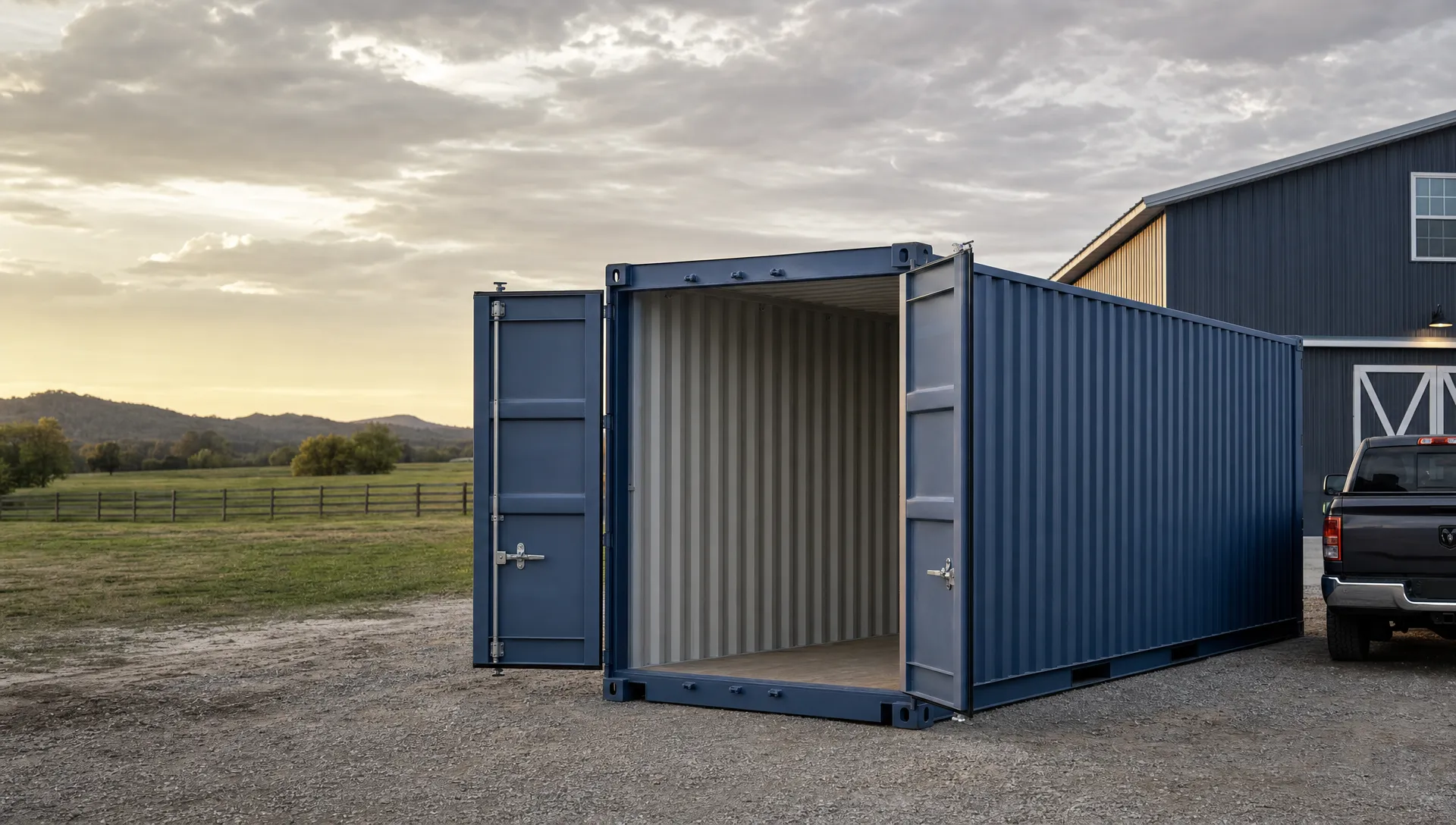
The standard 20 foot container size is 20 ft long, 8 ft wide, and 8 ft 6 in tall on the outside. Inside, most standard dry cargo containers give you about 19 ft 4 in of length, 7 ft 8 in of width, and 7 ft 10 in of height. That equals roughly 148 sq ft of floor space and about 1,170 cu ft of usable storage.
Quick Answer: A 20ft shipping container is a good fit when you need secure storage that is larger than a shed but easier to place than a 40ft container. It works well for household overflow, contractor tools, farm supplies, jobsite materials, and small business inventory.
Key Takeaways
- A standard 20ft container has an exterior footprint of 160 sq ft and usable interior floor space of about 148 sq ft.
- Most 20ft dry containers have about 1,170 cu ft of storage volume, before shelving, aisle space, or bulky items reduce usable capacity.
- Typical tare weight is about 4,800 to 5,100 lb, while maximum gross rating is commonly 67,200 lb.
- WWT and CWO matter more than age alone. Storage buyers should focus on roof condition, doors, floor, seals, and inspection status.
- Delivery planning is part of sizing. You need room for the container, truck access, door swing, drainage, and local permit compliance.
20 Foot Container Size: Exact Storage Specs
A 20ft shipping container is part of the ISO container family, also called an intermodal container, cargo container, or conex box. The common 20ft dry container is designed around international freight standards, which is why most units have very similar outside dimensions.
The ISO 668 standard defines classification, dimensions, and ratings for Series 1 freight containers. For a storage buyer, the key point is simple: the outside size is very consistent, but the inside size can vary a little by manufacturer, floor thickness, door style, repairs, and whether the unit is standard, high cube, refrigerated, or modified.
| Spec | Standard 20ft dry container | Why storage buyers care |
|---|---|---|
| Exterior length | 20 ft 0 in | Confirms pad size and delivery fit |
| Exterior width | 8 ft 0 in | Fits many driveways, yards, farms, and job sites |
| Exterior height | 8 ft 6 in | Important for trees, wires, carports, and gates |
| Interior length | About 19 ft 4 in | Determines long-item storage |
| Interior width | About 7 ft 8 in | Determines shelving, aisle space, and pallet fit |
| Interior height | About 7 ft 10 in | Determines stacking and tall equipment clearance |
| Door opening width | About 7 ft 8 in | Measure your widest item before buying |
| Door opening height | About 7 ft 5 in to 7 ft 6 in | Critical for mowers, ATVs, carts, and machinery |
| Interior volume | About 1,170 cu ft | Best estimate for total storage capacity |
| Interior floor area | About 148 sq ft | Similar to a long, narrow storage room |
Exterior footprint vs usable space
The outside footprint of a 20ft container is 160 sq ft. That is 20 ft multiplied by 8 ft. You should plan for more than that on the ground, because the doors need swing clearance and the delivery truck needs access.
The usable floor area inside is closer to 148 sq ft. The steel wall structure, door frame, and corrugated sides reduce the interior space. If you add shelving along one wall, your walking aisle will get narrower, so plan the layout before you order.
Standard height vs high cube
Most 20ft containers are standard height at 8 ft 6 in outside. A 20ft high cube container is 9 ft 6 in outside, which gives about one extra foot of interior height. High cube 20ft units exist, but they are less common than standard 20ft and 40ft high cube containers.
That extra height can help if you want tall racks, stacked totes, workshop lighting, or a container conversion. For simple ground-level storage, a standard 20ft dry container is often enough.
How Much Storage Capacity Does a 20ft Container Offer?
A 20ft container is not just a steel box with 160 sq ft on paper. The real storage value depends on how you load it. Long items, pallets, shelving, and aisle space all change what you can fit.
For most buyers, the 20ft size works best when items are dense, valuable, or need to stay secure. It is easier to organize than a 40ft container if you use shelves, bins, and wall hooks. It is also easier to place on residential lots, farms, and tight job sites.
| Storage need | Fit notes | Is a 20ft container a good fit? |
|---|---|---|
| Household overflow | Furniture, boxes, tools, holiday items, appliances | Yes, if items are organized and protected from condensation |
| Contractor tools | Saws, compressors, ladders, fasteners, fittings, supplies | Yes, especially with shelving and a lockbox |
| Farm and ranch storage | Feed bags, fencing tools, parts, tack, pumps, seasonal gear | Yes, if placed on a dry pad with ventilation |
| Palletized inventory | Up to about 10 standard 48 in by 40 in pallets in a simple floor layout | Yes, but aisle access may reduce pallet count |
| Lawn and small equipment | Mowers, ATVs, carts, attachments | Often, but door height and ramp angle must be checked |
| Workshop use | Benches, tools, electrical equipment, storage racks | Yes, if modified for lighting, airflow, and local code requirements |
Weight capacity and payload
A typical 20ft dry container has a tare weight around 4,800 to 5,100 lb. Tare weight means the empty container weight. Many standard 20ft units have a maximum gross rating of 67,200 lb, which leaves a payload capacity around 62,000 lb.
That does not mean every site can safely hold 62,000 lb of stored goods. For static storage, your real limits are the ground, pad, corner support, forklift access, floor condition, and the way weight is spread. Dense items such as tile, stone, machine parts, liquids, and metal stock need extra planning.
If the container will move loaded on public roads, road weight rules and equipment limits matter. The Federal Highway Administration explains US truck size and weight topics in its freight size and weight overview, but final rules can also depend on state, route, axle setup, and carrier equipment.
Door access matters as much as cubic feet
A standard 20ft container has cargo doors on one end. That makes it strong and weather resistant, but it also means poor loading can bury important items in the back.
If you need daily access, leave a center aisle. If you need to reach inventory by category, use shelves, labels, and stackable bins. If you need side access, ask about modified containers, open-side containers, or custom doors.
20ft vs 40ft: Which Size Makes More Sense?
The choice between 20ft and 40ft is not just about length. A 40ft container gives more than double the interior volume in many cases, but it also needs a larger placement area, more delivery room, and more level ground.
For first-time storage buyers, a 20ft container is often the safer starting point. It is easier to place, easier to move later, and easier to keep organized. A 40ft container makes more sense when you have bulk inventory, long materials, or a large job site with open access.
| Feature | 20ft container | 40ft container |
|---|---|---|
| Exterior length | 20 ft | 40 ft |
| Exterior width | 8 ft | 8 ft |
| Standard exterior height | 8 ft 6 in | 8 ft 6 in |
| Approx. interior floor area | 148 sq ft | About 300 sq ft |
| Approx. interior volume | 1,170 cu ft | About 2,390 cu ft |
| Typical empty weight | 4,800 to 5,100 lb | About 8,000 to 8,800 lb |
| Placement difficulty | Easier | Harder |
| Best for | Residential storage, tools, small business inventory, farm supplies | Bulk storage, long materials, large sites, high-volume inventory |
Cost is also part of the decision. A 40ft container does not always cost twice as much as a 20ft unit, but delivery, site prep, and available space can change the total cost. For a deeper buying comparison, review the 20ft vs 40ft container price guide before you choose.
New, Used, WWT, and CWO: Which 20ft Container Should You Buy?
Condition matters as much as size. A clean 20ft container with tight doors and a sound roof is worth more for storage than a cheaper box with leaks, weak flooring, or door problems.
Here are the common condition terms you will see when shopping.
| Term | What it means | Best use |
|---|---|---|
| One-trip | Usually shipped once with cargo, then sold into storage or conversion markets | Clean storage, business inventory, container conversion, premium appearance |
| WWT | Wind and watertight, meaning it should keep out normal wind and rain when closed | General storage, tools, household goods, farm supplies |
| CWO | Cargo-worthy, meaning it has been inspected for cargo use and is generally suitable for transport | Storage plus possible freight use |
| Refurbished | Used unit that may be repaired, painted, or upgraded | Buyers who want better appearance than a basic used unit |
| CSC plated | Has a Container Safety Convention plate for intermodal shipping | Important if you plan to ship cargo, not always needed for static storage |
For basic storage, WWT is usually the key minimum. For freight use, ask about CWO status and CSC requirements. For a shipping container home, office, or retail container conversion, many buyers prefer a one-trip unit because the steel, doors, and appearance are usually cleaner.
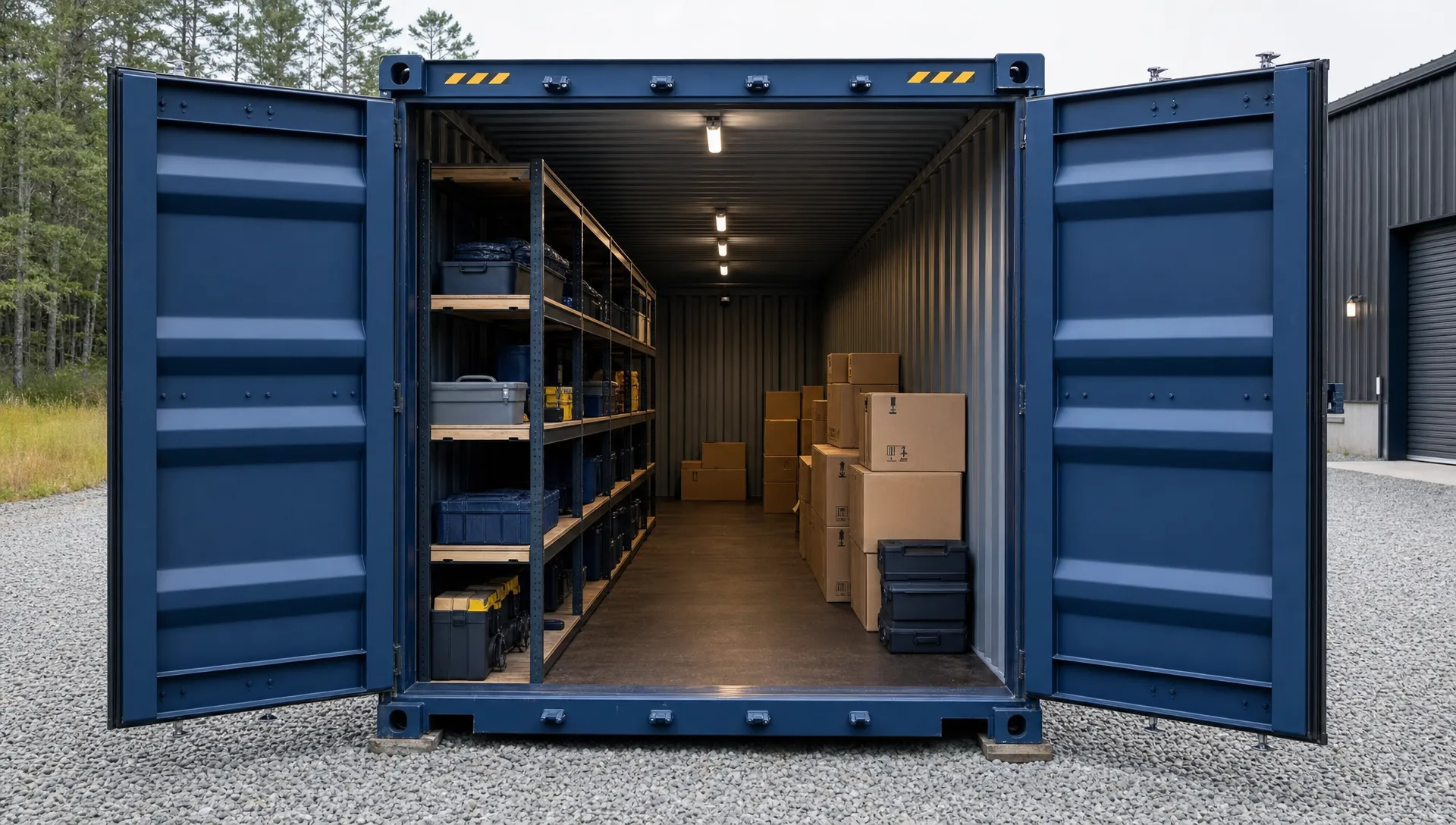
If you want a clean dry 20ft unit for general storage, this 20ft new wind and watertight container listing is a useful reference for current specs, color, checkout options, delivery details, and online pricing. The listed example shows a new one-trip 20ft WWT container priced at $3,400 before any applicable delivery or options, but always confirm current pricing on the product page before ordering.
Delivery and Site Prep for a 20 Foot Container
A 20ft container is easier to deliver than a 40ft container, but it still needs planning. Most storage problems happen before the container is unloaded, not after. The site needs to be reachable, stable, level, and clear enough for the truck to set the box where you want it.
Many deliveries use a tilt-bed, rollback, crane, or similar equipment. Exact requirements depend on the carrier, terrain, and unload method. As a practical rule, ask your supplier how much straight-line approach the truck needs before delivery day. For many tilt-bed deliveries, the driver may need 100 ft for a 20ft (120 ft for a 40ft) of clear approach, but this can vary.
Check these site factors before ordering:
- Confirm the container footprint plus door swing clearance. Plan for at least several feet in front of the doors.
- Check overhead clearance for branches, wires, roof eaves, gates, and signs.
- Place the container on compacted gravel, concrete, asphalt, railroad ties, or properly set blocks.
- Keep the corners supported and level so the doors do not bind.
- Slope the surrounding ground away from the container to reduce standing water.
- Confirm local rules before placement, especially in neighborhoods, cities, commercial sites, and coastal or high-wind areas.
Permits and zoning rules vary by city, county, HOA, and state. Some areas treat a storage container as temporary equipment. Others treat it like an accessory structure. If you plan to add electrical, plumbing, windows, insulation, or use it as occupied space, talk to your local building department before work begins.
Condensation and ventilation
A wind and watertight container keeps rain out, but moisture can still form inside. Condensation happens when humid air meets cool steel. This is common in areas with large day-night temperature swings.
For household goods, paperwork, furniture, clothing, or business inventory, consider vents, desiccants, vapor barriers, raised pallets, and airflow gaps. Do not push cardboard boxes tight against steel walls. For valuable items, use shelving and sealed bins.
Security and access
A 20ft steel container is much more secure than a wood shed, but the locking setup still matters. Look for tight doors, good gaskets, smooth locking bars, and a lockbox or shrouded hasp. Place the doors where they are visible from the home, office, or job trailer when possible.
If you visit the container daily, think about lighting, a safe walkway, and door swing in snow or mud. Small setup details make a big difference over years of use.
Best Uses for a 20ft Storage Container
The 20ft size is popular because it solves many storage problems without taking over the site. It is large enough for serious use, but still compact enough for residential, agricultural, and commercial properties.
For homeowners, a 20ft container works well during remodeling, moving, garage cleanouts, and long-term property storage. It can hold tools, furniture, seasonal items, bicycles, outdoor gear, and building materials. It is also useful when you need temporary storage during storm repairs or construction.
For contractors, it can serve as a jobsite tool crib. Shelving along one side, a workbench at the back, and a clear center aisle can turn it into a practical storage and staging area. Compared with renting off-site storage, keeping tools on the job site saves trips and improves control.
For farms and ranches, a 20ft conex box can store fencing supplies, pumps, feed tools, tack, spare parts, seed, and seasonal equipment. Rural buyers should pay close attention to delivery access, low-water crossings, soft ground, and the turn radius for the delivery truck.
For small businesses, a 20ft container can handle overflow inventory, event gear, records, supplies, and palletized goods. If you need temperature control for products such as food, flowers, or certain chemicals, a dry container may not be enough. In that case, compare dry storage with 20ft refrigerated container options and confirm power requirements before ordering.
When a 20ft container is too small
A 20ft container may feel tight if you store long lumber, pipe, vehicles, large machinery, or high-volume inventory. It can also be frustrating if multiple crews need access at the same time. If two people must work inside with carts or forklifts, the narrow interior can slow things down.
In those cases, a 40ft container, double-door unit, open-side container, or custom modular build may be a better choice. If appearance matters for a retail site, Airbnb support building, backyard office, or property development project, ask about new one-trip units and custom finish options.
Final fit checklist before you buy
Before you commit to a 20ft container, measure the site and the items you plan to store. A few minutes with a tape measure can prevent a costly delivery problem.
- Measure your widest and tallest item, then compare it with the door opening.
- Decide if you need a center aisle or full floor loading.
- Check whether a standard-height unit is enough or whether a high cube is worth finding.
- Confirm WWT, CWO, or one-trip condition based on your storage risk.
- Ask how delivery is handled in your state and whether remote or rural delivery affects cost.
- Call your local building office if the container will stay long term or be modified.
Frequently Asked Questions
What are the dimensions of a 20 foot shipping container?
A standard 20ft shipping container is 20 ft long, 8 ft wide, and 8 ft 6 in tall outside. Inside, most dry containers measure about 19 ft 4 in long, 7 ft 8 in wide, and 7 ft 10 in tall. Door openings are usually about 7 ft 8 in wide and about 7 ft 5 in to 7 ft 6 in high.
How much can you fit in a 20 foot container?
A 20ft container offers about 148 sq ft of interior floor space and roughly 1,170 cu ft of volume. In practice, capacity depends on how you load it. Shelving, center aisles, bulky furniture, pallets, and equipment reduce usable space, but the size works well for household storage, tools, farm supplies, and small business inventory.
How much does a 20ft shipping container weigh empty?
Most standard 20ft dry containers weigh about 4,800 to 5,100 lb empty. This is called tare weight. Exact weight varies by manufacturer, age, flooring, repairs, and container type. Refrigerated containers and modified containers can weigh more because of insulation, machinery, framing, or added materials.
Do I need a permit for a 20ft storage container?
Maybe. Permit rules vary by city, county, state, HOA, zoning district, and use. Some places allow temporary storage containers with few limits. Others require permits, setbacks, screening, or time limits. If you plan to modify the container or use it as occupied space, contact your local building department first.
Is a 20ft or 40ft container better for storage?
Choose a 20ft container if you need easier placement, smaller footprint, and secure storage for tools, household goods, farm supplies, or moderate inventory. Choose a 40ft container if you need more volume, long-item storage, or bulk inventory space. Delivery access and site size often decide the best option.
Can a 20ft shipping container fit in a driveway?
Often, yes, but you must check width, slope, overhead clearance, and truck access. The container itself is 8 ft wide and 20 ft long, but the delivery truck needs much more room to unload. Also confirm that the driveway surface can support the empty container plus stored weight.
Need a 20ft storage container that fits your site, budget, and delivery needs? You can browse current 20ft containers from Outback Shipping Containers and compare new, used, wind and watertight, refrigerated, and custom options with nationwide delivery support.
About Outback Shipping Containers
This guide was prepared by the Outback Shipping Containers team, based on the questions our customers ask us most when buying, modifying and taking delivery of shipping containers. Learn more about us.
Ready to find your container?
Browse our in-stock shipping containers, container homes and custom builds, or ask our team for a free quote with delivery to your site.