How to Vet USA Containers LLC and Other Container Sellers
Searching usa containers llc? Verify seller identity, container condition, payment terms and delivery details before you buy.

How to Vet USA Containers LLC and Other Container Sellers
To vet a seller found through a search for “usa containers llc,” verify the legal business, confirm what container you will receive and get the full delivered price in writing. Then check payment protections, delivery responsibilities and rejection terms. A business name, professional website or low advertised price does not establish that a particular transaction is safe.
Quick Answer: Match the seller’s legal identity to its invoice and payment instructions. Require written container specifications, condition standards, delivery charges and remedies for a nonconforming unit before sending money.
Key Takeaways
- Verify the exact business and website, not just a familiar company name.
- Separate business registration from proof of inventory and delivery capability.
- Get the condition grade, total delivered cost and substitution policy in writing.
- Confirm who handles transportation, unloading and failed-delivery charges.
- Choose payment terms that give you a practical remedy if the order goes wrong.
How to Vet USA Containers LLC Without Guesswork
This guide provides a verification process, not a verdict on a particular company. It does not establish the registration status, inventory, reputation or current operations of any business using the name USA Containers LLC.
Start by recording the exact website address, phone number, business address and legal name on the proposed invoice. Similar names can belong to unrelated businesses. An impersonator can also copy a legitimate supplier’s name, photos or branding.
Your task is to connect three things: the business taking payment, the container being sold and the party responsible for delivery. Each connection should have evidence you can save.
When evaluating USA Containers LLC or another supplier, judge the specific transaction rather than assuming that search results identify the business you intended to contact. Keep emails, quotes, inspection records and payment instructions together in one order file.
Verify Who Will Take Your Money
Check the legal entity independently
Ask for the seller’s full legal business name and state of formation. Search the relevant Secretary of State or equivalent state business registry using that name. If the seller operates under a trade name, ask how that name connects to the registered entity.
Compare the registry information with the invoice. Differences in addresses can have reasonable explanations, such as a registered-agent address or separate sales office. Unexplained differences deserve clarification before payment.
An active LLC registration establishes a legal filing status. It does not prove that the seller owns containers, maintains a depot or will honor your order. Likewise, a registered-agent address is not evidence of a container yard.
For USA Containers LLC, use the same identity checks you would apply to any supplier. Do not treat the words “USA,” “containers” or “LLC” as substitutes for verification.
Connect the website, salesperson and payee
Find a contact channel independently of the message requesting payment. Call that number to confirm the quote, salesperson and payment instructions. This matters especially when bank details change shortly before a transfer.
Ask whether the payment recipient is the seller, a financing company or another authorized party. A different name is not automatically fraudulent, but the relationship needs a clear explanation supported by paperwork.
Reviews can help identify recurring issues with communication, delivery or refunds. Give more weight to detailed accounts describing completed transactions than to short, generic praise. Check several sources rather than relying on testimonials displayed by the seller.
Save the signed quote and sales terms as files. Website terms can change, and a screenshot of an advertised price does not necessarily capture the agreement governing your purchase.
Connect the Seller’s Claims to a Real Container
Understand condition grades before comparing offers
A cargo container, conex box and intermodal container can describe the same basic product. Condition labels, however, do not mean the same thing.
| Description | What it generally indicates | What you still need to verify |
|---|---|---|
| One-trip | A relatively new container sold after an initial cargo trip | Actual condition, dents, floor marks and warranty terms |
| WWT | Wind- and watertight condition suitable for keeping weather out | Inspection scope, doors, seals, roof and exclusions |
| CWO or cargo-worthy | A condition representation intended to indicate suitability for cargo service | Who assessed it and whether your intended carrier accepts it |
| Refurbished | Some repair, repainting or other reconditioning | Exactly what work was performed and what condition standard applies |
| As-is | The seller offers limited or no condition promises, depending on the contract | Defects, inspection rights and available remedies |
A WWT representation is not the same as transport approval. A visible CSC safety approval plate also does not, by itself, establish that a container meets current examination requirements for your intended transport.
If USA Containers LLC describes a unit as “certified,” ask what was certified, by whom and against which standard. Apply that question to every seller using the term.
Ask when your specific unit will be assigned
Some suppliers sell an individually identified container. Others fulfill orders from depot inventory after payment. Either approach can work, but the allocation process must be clear.
For an identified unit, request its container number and current photos showing the doors, roof, sidewalls, interior and floor. Ask for a continuous video when an in-person inspection is impractical. A timestamp or order reference can help connect the evidence to your purchase, though images alone cannot guarantee ownership.
For a depot-selected unit, get the promised grade and specifications in writing. Ask when you will receive its identification number, whether substitutions are allowed and what happens if the delivered unit falls below the agreed standard.
Our used shipping container inspection guide covers physical checks in greater detail. Here, the key question is whether inspection evidence actually supports the seller’s contractual promises.
Ask about ownership and intended use
A broker or reseller does not have to own a depot to arrange a legitimate purchase. Ask whether the seller owns the inventory or sources it through another party, and confirm that your purchase agreement transfers ownership without undisclosed liens or other claims.
For a shipping container home or container conversion, ordinary storage suitability is not enough. Cargo history, flooring, corrosion and planned structural cuts can affect the project. Used containers need appropriate assessment before residential use.
If USA Containers LLC is supplying a unit for conversion, separate the container sale from any engineering, fabrication or permitting services. Building and zoning requirements vary by state, county and municipality. Consult local authorities before treating a container as an approved dwelling or office.
Require a Complete Quote and Written Terms
Compare delivered totals, not headline prices
A low container price can become an expensive order once transportation and placement are included. Request a quote for your exact delivery address and intended unloading location.
Compare the total delivered cost, with each charge identified. The quote should address the container, applicable taxes, transportation, unloading, special equipment and any known access-related charges. Ask whether permits, escorts, waiting time or a second delivery attempt could create additional costs.
When reviewing a quote from USA Containers LLC, confirm whether “delivery included” means delivery to your address, placement at a specific location or only transport to an accessible unloading point. Those are different commitments.
There is no reliable nationwide delivered price without a specific size, condition, origin and destination. Use written, current quotes rather than treating an old online price as a firm offer.
Our guide to finding used containers without hidden fees explains how extra charges can affect an otherwise attractive purchase.
Put remedies and substitutions in writing
Read the terms before paying, not after receiving a delivery date. The agreement should identify the promised condition, warranty coverage, cancellation rules and process for reporting defects.
Ask what happens if the seller cannot supply the advertised unit. A replacement should meet agreed specifications, and any price difference should require your approval. “Equivalent container” is too vague when height, condition or door configuration matters.
Clarify who pays transportation costs if the wrong container arrives or the unit fails the agreed standard. A replacement promise provides limited protection if the buyer must pay for collection and redelivery.
A useful request is: “Please confirm the remedy and responsibility for transport costs if the delivered unit does not meet the written order specifications.” Keep the answer with the signed agreement.
Verify Delivery Before You Commit
Match the container to your site and transport plan
Standard ISO container sizes give you a starting point for planning. Confirm the actual unit’s dimensions before preparing foundations or approving access.
| Common container size | Nominal exterior length | Nominal exterior width | Nominal exterior height | Exterior footprint |
|---|---|---|---|---|
| 20ft standard | 20 feet | 8 feet | 8 feet 6 inches | 160 square feet |
| 40ft standard | 40 feet | 8 feet | 8 feet 6 inches | 320 square feet |
| 40ft high cube | 40 feet | 8 feet | 9 feet 6 inches | 320 square feet |
These are nominal exterior dimensions, not usable interior measurements. A 40ft high cube adds 12 inches of exterior height over a standard-height 40ft container. Insulation, framing and finishes reduce interior space in a conversion.
Also request tare weight and maximum gross weight. Tare weight means the empty container’s weight. Payload capacity concerns the cargo allowance under its specifications; it does not establish how much your truck can legally move on a particular route.
For USA Containers LLC or another seller, ask whether the delivery quote assumes an empty, unmodified unit. Installed equipment or modifications can change weight and handling requirements.
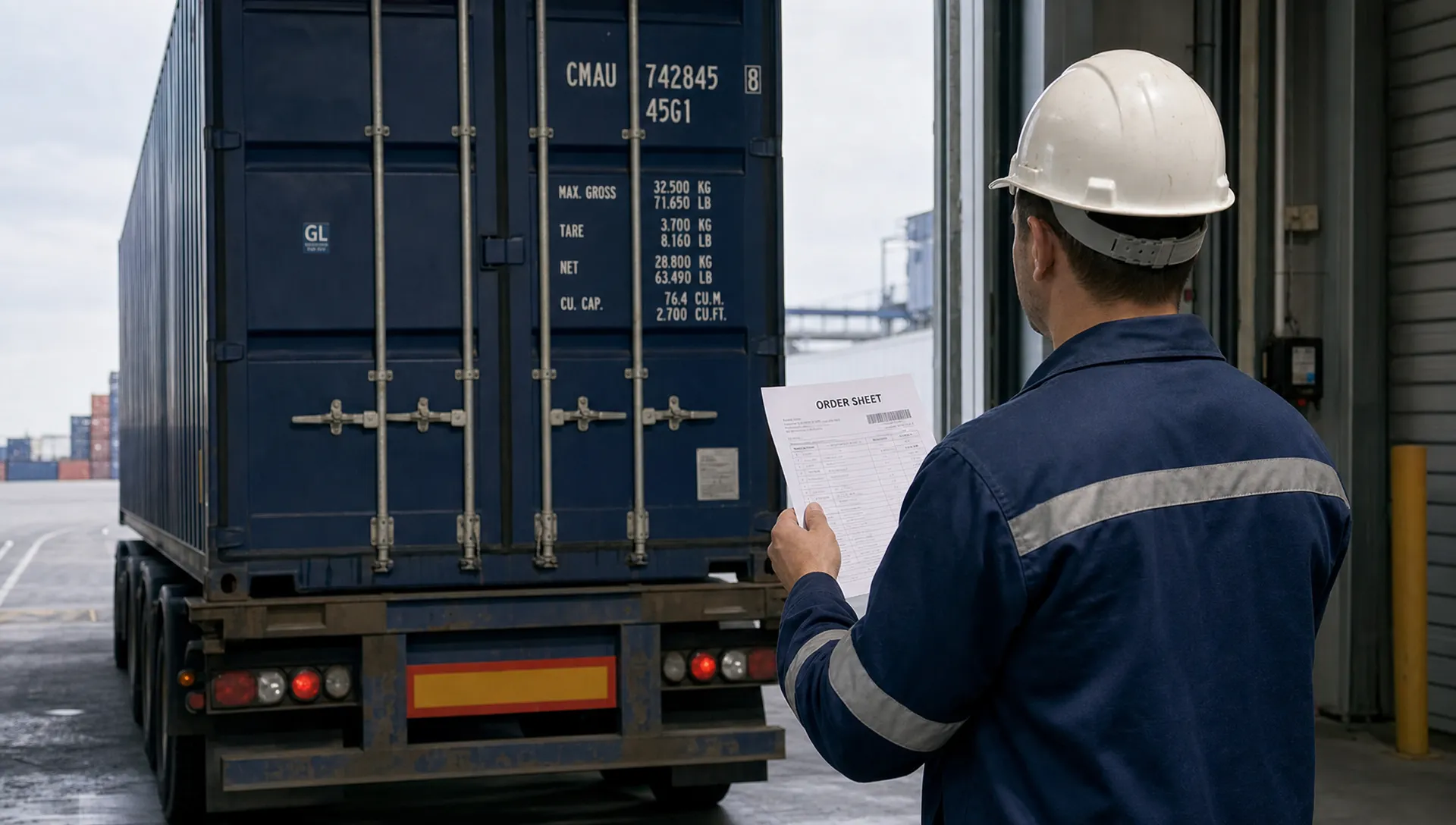
If you need a unit for a farm, workshop or job site, use our business storage container buying guide to narrow the size and condition before requesting comparable quotes.
Confirm the unloading method and carrier
Ask whether delivery uses a tilt-bed truck, side loader, crane or another method. Each has different clearance, surface and access needs. Do not assume that having room for the container means having room for the delivery vehicle.
Send photos of the driveway, entrance, overhead obstacles and placement area. Provide measurements requested by the dispatcher. Ask who decides whether the ground can support the loaded vehicle and who bears the cost if access is inadequate.
For an interstate carrier subject to federal registration, use the official FMCSA Company Snapshot to compare its identity and USDOT information with the carrier assigned to your move. The record provides identification and safety information, not a guarantee of delivery performance.
A seller may use an outside carrier. Confirm who coordinates that carrier, who handles damage claims and whom you contact if the truck cannot complete the delivery.
Use Safer Payment and Acceptance Procedures
Choose payment terms deliberately
The payment method affects your options if a transaction fails. The Federal Trade Commission’s online shopping guidance explains why shoppers should review seller details, return terms and payment protections before purchasing.
Credit cards may provide dispute rights that a wire transfer does not. Those rights depend on the transaction and applicable rules; they are not a blanket guarantee of reimbursement. Ask about accepted methods and fees before agreeing to buy.
If USA Containers LLC requests a wire transfer, verify the beneficiary and instructions through an independently confirmed contact channel. Do not rely solely on an emailed invoice, especially after an unexpected change in account details.
Full prepayment is not proof of fraud. However, it increases your exposure when identity, inventory or remedies remain unresolved. If escrow is proposed, verify the escrow provider independently rather than using an unfamiliar link supplied by the seller.
Set your pause points before sending money
Pause when important facts remain inconsistent. Examples include unexplained payee names, refusal to provide written specifications or payment pressure tied to an unusually short deadline.
A low price alone does not establish a scam. A supplier without a public retail yard can still operate legitimately. The stronger warning sign is a seller who cannot explain its business model or document its responsibilities.
Use a simple rule: do not pay until you understand who owes you the container, what qualifies as acceptable delivery and how a failure will be resolved. A missing answer is a reason to investigate, not a reason to guess.
Document delivery before signing acceptance
Arrange for someone to be present when the truck arrives. Match the container number to your paperwork when an identified unit was promised. Photograph the exterior, interior and any visible damage when it is safe to do so.
Follow the agreed inspection and rejection procedure. Do not enter a container while it is being moved or stand within the unloading area. Record discrepancies on the delivery receipt where possible and notify the seller within the contractual reporting period.
For an order from USA Containers LLC, retain the same evidence you would keep for any supplier: the quote, payment record, unit identification, delivery receipt and condition photos. These records make a later disagreement easier to assess.
Frequently Asked Questions
Is USA Containers LLC a legitimate container seller?
A business name alone is not enough to establish legitimacy, and this guide does not provide a verified finding about a particular company. Check the exact website, state registration, invoice entity and payment recipient. Then verify container availability, written sales terms and delivery responsibility for the transaction you are considering.
How can I tell if a shipping container seller is a scam?
Look for combinations of warning signs, including unexplained identity differences, payment pressure and refusal to provide written specifications. Independently verify contact information and bank instructions. Copied photos or an unusually low price deserve further checking, but neither alone proves fraud. Resolve inconsistencies before sending money.
What paperwork should I get when buying a shipping container?
Get a written quote or purchase agreement identifying the seller, size, condition grade, total charges and delivery terms. Keep warranty and cancellation terms, payment receipts and the container number when assigned. If you need the unit for freight transport, separately confirm the documentation required by your carrier.
Is WWT the same as cargo-worthy?
No. WWT means wind- and watertight and generally addresses weather protection for storage. Cargo-worthy describes suitability for cargo service, subject to the assessment and intended use. Neither label should replace a clear inspection record. Ask who made the determination and whether your carrier accepts the unit for transport.
Should I pay for a container before delivery?
Some legitimate sellers require payment before dispatch. Decide only after verifying the business, specifications, written remedies and payment instructions. Ask when the unit will be allocated and what happens if delivery fails. Consider available payment protections rather than assuming that prepayment is always safe or always fraudulent.
Compare Sellers on Evidence, Not Promises
The practical way to assess USA Containers LLC and other sellers is to compare complete transaction records. A reliable offer connects a verified business to defined container specifications, clear payment terms and an achievable delivery plan.
Outback Shipping Containers supplies new and used containers nationwide, with transparent online pricing, inspected units, wind- and watertight guarantees and financing options. Ask how those commitments apply to your selected unit and destination, just as you would with any supplier.
When you are ready to compare options, explore new and used shipping containers from Outback Shipping Containers and request written specifications and a delivered quote for your site.