How to Compare Conex Box Sellers Before Ordering
Compare conex boxes near me by seller reliability, condition, delivered cost and payment terms. Use this checklist before you order.

“conex boxes near me”: How to Compare Sellers Before Ordering
To compare sellers for conex boxes near me, request the same container size, condition grade and delivery service from each company. Then verify the business, confirm what inventory the quote covers and compare the total delivered cost. Before paying, get written terms for inspection, rejected deliveries and condition guarantees. A low advertised price alone does not establish a good deal.
Quick Answer: Choose the seller that can document the container’s condition, explain every charge and take responsibility for delivery and any covered defects. Compare at least three written quotes using identical specifications.
A conex box is a steel shipping container, also called a cargo container or intermodal container. Sellers may offer similar-looking units but very different purchase terms. Those differences matter when a truck arrives with a container you cannot use.
Key Takeaways
- Compare identical sizes, grades and delivery methods, not just advertised prices.
- Confirm whether photos show your actual unit or a representative container.
- Get unloading requirements, extra charges and defect remedies in writing.
- Verify the business and payment recipient before sending money.
- Treat missing answers as a reason to pause the purchase.
How to compare sellers for “conex boxes near me”
Establish who is responsible for the sale
Start by identifying the legal business selling the container. Ask for its business name, billing address, phone number and written purchase terms. Check those details against the invoice, website and relevant state business registry.
A registration record helps establish identity, but it does not prove good service or container quality. Read recent reviews for specific patterns: unexplained fees, condition disputes, missed deliveries or difficulty reaching support after payment.
When searching for conex boxes near me, distinguish the seller’s office address from the depot holding the inventory. A nearby office does not necessarily mean a nearby container or a lower delivery charge.
Ask whether you are dealing with a depot operator, inventory owner or reseller. Reselling containers is not inherently a problem. The important issue is who handles the order and who must resolve a dispute.
Find out what “available” actually means
Some sellers quote a specific container. Others sell from a pool of units that meet a stated grade, with the individual box assigned later. Either arrangement can work if the seller explains it before payment.
Ask whether the quote reserves a unit, how long the quote remains valid and when availability will be confirmed. If the seller assigns inventory after purchase, request its selection criteria and substitution policy.
Do not treat a website photo as proof that a particular unit is waiting for you. Establish whether it shows current inventory, a representative example or the exact container being sold.
Confirm exactly what the seller is promising
A seller found through conex boxes near me should define condition in writing rather than rely on words such as “good” or “premium.” Condition labels help organize quotes, but the promised inspection standard matters more than the label alone.
Compare condition grades and inspection evidence
Use this table to identify what you still need to verify. These are common industry descriptions, not a substitute for the seller’s contract.
| Description | What it generally indicates | What to ask the seller |
|---|---|---|
| New or one-trip | A recently manufactured container that has generally completed one loaded trip | Are handling marks or dents present, and are photos available? |
| Used WWT | Wind- and watertight condition intended to keep ordinary weather out when properly closed | What inspection supports the claim, and what remedy covers leaks? |
| Used CWO | Cargo-worthy condition assessed for transport service | What survey or documentation is supplied, and is it suitable for your intended shipment? |
| As-is | Condition sold under limited or no seller assurances, depending on the terms | What defects are disclosed, and can you inspect before payment? |
WWT does not, by itself, establish structural fitness for international cargo transport. Likewise, a cargo-worthy description does not tell you whether every required approval or examination is current.
For international freight, ask about the CSC safety approval plate and applicable examination requirements. The International Maritime Organization’s container safety guidance explains the role of the Convention for Safe Containers. Do not assume that a storage-grade box is ready for ocean shipment.
Ask for evidence that matches your intended use
Request clear views of the roof, corner posts, underside, floor, door seals and door hardware. If the photos show a specific unit, ask for its container number. Fresh paint can improve appearance without proving that the steel beneath it is sound.
For storage, prioritize leaks, floor condition and doors that open and lock correctly. For heavy cargo, verify the marked tare weight, maximum gross weight and payload capacity of the actual container. These figures vary by unit.
Your search for conex boxes near me should also account for the project beyond delivery. Standard ISO dry containers are typically 8 feet wide and 8 feet 6 inches high externally; high cube versions are 9 feet 6 inches high. A 20-foot or 40-foot label does not describe usable interior space after insulation or framing.
If you plan a shipping container home, office or workshop, the conex building planning guide can help you evaluate the conversion scope. Ask the seller what it knows about prior use and floor treatment. Permits, zoning and building-code requirements vary by state, county and municipality, so consult local authorities before buying for an occupied structure.
Compare the full delivered cost, not the headline price
Request an itemized quote
The price you need is the cost to place the agreed container at your approved location. An advertised starting price may cover only certain inventory, conditions or pickup locations.
Ask each seller to separate the container price, delivery charge, unloading service, applicable taxes and any administrative fees. Have it identify potential waiting-time, failed-delivery, redelivery or equipment charges as well.
Comparing conex boxes near me becomes much easier when every quote uses the same delivery address and site description. Give sellers the same information about gates, road surfaces, slopes and the requested placement position.
Do not compare a customer-pickup quote with a delivered-and-unloaded quote. Also confirm whether delivery means placement on your prepared supports or unloading at the nearest accessible point.
Separate financing from the purchase price
If financing is available, ask for the down payment, annual percentage rate where applicable, term length, fees and total repayment amount. Compare those figures with the cash purchase price. A smaller monthly payment can hide a longer repayment period or higher total cost.
Clarify who owns the container during the agreement and when title transfers. Ask whether the arrangement is a loan, lease or lease-to-own contract, since those structures can have different obligations.
Outback Shipping Containers offers financing options. If leasing is part of your comparison, distinguish Outback Shipping Containers, the main sales site, from LeaseLink Containers, its leasing arm. Obtain the actual agreement before judging either option by a monthly figure.
The strongest quote for conex boxes near me is not automatically the cheapest. A slightly higher documented total may be preferable to a lower quote that leaves unloading costs or defect responsibility unresolved.
Verify who will deliver and what happens on arrival
Have the carrier approve access before dispatch
A container’s footprint is not the same as the truck’s operating footprint. A trailer may need substantial room to approach, unload and leave. Requirements depend on the truck, trailer, container length and placement method.
Send photos or a site sketch showing the approach road, gate opening, overhead obstacles and unloading area. Ask the seller or carrier to provide the clearance and ground requirements for the equipment assigned to your order.
For remote property, explain private-road conditions and any seasonal access problems. Do not assume that a truck can cross a culvert, soft shoulder or narrow bridge because a pickup truck can.
When evaluating delivery promises for conex boxes near me, ask whether the proposed date is confirmed or estimated. Establish who contacts you about delays and whether the carrier will call before arrival.
Agree on the delivery inspection process
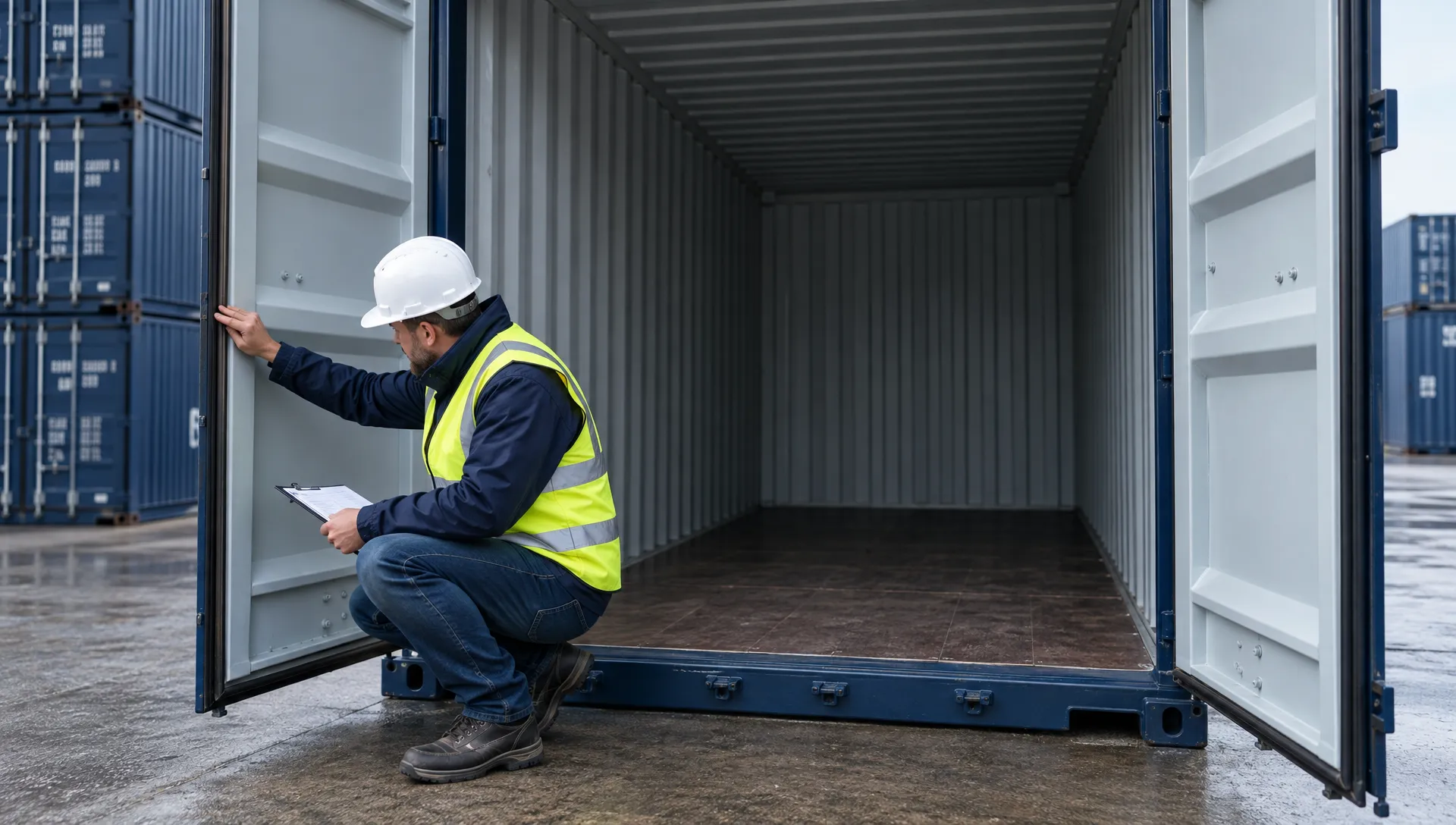
Before dispatch, ask how long you have to inspect the unit and what happens if it does not match the order. Clarify the process for documenting damage, accepting with noted exceptions or refusing delivery.
At arrival, check the container number if a specific unit was promised. Photograph all sides, inspect accessible areas and test the doors when it is safe to do so. Do not climb onto the roof or beneath an unsecured container.
Report problems promptly and follow the written notification process. Delivery receipts may record condition or acceptance, so read them before signing. Ask how any noted exception will be acknowledged by the seller.
For a like-for-like one-trip comparison, review the 20ft New Shipping Container, Wind & Watertight, Gray, a gray one-trip, cargo-worthy unit. Use its stated specifications as a starting point, then request current availability and a delivered quote for your address.
Check the contract, payment terms and after-sale support
Read the remedy, not just the guarantee
A guarantee needs a clear scope. Ask what condition is covered, how long coverage lasts, what evidence you must submit and what remedy the seller provides.
Possible remedies include repair, replacement or a refund, but do not assume any of them applies without reading the terms. Ask who pays transport costs if a replacement is needed. Moving a container can make a condition dispute expensive.
Before ordering from a conex boxes near me result, confirm whether the guarantee applies to the assigned unit and your intended use. Cutting openings, adding doors or modifying the roof may affect coverage. Get that answer before starting a container conversion.
Outback Shipping Containers states that it supplies inspected units with wind- and watertight guarantees. Buyers should still review the coverage and purchase terms attached to their particular order rather than infer details from a general website statement.
Verify payment instructions independently
Match the invoice recipient to the business you verified. If payment instructions change unexpectedly, call a previously confirmed number rather than the number included in the change request.
Pressure to pay immediately, a payment recipient unrelated to the business or refusal to provide written terms should stop the transaction. No single warning sign proves fraud, but unresolved inconsistencies are enough reason to pause.
The Federal Trade Commission’s online shopping guidance covers checking sellers, purchase terms and payment risks. Ask your payment provider what dispute protections apply to your transaction. Consumer credit-card protections should not be assumed to apply identically to every commercial purchase.
Use a seller scorecard before you decide
Put the competing quotes side by side. This scorecard focuses on evidence you can collect, rather than an arbitrary ranking or a seller’s marketing language.
| Comparison point | Evidence to collect | Reason to pause |
|---|---|---|
| Business identity | Matching business details, invoice and payment recipient | Inconsistent names or unexplained payment changes |
| Inventory commitment | Exact unit identification or written grade-based selection terms | Unclear substitutions or uncertain availability |
| Condition | Inspection details, relevant photos and written assurances | Vague labels without supporting information |
| Delivered cost | Itemized total and disclosed contingent charges | Unexplained fees or incomplete unloading scope |
| Delivery plan | Carrier-approved access and placement requirements | Promises made without reviewing the site |
| Defect resolution | Written reporting deadlines and remedies | No clear responsibility after delivery |
Use this scorecard to compare conex boxes near me without letting one attractive detail dominate the decision. Strong reviews do not replace a delivery plan, and a documented container grade does not replace clear payment terms.
Send every seller the same request
A concise request might read: “Please quote a 20-foot standard-height, one-trip container delivered and unloaded at my address. Confirm whether photos show the actual unit, list all charges and provide access requirements, estimated timing and written condition remedies.”
Change the size and grade to fit your project, but keep the wording consistent across sellers. Attach the same site photos to each request.
If one seller leaves a field unanswered, ask again before paying. The objective is not to collect the most quotes. It is to obtain several complete offers that you can compare fairly.
Frequently asked questions
Are conex boxes and shipping containers the same thing?
In common US usage, “conex box” usually means a steel shipping container used for storage or transport. Sellers also use terms such as cargo container and intermodal container. Confirm the actual size, construction and condition rather than assuming that different names indicate different products.
Is it cheaper to buy a shipping container locally?
Not always. When comparing conex boxes near me, check where the container is stored and what delivery includes. A local business may source inventory elsewhere, while a nationwide seller may use a nearby depot. Compare itemized delivered totals for the same size and condition grade.
How can I tell if a container seller is legitimate?
Check the business identity, independently confirm contact details and compare the payment recipient with the invoice. Request written specifications and purchase terms. Look for consistent reviews that describe completed deliveries and resolved problems. A business registration or polished website alone does not establish reliability.
What should I inspect before accepting a conex box?
Check that the size, grade and any promised unit number match the order. Inspect accessible steel, floor surfaces, door seals and locking hardware. Photograph visible damage and follow the agreed reporting procedure. Stay clear of unloading equipment, and do not enter or inspect beneath an unsecured container.
Does a wind- and watertight container need a CSC plate?
A wind- and watertight claim concerns condition, not current international transport approval. For a container used only as stationary storage, transport documentation may not determine suitability. For international shipping, confirm applicable CSC approval, examination status and carrier requirements rather than relying on a WWT description.
Request a quote you can compare
Before paying, make sure you can answer five questions: what you are buying, what it costs delivered, how it reaches the site, how you inspect it and who handles a covered problem.
If you are still comparing conex boxes near me, browse Outback Shipping Containers’ conex boxes for sale. Request a quote for your chosen size and condition, share your site details and use the same checklist to evaluate the offer alongside other sellers.