40ft Container Guide for Storage, Delivery and Layout
40ft container guide with dimensions, storage layouts, delivery clearance, site prep tips, and buying advice for first-time container buyers.
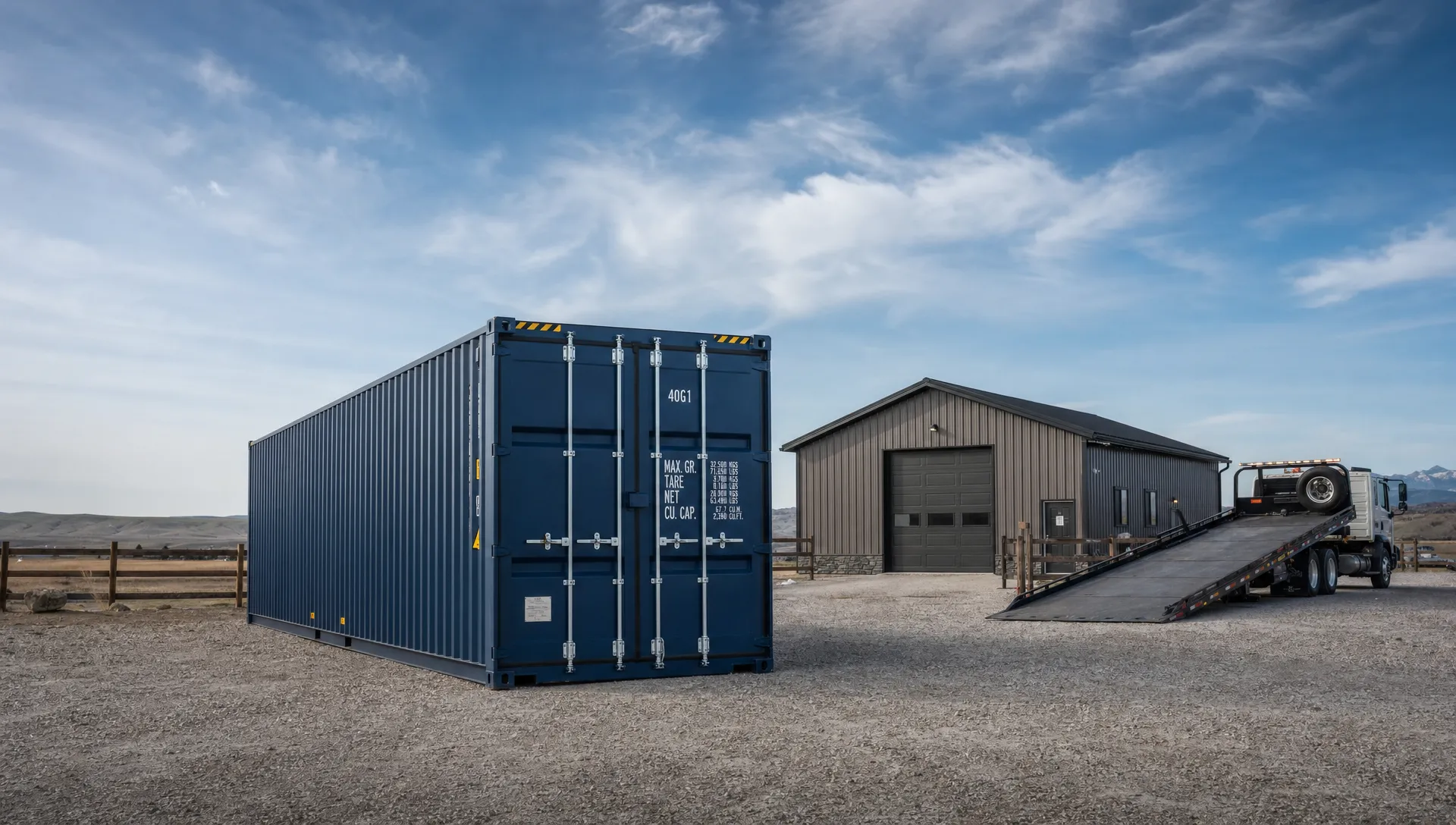
40ft Container Guide for Storage, Delivery and Layout
A 40ft container is best when you need maximum storage space, a long workshop, or a larger container conversion without buying multiple units. It gives about 300 square feet of interior floor area, roughly 2,350 to 2,390 cubic feet of storage volume, and a standard exterior footprint of 40 feet by 8 feet. The main tradeoff is delivery space. A 40ft cargo container needs more truck clearance, a firmer pad, and better site planning than a 20ft conex box.
Quick Answer: A 40ft container is a strong choice for equipment storage, farm supplies, job-site materials, retail inventory, workshops, and some shipping container home layouts. Plan for about 100 to 120 feet of straight-line delivery clearance, a level foundation, and local permit checks before the unit arrives.
Key Takeaways
- A standard 40ft ISO container is 40 feet long, 8 feet wide, and 8 feet 6 inches tall on the outside.
- Interior space is usually about 39 feet 5 inches long, 7 feet 8 inches wide, and 7 feet 10 inches tall.
- A 40ft unit gives roughly twice the storage length of a 20ft container, but it needs more delivery room.
- Used CWO or WWT containers work well for storage, while one-trip units are better for clean builds and premium conversions.
- Site prep matters. A level gravel pad, good drainage, and truck access prevent most delivery problems.
40ft Container Dimensions, Capacity and Specs
Most 40ft containers used for storage and transport are ISO intermodal containers. That means they are built to standardized freight dimensions, so they can move by ship, rail, and truck. ISO standards, including ISO 668, define classification, dimensions, and ratings for Series 1 freight containers.
Exact measurements vary slightly by manufacturer, floor thickness, and door design. Still, the table below is a reliable planning guide for a standard 40ft dry container.
| Spec | Typical 40ft Standard Container |
|---|---|
| Exterior length | 40 ft |
| Exterior width | 8 ft |
| Exterior height | 8 ft 6 in |
| Interior length | About 39 ft 5 in |
| Interior width | About 7 ft 8 in |
| Interior height | About 7 ft 10 in |
| Door opening width | About 7 ft 8 in |
| Door opening height | About 7 ft 5 in |
| Interior floor area | About 300 sq ft |
| Cubic capacity | About 2,350 to 2,390 cu ft |
| Tare weight | Often about 8,000 to 8,500 lb |
| Max gross rating | Commonly up to 67,200 lb |
| Payload capacity | Often about 57,000 to 59,000 lb |
Do not confuse payload capacity with what you can legally haul on a road. A container may be rated for heavy cargo, but truck weight limits, bridge rules, chassis limits, and state laws still apply. For stationary storage, the bigger issue is usually floor loading and how weight is spread across the wood floor and steel crossmembers.
A 40ft container is also available as a high cube. A 40ft high cube is 9 feet 6 inches tall on the outside, which gives about one extra foot of interior height. That extra height helps with palletized storage, overhead lights, insulation, loft beds, gym equipment, or workshop ventilation. If height is a major concern, compare the detailed measurements in this 40ft high cube shipping container dimensions guide.
Common condition grades
A 40ft container may be sold as new, one-trip, cargo-worthy, wind and watertight, refurbished, or as-is. These terms matter.
One-trip containers are usually the cleanest option. They have made one cargo trip from the factory and have less wear, fewer dents, and newer door gaskets. They are often preferred for container homes, retail builds, offices, and projects where appearance matters.
CWO containers, short for cargo-worthy, are used containers that can still carry freight when properly certified. They may show dents, surface rust, patches, and old shipping marks, but they remain structurally useful.
WWT containers, short for wind and watertight, are used for stationary storage. They should keep out normal rain and wind when the doors are closed, but they may not be certified for international freight.
Should You Choose a 40ft or 20ft Container?
The right container size depends on your site, storage needs, and delivery access. A 40ft container gives more space per delivery, but a 20ft container is easier to place on tight residential lots, small farms, and crowded job sites.
If you are still comparing standard sizes, Outback Shipping Containers has a broader standard container size guide for storage and builds that covers 10ft, 20ft, 40ft, high cube, and 45ft options.
| Use Case | 20ft Container | 40ft Container |
|---|---|---|
| Interior floor area | About 150 sq ft | About 300 sq ft |
| Best for | Small sites, tools, seasonal storage, tight yards | Bulk storage, equipment, workshops, large inventory |
| Delivery access | Easier on narrow lots | Needs more straight-line room |
| Cost per square foot | Often higher | Often lower, depending on market and delivery |
| Mobility after placement | Easier to reposition | Harder to move without equipment |
| Conversion potential | Compact offices, sheds, small studios | Larger offices, tiny homes, retail, workshops |
A 20ft container can be the smarter choice when your space is tight. A 40ft container makes more sense when you need to store long materials, organize inventory by zone, or build a layout with separate rooms.
For example, contractors often choose a 40ft conex box because it can hold ladders, pipe, lumber, job boxes, generators, and seasonal equipment in one secure space. Farm and ranch owners may use the same size for feed, fencing supplies, irrigation parts, tack, tools, and small implements.
Homeowners may not need the full length unless they are remodeling, moving, storing furniture, or planning a container conversion. If your main goal is simple backyard storage, review this 20 ft sea container guide for storage and delivery before committing to a 40ft unit.
Storage Layout: How to Use a 40ft Container Well
A 40ft container can turn into a cluttered tunnel if you do not plan the interior. The length is useful only when you can reach what you store. Think in zones before the container arrives.
The simplest layout is a center aisle with shelves on both sides. This works for tools, boxes, parts, supplies, and inventory. Keep the aisle at least 30 to 36 inches wide if people will carry items by hand. Use wider clearance if you plan to roll carts, pallet jacks, or small equipment inside.
Layout ideas for storage buyers
- Front-access storage: Place your most-used items within the first 8 to 12 feet near the doors.
- Seasonal zones: Store holiday items, seed, hay supplies, or event gear toward the back if you need them only a few times a year.
- Heavy-item zone: Keep heavy machines, safes, and dense pallets low and centered over the floor structure.
- Long-material lane: Reserve one side for lumber, pipe, conduit, fencing, ladders, or trim.
- Secure cage area: Add an interior lock cage for expensive tools, chemicals, or restricted materials.
A standard 40ft container can often fit around 20 standard 48-inch by 40-inch pallets in a single layer, depending on load pattern and pallet condition. Real capacity depends on packaging, forklift access, aisle space, and whether you need to reach each pallet without unloading others.
If you are storing household goods, a 40ft container can hold the contents of many multi-room homes, but volume estimates vary. Bulky furniture, appliances, mattresses, and odd-shaped items use space faster than boxes. Use moving blankets and tie-downs to protect finishes.
Moisture and airflow
Shipping containers are steel boxes. They are strong, but they can sweat when warm air hits cold steel. This is common in humid climates and during temperature swings.
Good storage planning should include ventilation, air gaps, and moisture control. Keep boxes off the walls when possible. Use pallets, shelving, or dunnage to lift items off the floor. Avoid storing wet equipment, green lumber, or damp textiles without airflow.
For long-term storage, consider vents, a small dehumidifier if power is available, desiccant packs, or insulation for sensitive items. If you store paper records, furniture, electronics, or fabrics, moisture planning is not optional.
Delivery Planning for a 40ft Cargo Container
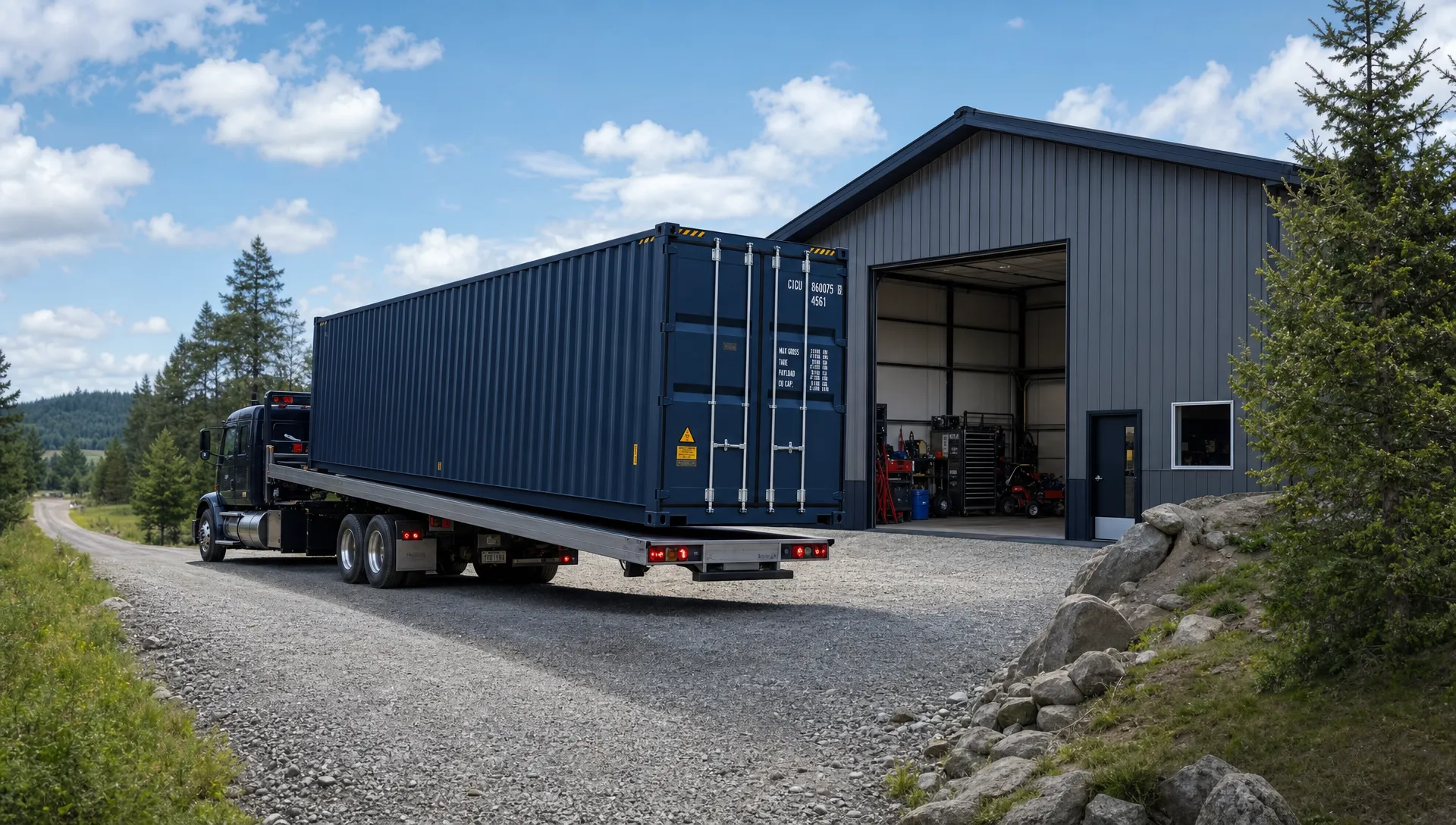
Delivery is where many first-time buyers get surprised. A 40ft container is not dropped straight down by a standard delivery truck. In most cases, it is rolled off a tilt-bed trailer. The driver tilts the trailer, sets one end of the container on the ground, then pulls forward while the container slides into place.
That process needs room. A good rule of thumb is to plan for 100 to 120 feet of straight-line clearance for a 40ft container delivery. Some sites need more. Exact requirements depend on the truck, trailer, slope, ground conditions, and approach angle.
| Delivery Factor | Practical Planning Target |
|---|---|
| Straight-line clearance | About 100 to 120 ft for tilt-bed delivery |
| Approach width | Often 12 ft or more is preferred |
| Overhead clearance | Commonly 14 to 16 ft, more is better |
| Ground surface | Firm gravel, asphalt, concrete, or dry compacted soil |
| Slope | As level as possible for safe unloading |
| Turning area | Enough room for a long truck and trailer to align straight |
Tree limbs, power lines, soft yards, fences, gates, steep driveways, and sharp turns can all block delivery. Walk the route from the public road to the pad. Measure gates and check low branches. If the truck cannot line up with the final location, you may need a crane, forklift, side-loader, or different placement plan.
Door orientation matters
Before delivery, decide which way the doors should face. This affects how the container is loaded on the truck and how it comes off the trailer. If you want the doors facing the driveway, tell the seller before dispatch.
Also think about door swing. Container cargo doors are heavy and wide. Leave enough room in front for both doors to open fully. Keep the door area slightly higher than the rear if possible, so rainwater drains away instead of toward the threshold.
Rural and remote delivery
Outback Shipping Containers serves all 50 states, including rural and remote sites. Remote delivery can work well, but it requires clear directions and honest site details. A satellite pin, driveway photos, gate measurements, and notes about road surface can help the logistics team plan the right truck.
If your property is off a dirt road, check the route after heavy rain. A loaded delivery truck is much heavier than a pickup. Soft shoulders and tight cattle guards can become real problems.
Permits and local rules
Rules vary by city, county, HOA, and state. Some areas treat a storage container as temporary equipment. Others treat it as an accessory structure. If you add plumbing, electrical, a foundation, or living space, building codes and zoning rules may apply.
For container homes or habitable conversions, check with your local building department early. If your site is near a floodplain, use the FEMA Flood Map Service Center to check flood risk before you invest in site work. Local officials, not the container seller, decide what is allowed on your parcel.
Foundation, Drainage and Long-Term Placement
A 40ft container needs support at the corners and along the base. It should not sit in mud. Poor placement can twist the frame, bind the doors, trap moisture, and speed up corrosion.
A compacted gravel pad is one of the most common options for storage use. It drains well, spreads weight, and is cheaper than a full concrete slab in many areas. Concrete piers, railroad ties, steel beams, and slab foundations can also work when designed and installed correctly.
The goal is simple: keep the container level, stable, and dry.
Basic site prep checklist
- Mark the final footprint with stakes, paint, or cones.
- Remove roots, debris, grass, and soft topsoil from the pad area.
- Create a level base with compacted gravel or another stable surface.
- Slope surrounding grade so water drains away from the container.
- Leave room to open doors, inspect walls, and maintain the roof.
- Keep vegetation trimmed so vines and wet brush do not hold moisture against the steel.
Door function is your best early warning sign. If the doors are hard to open after placement, the container may be out of level or twisted. Small adjustments under the corner castings can often solve the issue before it becomes a long-term problem.
For long-term use, do not ignore the roof. A shipping container roof is strong enough for normal service, but it is not designed as a deck without added structure. Keep standing water, leaves, and heavy debris off the top. If you plan to add solar panels, a rooftop patio, snow-load framing, or a second container, speak with a qualified engineer.
Layout Ideas for Workshops, Offices and Container Conversions
A 40ft container is popular because it gives you enough length to divide the space. You can create a tool room in front and bulk storage in back. You can frame a small office on one end and leave the rest as a workshop. You can also use the full length for a narrow studio, cabin, or retail space.
For job sites, a common layout is office plus storage. The office side may need windows, insulation, electrical service, HVAC, and interior wall panels. The storage side stays rugged for tools and materials. If fast site setup is your goal, this shipping container office guide explains practical planning steps for container offices.
Workshop layout
A 40ft workshop works best when the workbench, tool storage, and power plan are designed together. Put the main bench along one long wall. Keep bulky machines near the doors if they may move in and out. Add ventilation if you will cut, paint, weld, run engines, or store fuels.
For electrical work, use a licensed electrician. Containers are steel structures, so grounding, penetrations, conduit, and moisture protection matter. Local electrical codes apply.
Shipping container home layout
A single 40ft container can be used for a compact tiny home, studio, hunting cabin, backyard office, or rental unit where allowed. The narrow width is the main design challenge. Interior width is usually around 7 feet 8 inches before insulation and wall finishes. After framing and insulation, the finished width may be tighter.
A workable layout often places the bathroom and mechanical area near one end, the kitchen along one wall, and the living or sleeping area toward the other end. Large cutouts for windows and doors usually need structural reinforcement. Removing too much sidewall steel without engineering can weaken the container.
A high cube often makes more sense for home builds. The extra height gives more room for insulation, ceiling finishes, ducts, fans, and a less cramped feel.
Mid-article CTA: If you already know a 40ft unit fits your site, you can compare available container options from Outback Shipping Containers and request current pricing with nationwide delivery support.
Retail, farm and business layouts
Small businesses use 40ft containers for inventory, pop-up retail, mobile workshops, and back-of-house storage. Farmers and ranchers use them for fencing gear, feed, parts, tools, tack, and seasonal equipment.
For retail or customer-facing uses, appearance matters. A one-trip container or refurbished unit can reduce prep time. For farm storage, a WWT unit may be enough if the structure is solid and the doors seal well.
Buying Checklist for a 40ft Container
Container prices change with steel costs, port supply, condition, season, delivery distance, and local inventory. That is why fixed national pricing can mislead buyers. A low advertised price may exclude delivery, taxes, site issues, or condition details.
A better approach is to compare total delivered cost and confirmed condition. Ask for clear photos, grade details, delivery terms, and whether the unit is wind and watertight. Outback Shipping Containers offers transparent online shopping, financing options, inspected units, and delivery logistics across all 50 states.
Use this checklist before you buy:
- Confirm the size: standard 40ft, 40ft high cube, or another container size.
- Confirm condition: one-trip, CWO, WWT, refurbished, or as-is.
- Ask whether the unit is inspected for wind and watertight performance.
- Check door seals, locking rods, hinges, floor condition, roof dents, and patch repairs.
- Review delivery access before placing the order.
- Ask what happens if the truck cannot place the unit due to site conditions.
- Confirm payment terms, financing options, and delivery window.
- Be cautious with sellers who avoid photos, rush payment, or offer prices far below market.
If you only need a container for a short project, ask whether leasing through LeaseLink Containers, the leasing arm, may fit better than buying. If you need long-term storage, a permanent workshop, or a conversion base, buying often gives you more control.
The safest purchase is not always the cheapest unit. It is the unit that matches your use, arrives as described, and can be placed without damage to your property.
Frequently Asked Questions
How much can you fit in a 40ft container?
A standard 40ft container provides about 300 square feet of floor space and roughly 2,350 to 2,390 cubic feet of storage volume. It can often hold around 20 standard 48-inch by 40-inch pallets in one layer, depending on loading pattern, pallet condition, and aisle needs.
How much room do you need to deliver a 40ft container?
Plan for about 100 to 120 feet of straight, clear space for tilt-bed delivery. You may also need around 12 feet of approach width and 14 to 16 feet of overhead clearance. Site conditions vary, so confirm access with the delivery team before dispatch.
Is a 40ft container cheaper than two 20ft containers?
A 40ft container is often more cost-effective per square foot, but total delivered cost depends on inventory, condition, location, and freight. Two 20ft containers cost more in many cases, but they are easier to place separately and may work better on tight sites.
Do you need a permit for a 40ft shipping container?
Permit rules vary by city, county, state, and HOA. Temporary storage may be treated differently from permanent placement or habitable use. If you add utilities, a foundation, windows, plumbing, or living space, contact your local building department before buying.
What is the difference between a 40ft standard and a 40ft high cube container?
A standard 40ft container is 8 feet 6 inches tall outside. A 40ft high cube is 9 feet 6 inches tall outside. That extra foot helps with insulation, overhead storage, lighting, HVAC, taller cargo, and container home layouts that need more headroom.
Can you turn a 40ft container into a home or office?
Yes, if local zoning and building rules allow it. A 40ft container can work for a tiny home, cabin, office, studio, or workshop. Major wall cutouts, stacked designs, and habitable builds should involve qualified professionals, especially for structural reinforcement, electrical work, insulation, and code compliance.
A 40ft container is one of the most useful sizes you can buy, but it rewards careful planning. Measure your site, choose the right condition grade, think through the layout, and confirm delivery access before you order.
For help choosing a 40ft storage unit, high cube container, office shell, or custom build, start with Outback Shipping Containers and request current options for your location.