Used Storage Containers: Best Grades for Buyers
Used storage containers guide: compare WWT, cargo-worthy, refurbished, and as-is grades so you can buy the right box with fewer surprises.
Used Storage Containers: Best Grades for Buyers
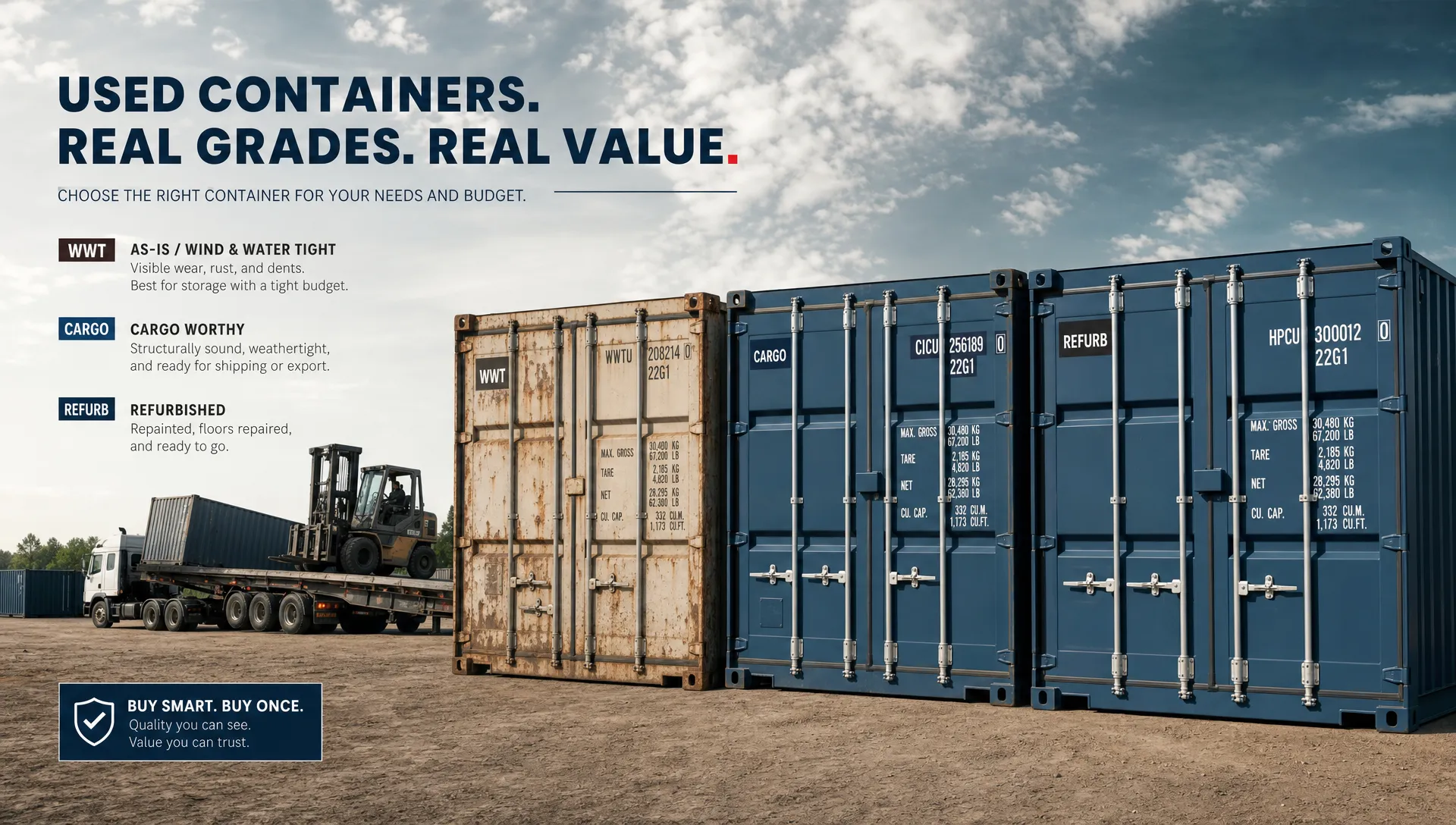
Used storage containers are best bought by grade, not just by price. For most homeowners, farms, contractors, and small businesses, a WWT (wind and watertight) container is the best value for dry storage. Choose cargo-worthy if it may travel loaded again, refurbished if appearance matters, and as-is only if you can inspect it and accept repair risk.
Quick Answer: The best used storage container grade for general storage is usually WWT because it should keep out wind and rain at a lower cost than cargo-worthy or one-trip containers. Cargo-worthy is better for transport. Refurbished is better for customer-facing sites. As-is is the riskiest grade.
Key Takeaways
- WWT containers are the usual sweet spot for tools, furniture, feed, records, inventory, and job-site storage.
- Cargo-worthy containers cost more because they must meet a higher structural standard for freight use.
- Refurbished containers are used units that have been repaired, repainted, or both, which makes them better for visible sites.
- As-is containers can be cheap upfront, but leaks, bad floors, and hard-to-open doors can erase the savings.
- Always compare the delivered price, not just the container price at the depot.
Best Grades for Used Storage Containers
A shipping container is also called a cargo container, conex box, ISO container, or intermodal container. The names change by industry, but buyers usually care about the same things: Will it stay dry? Are the doors usable? Is the floor solid? Can it be delivered without surprises?
Used containers are not graded like used cars. There is no single national retail grading system that every seller follows in the same way. Still, most reputable sellers use common condition terms. Outback Shipping Containers also provides certified inspected units with wind and watertight guarantees, which matters when you are buying sight unseen or ordering for a rural site.
Here is the practical grade ladder most buyers should understand.
| Grade | Best for | What it usually means | Main risk |
|---|---|---|---|
| One-trip / new | Clean builds, offices, container homes, premium storage | Used once for cargo, newer paint, fewer dents | Higher price than used grades |
| IICL / premium cargo-worthy | Freight, export, high-value storage, conversions | Strong used unit repaired to a stricter leasing standard | May be more grade than you need for basic storage |
| Cargo-worthy / CWO | Loaded transport, heavy storage, business inventory | Structurally sound enough for cargo use when properly certified | Appearance can still be rough |
| WWT | Home, farm, ranch, job-site, and business storage | Wind and watertight, doors seal, roof should not leak | Not always certified for ocean or rail freight |
| Refurbished | Retail, office, visible property, Airbnb support use | Used unit repaired, cleaned, and often repainted | Quality depends on what work was done |
| As-is | Scrap use, short-term low-value storage, repair projects | Sold with no strong condition promise | Leaks, rust, floor damage, door problems |
If you want a deeper breakdown of grading language, Outback’s guide to shipping container condition grades explains how one-trip, cargo-worthy, WWT, and as-is units compare.
What Each Grade Means in Real Buying Terms
WWT: The best fit for most storage buyers
WWT stands for wind and watertight. It means the container should keep weather out when the doors are closed and sealed. For a buyer using the unit as a backyard shed, construction storage box, farm supply container, or small business inventory space, this is often enough.
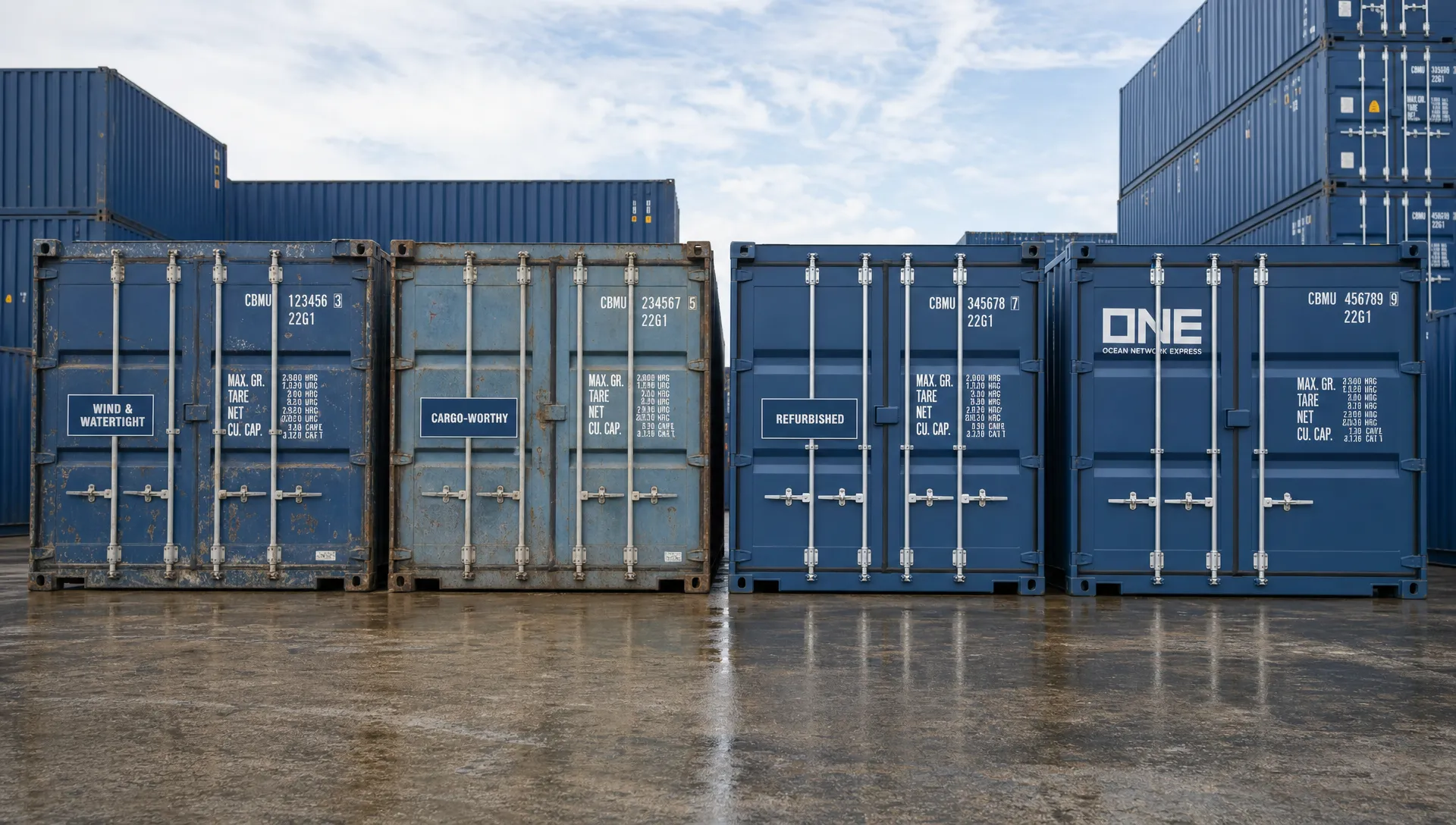
A good WWT container will have working cargo doors, intact door gaskets, no daylight through the roof or walls, and a floor that can handle normal storage loads. It may have dents, faded paint, patches, surface rust, labels, and previous cargo marks. That is normal for a used storage container.
WWT is not the same as cargo-worthy. A WWT unit may not have current approval for loaded international shipping. That does not matter if it will sit on your property. It does matter if you plan to load it with goods and move it by truck, rail, or ship.
Choose WWT if you need secure, dry storage for:
- Tools, equipment, furniture, seasonal items, feed, or records.
- Construction materials and job-site supplies.
- Farm and ranch equipment that needs weather protection.
- Small business inventory that does not require climate control.
Cargo-worthy: Best when the container may move loaded
Cargo-worthy, often written CW or CWO, means the container is structurally fit for cargo transport at the time of inspection. It should have sound corner posts, rails, crossmembers, doors, locking gear, and flooring. It may still show dents, rust, and worn paint.
Cargo-worthy matters if the container might be used again as an intermodal container. That means it may travel by truck, rail, or ship while loaded. A current CSC plate and valid inspection status are part of that conversation. The International Maritime Organization explains the role of the International Convention for Safe Containers, which is the safety framework behind CSC approval.
For pure stationary storage, cargo-worthy may be more than you need. But it can be a smart choice when the contents are high value, the container may be relocated, or the structure will be modified into a workshop or container conversion.
IICL: A higher used grade
IICL standards come from the Institute of International Container Lessors. In the used container market, an IICL-grade unit is usually a higher-quality used container that has been maintained for leasing or shipping service.
Most first-time buyers do not need IICL for backyard or farm storage. It can make sense for companies that want a cleaner, stronger used unit without paying one-trip pricing. It may also be worth considering for modular offices, workshops, or higher-end container conversion projects where a better starting shell saves repair time.
Refurbished: Better appearance with used-container value
A refurbished container is still used, but it has received repairs, repainting, or other cosmetic improvements. This grade is useful when the container will sit where customers, tenants, neighbors, or inspectors may see it.
Ask what “refurbished” includes. Some sellers mean patched and painted. Others mean door gasket repairs, floor touch-ups, rust treatment, primer, and a full exterior repaint. The word alone is not enough. You want the work described in writing.
Refurbished units often suit retail storage, farm stores, job-site offices, schools, parks departments, and property managers. They can also be a good base for a shipping container home or tiny home when budget matters but you do not want a rough-looking shell.
As-is: Only for buyers who can handle problems
As-is containers are sold without a strong condition guarantee. Some are still useful. Others have holes, bent doors, floor rot, missing parts, severe corrosion, or structural damage.
The danger is not just the repair cost. It is the time lost after delivery. A leaking roof can damage stored items. A twisted frame can make doors hard to close. A weak floor can be unsafe for heavy equipment or palletized goods.
As-is can make sense for non-critical uses, repair-minded buyers, or projects where the container will be heavily cut apart. It is not the best choice for a first-time buyer storing valuables.
Size, Weight, and Capacity: Match the Grade to the Job
Condition grade is only half of the decision. Size matters just as much. Most buyers compare 20ft and 40ft containers first. A 40ft high cube adds extra height and can be useful for equipment, shelving, or conversion work.
Standard container dimensions are based on international freight container standards. ISO publishes the framework for Series 1 freight containers under ISO 668, though exact interior dimensions and ratings can vary by manufacturer.
| Container size | Common exterior dimensions | Approx. interior length | Typical tare weight range | Best use |
|---|---|---|---|---|
| 10ft standard | 10ft x 8ft x 8ft 6in | About 9ft 3in | Varies by build | Tight sites, residential storage, small tools |
| 20ft standard | 20ft x 8ft x 8ft 6in | About 19ft 4in | About 4,800 to 5,100 lb | Home, farm, job-site, and small business storage |
| 40ft standard | 40ft x 8ft x 8ft 6in | About 39ft 5in | About 8,000 to 8,500 lb | Bulk storage, contractors, inventory, equipment |
| 40ft high cube | 40ft x 8ft x 9ft 6in | About 39ft 5in | About 8,500 to 9,000 lb | Taller items, shelving, workshops, conversions |
| 45ft high cube | 45ft x 8ft x 9ft 6in | About 44ft 5in | Varies by manufacturer | Large-volume storage and specialty builds |
Tare weight is the empty weight of the container. Payload capacity is the weight it can carry when used for freight. Always check the data plate on the actual unit if you plan to load heavy materials such as stone, tile, dense metal parts, batteries, liquids, or bagged feed.
For stationary storage, most buyers run out of floor space before they hit payload limits. The bigger concern is usually floor condition. Look for soft spots, delamination, heavy oil staining, holes, and repairs that were done poorly.
Grade by Buyer Type: What Should You Buy?
Different buyers need different risk levels. A homeowner storing patio furniture does not need the same grade as a logistics manager shipping machinery. A contractor storing power tools on a job site needs security and dry space more than perfect paint.
| Buyer type | Best grade | Why it fits | Grade to avoid |
|---|---|---|---|
| Homeowner or DIY buyer | WWT or refurbished | Good weather protection, reasonable cost, better appearance if visible | As-is for valuables |
| Contractor | WWT or cargo-worthy | Secure job-site storage, stronger structure if moved often | Cheap as-is units with door issues |
| Farm or ranch owner | WWT | Dry storage for feed, parts, tools, fencing, and seasonal gear | Leaky as-is units |
| Logistics manager | Cargo-worthy or IICL | Better fit for transport, loading, and higher-value cargo | WWT if freight certification is needed |
| Retail or small business | Refurbished or WWT | Cleaner look for customer-facing or staff areas | Rough as-is units near customers |
| Container home or office builder | One-trip, refurbished, or higher-grade used | Better shell reduces repair work before conversion | Unknown as-is shells |
If you are still comparing new versus used, Outback’s new vs used shipping container guide is a helpful next step. It explains when paying more upfront may save time later.
Inspection Checklist Before You Buy
A used container can look fine from ten feet away and still have problems. Good sellers inspect units before sale. Still, you should know what to ask for, especially if you are buying online or from a depot far from your site.
Start with the roof. Many leaks come from roof dents that hold water. Walk around the container and look for daylight from inside if photos or inspection access are available. Small pinholes matter because one rainstorm can damage contents.
Next, check the doors. Used container doors are heavy. They should open, close, and lock without a fight. Bent locking rods, damaged hinges, and bad gaskets are common issues on rough units.
Use this short checklist before you approve a used storage container:
- Confirm the grade in writing, such as WWT, cargo-worthy, refurbished, or as-is.
- Ask whether the unit has been inspected for leaks, roof holes, and door seal problems.
- Request current photos of all sides, the roof if available, the floor, door gaskets, and locking rods.
- Check whether the floor is solid enough for your intended load.
- Ask what is included in the delivered price, including taxes, delivery, and special equipment.
For a more detailed buying process, keep Outback’s used shipping container checklist handy while you compare sellers.
Red flags that should slow you down
Be careful with sellers who only show stock photos. A stock photo may not match the container that arrives. Also be careful if the seller will not define the grade or will not put the condition promise in writing.
A very low price can be real, but it can also hide delivery fees, poor condition, or a scam. Compare the full delivered price. A container sitting at a depot does not help you until it is placed on your property.
Price, Delivery, and Site Prep Matter as Much as Grade
Container pricing changes by size, condition, market, location, and delivery distance. Because of that, a national price without delivery can be misleading. A cheap container two states away can cost more than a better unit from a closer depot once trucking is included.
The cleanest comparison is delivered total cost. That means container price, delivery, taxes, site requirements, and any equipment needed for placement. Outback Shipping Containers supports transparent online shopping with instant quotes, which helps reduce the guesswork.
Delivery planning is where many first-time buyers get surprised. A 20ft container may need a tilt-bed truck, rollback, crane, forklift, or other equipment depending on the site and seller. A 40ft container usually needs more room to unload and turn.
Before delivery, confirm these points:
- The truck can access the road, driveway, gate, and final drop area.
- The site is firm, level, and free of low wires, branches, septic lids, and soft ground.
- You know which way the doors should face before the truck arrives.
- You have blocking, gravel, railroad ties, or concrete pads ready if needed.
- Local rules allow container placement, especially in neighborhoods, commercial zones, or near property lines.
Permits and zoning rules vary by city, county, and state. A storage container on a farm may be treated very differently from a container office, pool, cabin, or shipping container home. Always check with your local building department, zoning office, HOA, or fire authority before you buy for a permanent or converted use.
If you are comparing nearby sellers, Outback’s guide on how to shop storage containers in your area explains how to compare size, condition, delivered cost, and seller credibility.
When to Spend More and When to Save
The best grade is not always the highest grade. It is the grade that matches the risk of your use. A used 20ft WWT conex box behind a barn does not need showroom paint. A container that will sit near customers may need a cleaner refurbished finish.
Spend more when the contents are valuable, the site is visible, the container will be moved later, or the unit will become a workshop, modular office, cabin, or container home. Better doors, better floors, and fewer rust issues can save labor.
Save money when the container is for basic dry storage, the location is not visible, and minor dents or faded paint do not matter. In that case, WWT often gives the best balance.
As-is is the one grade where “saving” can backfire fast. If you need secure storage right away, avoid repair projects. A container that needs welding, door repair, roof patching, and floor work may cost more in time than the next grade up.
If buying does not fit your timeline or budget, ask whether leasing is a better short-term option. Outback Shipping Containers is the main site, while LeaseLink Containers is the leasing arm. Leasing can make sense for temporary construction projects, seasonal inventory, or short-term overflow storage.
Frequently Asked Questions
What is the best grade for used storage containers?
WWT is usually the best grade for used storage containers used for stationary dry storage. It should protect contents from wind and rain without the higher cost of cargo-worthy or one-trip units. Choose cargo-worthy if the container will move loaded or must meet freight requirements.
Is WWT better than cargo-worthy?
WWT is better for most stationary storage because it costs less and focuses on weather protection. Cargo-worthy is better if the container must be structurally approved for cargo transport. A cargo-worthy unit can also be WWT, but a WWT unit is not always cargo-worthy.
Are as-is shipping containers worth buying?
As-is containers are only worth buying if you can inspect them, accept leaks or damage, and handle repairs. They can work for low-value storage or projects where the shell will be modified. First-time buyers storing valuables should usually avoid as-is units.
What should I look for when buying a used shipping container?
Check the roof, door gaskets, locking rods, floor, corner posts, and underside if possible. Ask for the condition grade in writing and confirm whether the unit is WWT, cargo-worthy, refurbished, or as-is. Also compare delivered cost, not just the depot price.
Do used storage containers need permits?
Permit rules depend on your city, county, state, zoning district, and intended use. Temporary storage may be treated differently from a permanent structure, office, pool, cabin, or container home. Always check with local authorities before delivery, especially in residential areas or commercial sites.
Should I buy a 20ft or 40ft used storage container?
Buy a 20ft container if access is tight or you need basic storage. Buy a 40ft container if you need more floor space and have room for delivery. A 40ft high cube adds extra height for shelving, equipment, workshops, and some conversion projects.
Final Recommendation: Buy the Lowest Grade That Safely Fits the Job
For most buyers, the answer is simple: choose WWT for storage, cargo-worthy for transport, refurbished for appearance, and as-is only when you are ready for repairs. Do not buy by price alone. Buy by condition, delivered cost, and the risk level of what you are storing.
Outback Shipping Containers supplies new, used, and custom containers nationwide, including remote and rural delivery across all 50 states. If you want an inspected unit with clear pricing and support through delivery, start by reviewing options from Outback Shipping Containers and ask which used grade best fits your site, budget, and timeline.