Reefer Container Electrical Requirements: Complete Guide
By Outback Container Experts · Published July 30, 2026 · Last updated October 21, 2026

Buying a refrigerated container—commonly known as a reefer—is the fastest way to add high-capacity cold storage to your facility. However, most first-time buyers are surprised to find that these units cannot simply be plugged into a standard wall outlet. Unlike a domestic freezer, an industrial 40ft HC WORKING Refrigerated Container requires a dedicated single-phase 240V circuit to drive its heavy-duty compressor. Failing to prepare your site's electrical infrastructure can lead to expensive delays, especially during July heatwaves when cold storage demand peaks. This reefer container electrical requirements guide will break down exactly what you need to tell your electrician before your unit arrives.
Table of Contents
- reefer container electrical requirements guide: The Core Requirement: Single-Phase 240V Power
- Voltage and Amperage: Single-Phase 220/240V Requirements
- Reefer Container Plug Types and Connections
- Generator Power and Field Use
- Circuit Breaker Sizing and Protection Protocols
- Phase Rotation and Motor Directionality
- Cable Management and Environmental Considerations
- Frequently Asked Questions
- Explore Related Products & Guides
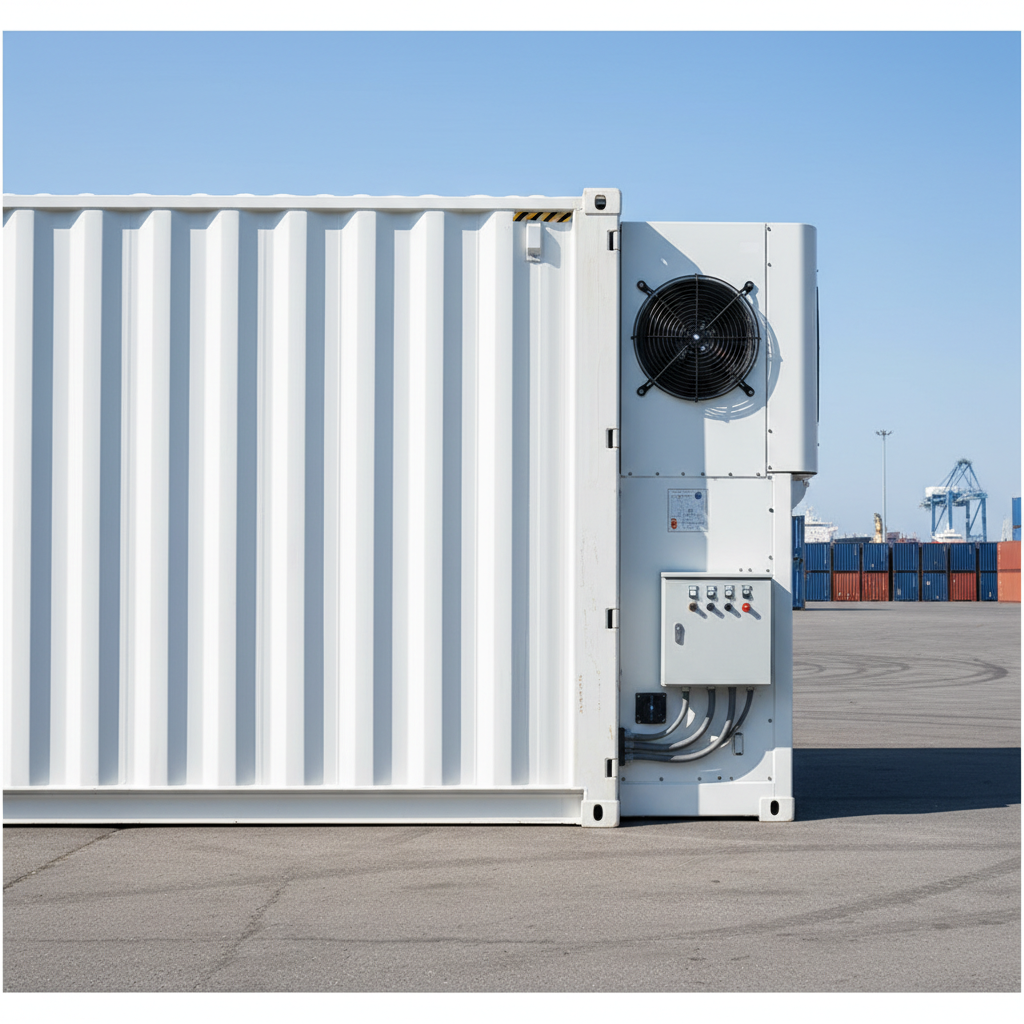
reefer container electrical requirements guide: The Core Requirement: Single-Phase 240V Power
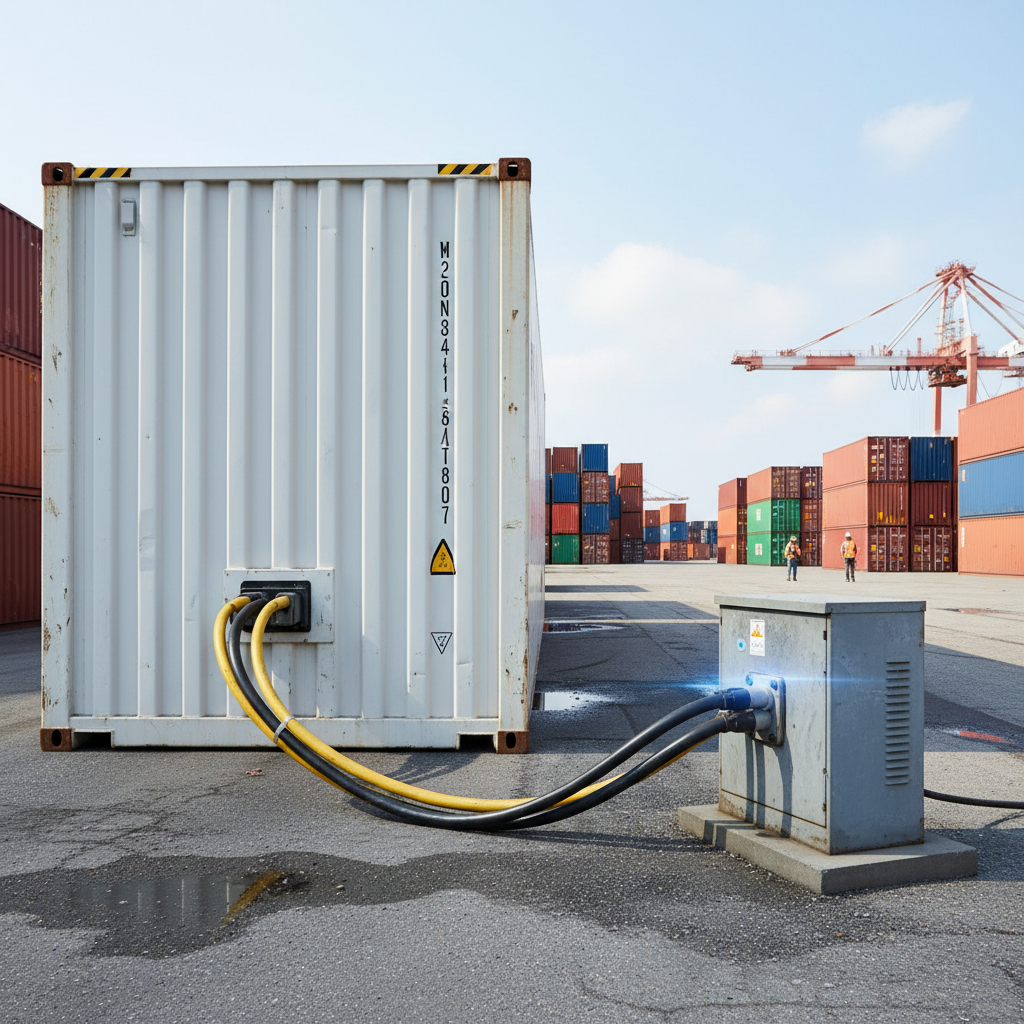
The most critical factor in this reefer container electrical requirements guide is understanding that Outback refrigeration units—whether from Carrier, Thermo King, or Daikin—operate on single-phase 220/240V power for shipping containers. Single-phase power, which is what feeds most residential and light commercial buildings, is generally insufficient for the high-torque start-up needs of a reefer compressor.
Because our units run on standard single-phase 240V power, no 3-phase service or phase converter is needed to connect your Single-Phase 20ft Refurbished Refrigerated Container. For the vast majority of standard refrigerated containers, you will need to ensure your facility can provide a dedicated single-phase 240V circuit.
Voltage and Amperage: Single-Phase 220/240V Requirements
Modern reefer units run efficiently on standard single-phase 220/240V, 60 Hz power. Understanding the shipping container refrigeration unit voltage at your site is the first step in determining if you need a step-up or step-down transformer.
- Single-Phase 220/240V: The standard supply for our reefer containers. It allows the unit to pull fewer amps, reducing heat in the wires and improving longevity.
- Dedicated 50A or 60A Circuit: Sized for standard reefers or blast freezer units. While most reefers can run on this, they pull significantly more amperage and often require a dedicated transformer for refrigerated container stability.
- Frequency: Most units are designed for 60Hz (North America) but are compatible with 50Hz (International) with slight performance variations.
| Parameter | Single-Phase 240V Requirement | 230V Requirement |
|---|---|---|
| Circuit Breaker | 30 Amp | 50-60 Amp |
| Max Power Draw (Startup) | 15-18 kW | 15-18 kW |
| Running Amps (Avg) | 8-12 Amps | 20-25 Amps |
| Plug Type | 4-Pin 32A (ISO) | 4-Pin 50A (Specialized) |
Important: Never attempt to 'hardwire' a reefer container directly to a panel without a disconnect switch. The vibration from the compressor and the need for periodic maintenance require a proper industrial plug and a dedicated disconnect within line-of-sight of the unit.
Reefer Container Plug Types and Connections
The reefer container plug type is a specific industrial 4-pin configuration. In the shipping industry, the standard is a 32-Amp, 4-pole, 3-wire plus earth (ground) plug that meets ISO standards. If you are buying a Maersk RAHC-031 Used 40ft Cold Storage Reefer Container, it will likely come with a 50-foot to 60-foot power cable already attached.
When discussing portable cold storage power needs with your electrician, ensure they install a matching female receptacle (usually a CEEform or similar UL-listed industrial socket). Because the container runs directly on single-phase 240V power, no 3-phase service or phase converter is needed and no step-up transformer is required. Attempting to run a unit on the wrong voltage will likely burn out the contactors or the compressor motor.
Generator Power and Field Use
If you are using a reefer for an event or at a remote site without grid access, you must know how to connect a reefer container to a generator. You cannot use a standard 'job site' generator. You need a single-phase 240V generator sized for the circuit to handle the in-rush current when the compressor kicks on. For more on site prep, see our guide on shipping container transport options and site rules.
Circuit Breaker Sizing and Protection Protocols
Correct circuit breaker selection is the first line of defense in protecting the expensive scroll compressors and fan motors inside a refrigerated container. For a standard single-phase 240V system, most manufacturers specify a dedicated 50-amp 2-pole circuit breaker. The delayed-trip or 'High-Inrush' characteristic is critical because reefer units pull a significant current spike—often 3 to 4 times the running amperage—the moment the compressor cycles on. Using a standard household-style breaker will result in frequent nuisance tripping, which risks thawing the cargo during unattended operation.
When running blast freezers or deep-freeze units on single-phase 240V power, a 60-amp 2-pole breaker is required. It is also imperative that the reefer unit is the only equipment on that specific circuit. In industrial settings, daisy-chaining multiple containers or sharing a circuit with high-load machinery like hydraulic balers or welders can cause voltage sags. These sags lead to overheating in the reefer's motor windings, eventually causing premature failure of the Carrier or Thermo King controller boards.
| Parameter | Single-Phase 240V Configuration | 230V Configuration |
|---|---|---|
| Full Load Amps (FLA) | 10 - 15 Amps | 20 - 30 Amps |
| Recommended Breaker | 25A or 30A (Type D) | 50A (Type D) |
| Wire Gauge (up to 50ft) | 10 AWG | 8 AWG |
| Nuisance Trip Risk | Low | High if undersized |
Important: Never bypass the internal circuit breaker of the reefer unit. If the unit continues to trip the main panel breaker while the unit breaker remains closed, you likely have a ground fault in the power cable or a phase imbalance in your facility's supply.
Phase Rotation and Motor Directionality
Because our reefer containers run on single-phase 240V power, phase rotation is not a concern when connecting the unit. If the phases are reversed (L1-L3-L2 instead of L1-L2-L3), the condenser fans and the compressor may run backwards. While modern digital controllers from brands like Daikin or Star Cool feature phase-correction logic that automatically adjusts the internal wiring, older analog units or 'working-as-is' surplus containers may not. Running a compressor in reverse for even a short period can lead to lubrication failure and catastrophic mechanical seizing.
Before finalizing a permanent installation, a certified electrician should use a phase rotation meter at the receptacle. If the unit's controller displays a 'Phase Error' or 'Low Pressure' alarm immediately upon startup, the first troubleshooting step should be swapping any two of the three hot wires at the plug or disconnect box. Proper phase alignment ensures that air is drawn through the condenser coils and exhausted away from the unit, which is vital for maintaining the thermal efficiency of the R-134a or R-404A refrigerant cycle.
- Check for 'Clockwise' phase rotation at the wall outlet using a sequencer.
- Observe condenser fan direction: Air should be blowing out, away from the container.
- Verify that the phase monitoring relay on the control panel shows a green 'Good' status.
- Ensure the ground wire (green) is never swapped with a hot leg during phase correction.
Tip: If you are using a portable generator (Genset) for a cross-country haul, ensure the generator is grounded to the container chassis to prevent static buildup that can fry the digital display components.
Cable Management and Environmental Considerations
The power cable of a reefer container, often called the 'Tir-cord,' is a heavy-duty 4-conductor 10/4 or 8/4 SOOW cable designed for extreme weather. However, in long-term static storage applications, these cables are often the weakest link. Cables should never be left coiled while the unit is under load; a coiled cable acts as an inductor, generating significant heat that can melt the outer jacket and lead to a short circuit. If the reach to the power source is shorter than the provided 50-foot or 60-foot cable, lay the excess in a 'figure-eight' pattern on the ground to dissipate heat.
Environmental protection for the connection point is equally important, especially in coastal or high-humidity regions where salt-air corrosion can increase resistance at the plug pins. Increased resistance leads to heat, which can weld the plug into the socket. Using a marine-grade, non-conductive dielectric grease on the pins of the ISO-standard 4-pin plug can prevent oxidation and ensure a watertight seal when the locking ring is engaged.
- Inspect the plug pins for signs of pitting, carbon buildup, or discoloration.
- Ensure the cable entry gland at the container's control box is tight to prevent moisture ingress.
- Utilize a 'drip loop' in the cable so that rainwater runs off the wire rather than into the receptacle.
- Confirm the cable is rated for UV exposure if it will be lying on asphalt in direct sunlight.
Tip: For facilities housing multiple containers, install a master emergency power-off (EPO) switch. This allows for rapid shutdown of all high-voltage lines in the event of a refrigerant leak or electrical fire.
Container delivery near you
We deliver to every state in the lower 48 plus Alaska and Hawaii. These local pages list pricing, metro coverage and typical lead times for the areas we run into most:
- Shipping containers near me — how we source from the depot closest to your ZIP code
- Shipping containers in Georgia — pricing and delivery to Atlanta and Savannah
- Shipping containers in North Carolina — pricing and delivery to Charlotte and Raleigh
- Shipping containers in Arizona — pricing and delivery to Phoenix and Tucson
- Shipping containers in Washington — pricing and delivery to Seattle and Spokane
- Shipping containers in Colorado — pricing and delivery to Denver and Colorado Springs
- Shipping containers Houston — local yard stock and lead times
Frequently Asked Questions
- What power does a 40ft reefer container need? It requires a dedicated single-phase 240V, 50-amp circuit for optimal performance.
- Can I run a refrigerated container on single phase power? Only if you purchase a unit specifically modified with a single-phase compressor. Our reefer containers run on single-phase 220/240V power, so no 3-phase service or phase converter is needed.
- How many amps does a reefer container pull? On single-phase 240V power, it requires a dedicated 50-amp breaker for standard reefers or a 60-amp breaker for blast freezers.
- What circuit breaker is needed for a reefer unit? A 50-amp 2-pole breaker is standard for regular reefers; 60 amps for blast freezers on a 240V single-phase circuit.
- How to connect a reefer container to a generator? Use a single-phase 240V generator sized for the circuit and a 250V/50A grounded receptacle or hard-wired connection.
- Do refrigerated containers need a special outlet? Yes, they use an industrial CEE 4-pin 32A socket, not a standard NEMA wall outlet.
- What is the typical reefer container power consumption kw? Most units consume between 4kW and 6kW per hour once they reach their set-point temperature.
- Is a permit required for the electrical hookup? Generally yes. Most local AHJs (Authorities Having Jurisdiction) require an electrical permit for a new dedicated 240V single-phase sub-panel or disconnect. Check our shipping container permit requirements by state for more context.
Proper electrical setup is the most important part of cold storage longevity. Beyond the power, make sure you understand the difference in container conditions by reading our one-trip vs WWT containers guide. If you're ready to compare inventory for your project, our team can pull matching units from our nationwide depots and provide the specific electrical spec sheet for your selected unit to share with your contractor.
Explore Related Products & Guides
Frequently Asked Questions
What power does a 40ft reefer container need?
A standard 40ft High Cube reefer requires single-phase 240V power with a dedicated 50-amp 2-pole circuit breaker. Each reefer unit runs efficiently on single-phase 220/240V, 60 Hz power as the standard configuration.
Can I run a refrigerated container on single phase power?
Standard ISO reefer units cannot run on single-phase power. You would need a unit specifically retrofitted with a single-phase motor and compressor, which are available but less common in the used market.
How many amps does a reefer container pull?
While running on single-phase 240V power, a reefer requires a dedicated 50-amp 2-pole breaker to handle operating loads. However, during the initial compressor start-up, the draw can briefly spike much higher, necessitating a dedicated breaker.
What circuit breaker is needed for a reefer unit?
For a standard single-phase 240V installation, a 50-amp, 2-pole circuit breaker is required. If running on 230V, you will need a 50-amp or 60-amp breaker to handle the increased amperage.
How to connect a reefer container to a generator?
You must use a single-phase 240V generator sized for the circuit. The container's power cable is plugged into a matching 4-pin receptacle on the generator's distribution panel.
Do refrigerated containers need a special outlet?
Yes. They utilize a specialized 4-pin, 32-amp ISO-standard industrial plug. This is not compatible with residential dryer outlets or standard 110V/220V wall sockets.
Frequently asked questions
What power does a 40ft reefer container need?
A standard 40ft High Cube reefer requires single-phase 240V power with a dedicated 50-amp 2-pole circuit breaker. Each reefer unit runs efficiently on single-phase 220/240V, 60 Hz power as the standard configuration.
Can I run a refrigerated container on single phase power?
Standard ISO reefer units cannot run on single-phase power. You would need a unit specifically retrofitted with a single-phase motor and compressor, which are available but less common in the used market.
How many amps does a reefer container pull?
While running on single-phase 240V power, a reefer requires a dedicated 50-amp 2-pole breaker to handle operating loads. However, during the initial compressor start-up, the draw can briefly spike much higher, necessitating a dedicated breaker.
What circuit breaker is needed for a reefer unit?
For a standard single-phase 240V installation, a 50-amp, 2-pole circuit breaker is required. If running on 230V, you will need a 50-amp or 60-amp breaker to handle the increased amperage.
How to connect a reefer container to a generator?
You must use a single-phase 240V generator sized for the circuit. The container's power cable is plugged into a matching 4-pin receptacle on the generator's distribution panel.
Do refrigerated containers need a special outlet?
Yes. They utilize a specialized 4-pin, 32-amp ISO-standard industrial plug. This is not compatible with residential dryer outlets or standard 110V/220V wall sockets.
About Outback Container Experts
This guide was prepared by the Outback Shipping Containers team, based on the questions our customers ask us most when buying, modifying and taking delivery of shipping containers. Learn more about us.
Ready to find your container?
Browse our in-stock shipping containers, container homes and custom builds, or ask our team for a free quote with delivery to your site.