Open Top Shipping Containers: New vs Used
Compare a new vs used open top shipping container for sale, including specs, condition grades, inspections, delivery, and buyer tips.
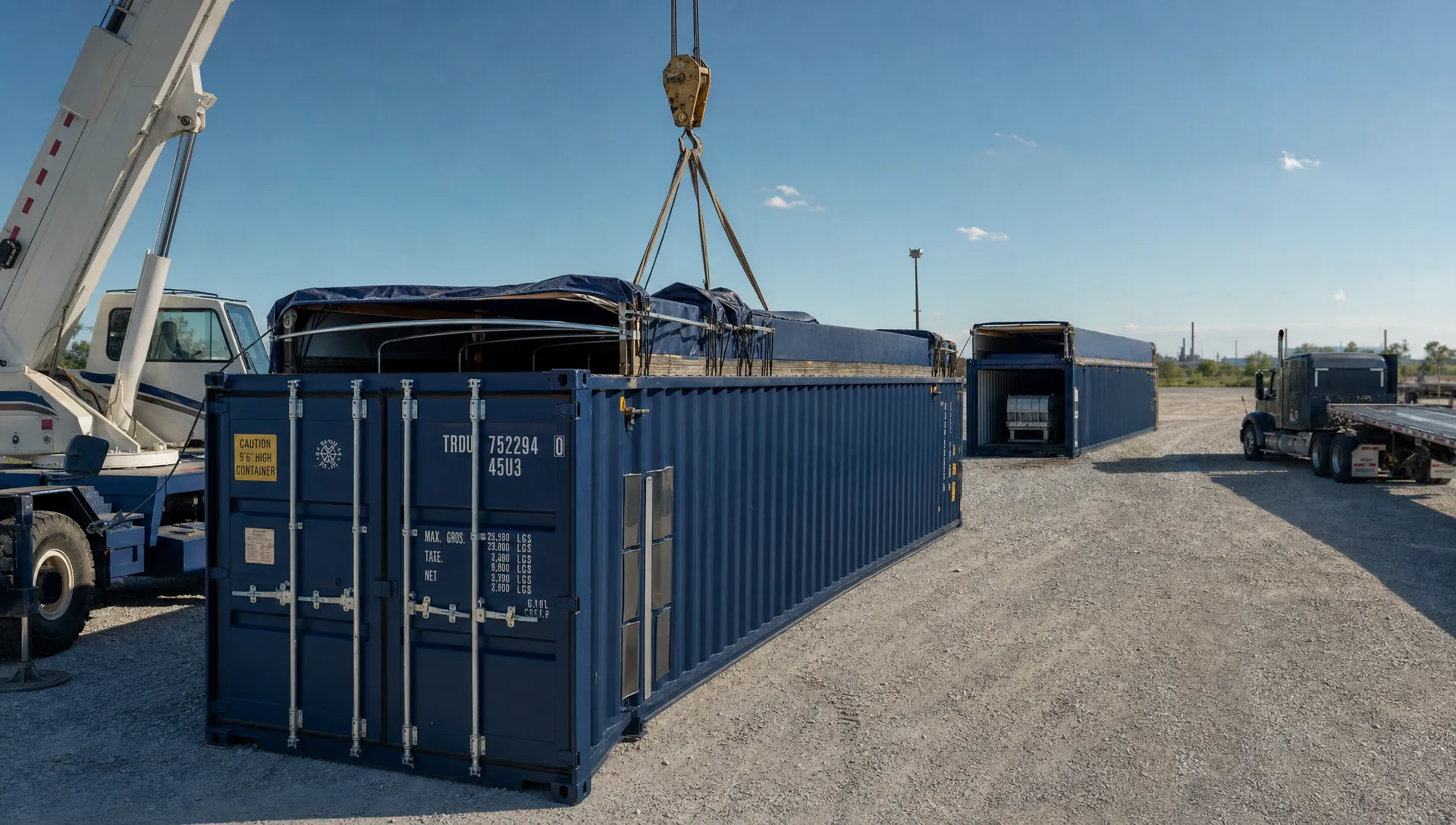
Open Top Shipping Container for Sale: New vs Used
If you need an open top shipping container for sale, choose new if you want the cleanest condition, the most predictable tarp system, and the lowest risk. Choose used if your budget matters more than appearance and you can inspect the roof bows, tarp, doors, floor, and frame. Both can work well for crane-loaded cargo, tall materials, scrap, equipment, and job-site storage. The right choice depends on the load, site, weather exposure, and how long you plan to keep the container.
Quick Answer: A new one-trip open top container is best for long-term use, customer-facing sites, sensitive cargo, and container conversion projects. A used open top container is best for construction, farm, industrial, and scrap applications where function matters more than cosmetics.
Key Takeaways
- Open top containers are built for cargo that cannot load through standard container doors.
- New one-trip units cost more, but usually offer cleaner steel, tighter doors, better paint, and a complete tarp system.
- Used CWO or WWT units can save money, but the tarp, roof bows, top rails, floor, and corner castings need a careful inspection.
- A 20ft open top is easier to place and often better for dense loads, while a 40ft open top gives more floor space for long cargo.
- Always compare delivered price, not just the container price, because open top inventory can vary by depot and distance.
Open Top Shipping Container for Sale: What You're Buying
An open top shipping container is an ISO-style cargo container with no fixed steel roof. Instead, it usually has removable roof bows and a heavy tarp. Many units also have a removable top door header, which helps crews load tall or awkward cargo from above.
This design solves one main problem: some cargo cannot fit through the end doors of a standard dry van container. A crane, loader, excavator, or overhead hoist can lower cargo into the box from the top.
Open tops are common on construction sites, farms, mines, recycling yards, fabrication shops, and industrial properties. They are also called open top conex boxes, open top cargo containers, or open top intermodal containers.
How an open top differs from a standard dry container
A standard shipping container has a fixed corrugated steel roof. That roof adds weather protection and rigidity, but it limits how you load cargo. Everything must pass through the end doors unless the container has been modified.
An open top container trades that fixed roof for overhead access. That makes loading easier for tall cargo, but it also adds parts that you must inspect. The tarp, roof bows, cables, and top rails matter as much as the walls and floor.
For more detail on the smaller size, Outback's guide to 20ft open top container uses, limits, and buying tips explains where a 20ft open top fits best.
Common cargo loaded into open tops
Open tops work best when the load is too tall, too bulky, or too hard to push through normal doors. They are not only for ocean freight. Many buyers use them for ground-level storage and job-site handling.
Common uses include:
- Stone, gravel, scrap metal, and demolition debris
- Machinery, pumps, engines, and fabrication parts
- Tall crates, reels, pipe bundles, and palletized material
- Farm equipment, feed systems, irrigation parts, and fencing supplies
- Job-site materials that need crane or loader access
Open tops are not always the best answer for every heavy load. If cargo is very wide, cannot fit between side walls, or needs side loading, a flat rack may be better. Outback compares those options in its guide to open top vs flat rack containers for heavy equipment.
New vs Used Open Top Shipping Containers: Fast Comparison
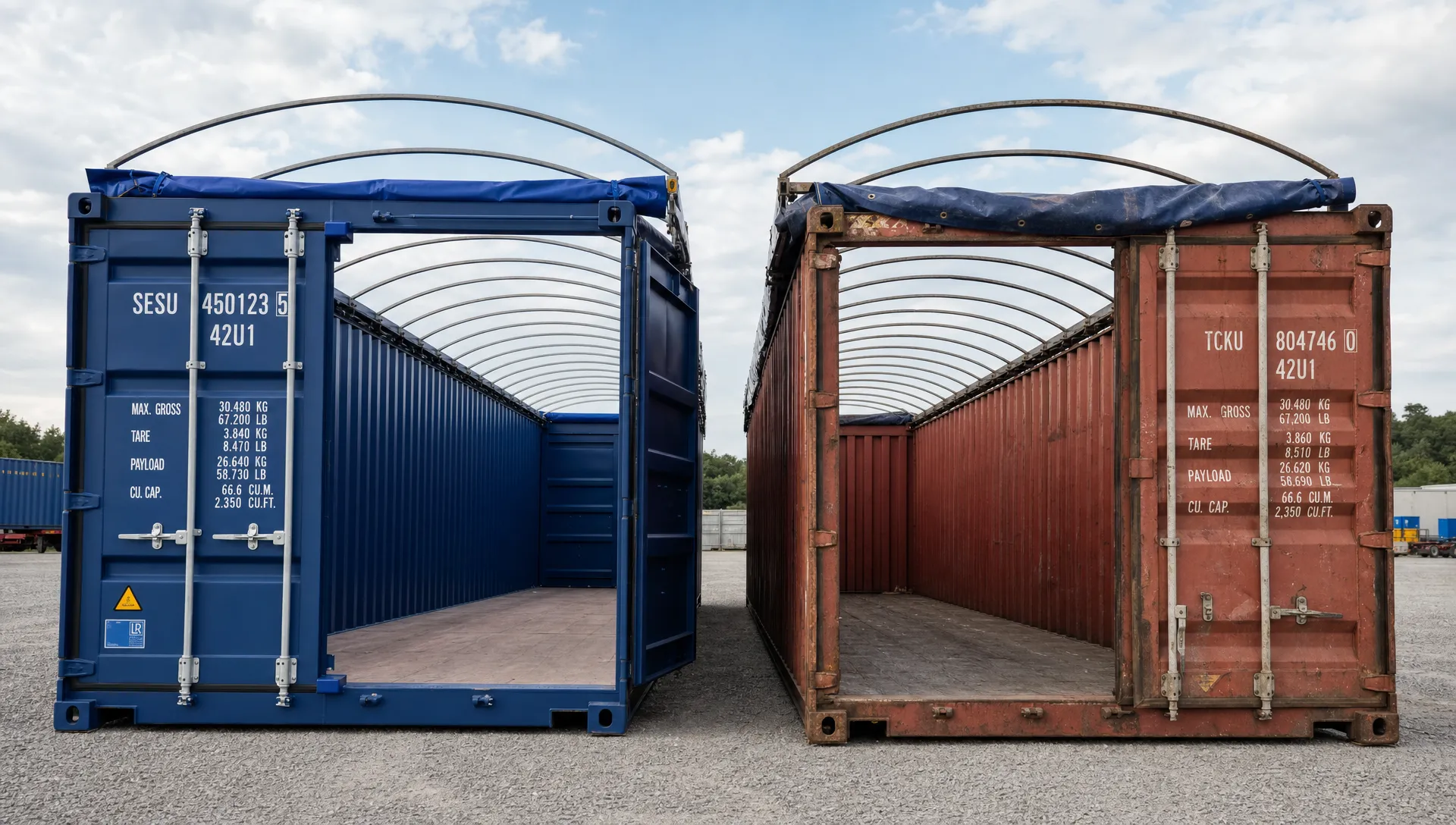
The main difference between a new and used open top container is risk. New units are usually one-trip containers, meaning they were manufactured overseas, loaded once, shipped once, and then sold. Used units have spent more time in service and may show dents, rust, patches, floor wear, and tarp wear.
That does not make used units bad. A good used container can be a smart buy, especially for rough work. But open tops have more weather-sensitive parts than dry containers, so condition matters.
| Factor | New one-trip open top | Used CWO or WWT open top |
|---|---|---|
| Best for | Long-term ownership, clean sites, sensitive cargo, custom builds | Construction, farms, scrap, industrial storage, budget-focused buyers |
| Appearance | Minimal dents, newer paint, cleaner interior | Dents, scratches, rust, patches, faded paint are common |
| Tarp condition | Usually newer and complete | Can be worn, patched, stiff, or due for replacement |
| Roof bows | Usually complete and straight | Must be checked for missing, bent, or rusted bows |
| Floor | Usually cleaner with less wear | May show gouges, stains, soft spots, or repairs |
| Weather protection | More predictable if tarp is fitted well | Depends heavily on tarp, seals, bows, and drainage |
| Up-front cost | Higher | Lower |
| Inspection need | Still important | Essential |
| Resale appeal | Usually stronger | Depends on condition and local demand |
If you are comparing open tops with standard containers too, Outback's broader guide to shipping containers new vs used for every budget explains one-trip, cargo-worthy, wind and watertight, refurbished, and as-is grades in more detail.
What new one-trip means
A new open top container is usually called a one-trip container in the US market. It is not factory-fresh in the sense that it has never moved. It has normally carried one cargo load from the manufacturer to the destination market.
A one-trip open top may still have small dents or handling marks. Containers are built for transport, not showroom display. Still, a one-trip unit should have a cleaner floor, better paint, less corrosion, newer door gaskets, and a more reliable tarp system than most used units.
New open tops make sense when downtime is expensive. If a missing roof bow, leaking tarp, or hard-to-close door would slow your crew, the extra up-front cost can be easier to justify.
What used CWO and WWT mean
Used open tops are often sold as cargo-worthy or wind and watertight. CWO, short for cargo-worthy, means the container is suitable for cargo use when inspected and certified for that purpose. WWT, short for wind and watertight, means it should keep out normal wind and rain when closed correctly.
For an open top, WWT depends on more than steel walls. The tarp and bow system are part of the weather barrier. A used open top with solid walls but a bad tarp is not truly weather-ready for many storage jobs.
If you plan to ship the unit internationally, ask about the CSC plate and inspection status. If you only need static storage on private land, your needs may be different.
When a New Open Top Container Makes More Sense
A new open top container is the safer choice when condition, appearance, and reliability matter. It reduces the chance of surprise repairs after delivery.
It also makes sense when you plan to keep the container for many years. The longer your ownership period, the more value you may get from cleaner steel and a better starting point.
Choose new for sensitive cargo
If you store expensive equipment, finished products, boxed inventory, or materials that cannot get wet, choose carefully. Open tops can protect cargo, but only when the tarp fits well and sheds water correctly.
A newer tarp and straight roof bows help prevent low spots where water can pool. Water pooling is a common cause of tarp stress, leaks, and sagging. It also makes the container harder to manage after storms.
Choose new for public-facing or customer-facing sites
Appearance matters on retail sites, event properties, equipment rental yards, and some commercial projects. A used open top may function well but still look rough. That can be fine behind a fence, but not beside a storefront.
A one-trip unit usually looks cleaner and may need less repainting. If the container will be seen every day, new can save time and finishing costs.
Choose new for modifications and conversions
Open tops are not the first container most people choose for a shipping container home. A standard dry container or high cube container is usually a better starting point because it already has a steel roof.
Still, some container conversion projects use open tops for specialty builds. Examples include equipment enclosures, utility modules, bulk material systems, and custom modular builds that need overhead installation. A new container gives fabricators cleaner steel and fewer unknowns.
Building rules vary by city, county, and state. If your project involves occupancy, utilities, foundations, or public access, talk with your local building department before you buy.
When a Used Open Top Container Makes More Sense
A used open top container makes sense when you need function more than cosmetics. Many construction companies, ranches, recyclers, and logistics teams care more about strength, access, and delivered cost than paint color.
A used unit can be a good value if it is structurally sound. The key is to avoid units with weak floors, severe corrosion, damaged top rails, missing bows, or a tarp that needs immediate replacement.
Choose used for rough material handling
If you load scrap, debris, stone, pipe, or non-sensitive machinery, a used unit may be enough. Small dents and surface rust often do not matter for these jobs.
The floor still matters. Heavy point loads can damage weak plywood or steel patches. If you plan to set dense cargo inside, check the floor rating, support structure, and payload capacity.
Choose used for temporary projects
Short-term job-site storage does not always justify a one-trip unit. A used WWT open top can work well if the project runs for months instead of years.
The same logic applies to farms and rural properties. If the container will sit near a barn, field, or equipment yard, a clean used unit may provide the right balance of cost and durability.
Choose used only after inspection
Do not buy a used open top based on price alone. Low price can hide missing parts, poor drainage, or a tarp that will need replacement soon.
Ask for current photos of the exact unit when possible. If the quote is based on depot availability, ask what grade you are buying and what the grade includes. A clear quote should define the size, condition, delivery cost, and any included accessories.
Size, Tare Weight, and Payload Capacity
Most buyers compare 20ft and 40ft open top containers first. Both are typically 8 feet wide and 8 feet 6 inches tall on the outside. High cube open top units add one foot of height, making them about 9 feet 6 inches tall.
Exact dimensions and ratings vary by manufacturer, series, and certification. ISO publishes standards for Series 1 freight containers, including size and rating frameworks, through ISO 668. Always confirm the data plate on the actual unit before loading.
| Typical spec | 20ft open top container | 40ft open top container |
|---|---|---|
| Exterior length | 20 ft | 40 ft |
| Exterior width | 8 ft | 8 ft |
| Standard exterior height | 8 ft 6 in | 8 ft 6 in |
| Common high cube height | 9 ft 6 in | 9 ft 6 in |
| Typical tare weight | About 5,000 to 5,500 lb | About 8,000 to 9,000 lb |
| Typical max gross weight | About 67,200 lb | About 67,200 lb |
| Typical payload capacity | About 61,000 to 62,000 lb | About 58,000 to 59,000 lb |
| Best fit | Dense loads, tighter sites, shorter equipment | Long cargo, more floor space, larger job sites |
20ft open top: easier to place and better for dense loads
A 20ft open top is often easier to deliver on tight sites. It also tends to work better for very dense cargo because the container itself weighs less, leaving more payload under the same common gross rating.
For farms, smaller contractors, and shops with limited space, 20ft is often the practical choice. It gives overhead loading without requiring as much room for delivery.
40ft open top: more space for long or bulky cargo
A 40ft open top gives twice the length, but not twice the payload. This matters if you plan to load heavy material. You may run out of weight capacity before you run out of space.
Choose 40ft when cargo is long, bulky, or needs more floor area. Examples include pipe bundles, long crates, equipment attachments, and mixed job-site materials.
High cube open top: more vertical clearance
A high cube open top adds height. This helps when cargo sits above the normal wall line or when you need more interior working room.
Do not assume high cube solves every oversized load problem. Door opening height, header design, side wall height, and lifting clearance still matter. Measure the actual cargo, including pallets, rigging, lifting lugs, and protective frames.
Mid-article buyer tip: If you already know your load size, weight, and delivery ZIP code, you can use Outback Shipping Containers to compare current availability, delivered pricing, and financing options for the container type that fits your site.
How to Inspect a Used Open Top Container
Used open tops deserve a more careful inspection than standard dry containers. A standard container has a steel roof. An open top relies on a removable system, and every part of that system can affect performance.
If you cannot inspect in person, ask for clear photos or video. You want exterior shots, interior shots, roof bow shots, tarp shots, corner casting shots, floor shots, door shots, and close-ups of rust or repairs.
Check the tarp system first
The tarp is the roof. Treat it that way. Look for holes, brittle areas, loose seams, poor patches, missing grommets, torn cable pockets, and weak edges.
A tarp can look acceptable when dry and still leak under a hard rain. Ask whether the tarp is included, whether it fits the unit, and whether the tie-down system is complete.
Inspect roof bows and top rails
Roof bows support the tarp. Missing or bent bows create sagging areas where water can collect. Sagging also increases wear because the tarp moves and stretches under wind and rain.
Top rails need attention too. Severe bends, cracks, or corrosion near the rail can affect structural strength and tarp fit. If the container has a removable door header, check that it seats correctly and locks as intended.
Look closely at the floor
Open tops often carry rough cargo. Floors may show gouges, stains, cracks, delamination, steel patches, or soft areas.
Walk the floor if you inspect in person. Bounce lightly with your body weight and listen for weak spots. For machinery storage, ask whether the floor can handle point loads or if steel plates, dunnage, or blocking will be needed.
Check doors, seals, and corner castings
Doors should open, close, and lock without extreme force. Door gaskets should be present and flexible enough to seal. Rust around the lower door area is common, but deep corrosion can be a problem.
Corner castings matter for lifting, stacking, and transport. If you need intermodal use or crane handling, do not ignore them. Damaged castings can create safety and transport issues.
Ask the right buying questions
Before you place a deposit, ask direct questions. Clear answers help you compare quotes fairly.
- Is the unit new one-trip, CWO, WWT, refurbished, or as-is?
- Is the exact tarp included, and what condition is it in?
- Are all roof bows included and straight?
- Does the container have a valid CSC plate if needed for shipping?
- What is the delivered price to my ZIP code?
- Who unloads the container, and what equipment is required?
- Are photos of the exact unit available before delivery?
A cheap used open top can become expensive if you need to replace the tarp, repair the floor, repaint major rust, or hire extra equipment because delivery was not planned correctly.
Delivery, Site Prep, and Permits
Open top delivery depends on size, site access, and unload method. Most buyers focus on the container, but delivery planning is just as important. A good unit still causes problems if the truck cannot reach the pad.
Outback Shipping Containers delivers nationwide, including rural and remote areas. Still, every site is different. Driveway width, road surface, overhead wires, trees, gates, slopes, and turning room can all affect delivery.
Plan truck access before the delivery date
A tilt-bed truck needs room to back in, raise the bed, and pull away as the container slides down. As a rough planning rule, many 20ft deliveries need about 60 feet of straight clearance, while many 40ft deliveries need closer to 100 feet. Actual needs vary by truck and site.
You should also plan for width and height. A truck may need about 12 feet of width and 14 to 16 feet of overhead clearance, depending on equipment and terrain. Remove low branches, confirm gate openings, and mark the placement area before the driver arrives.
Prepare a level base
Containers perform best on level, firm support. Gravel pads, concrete strips, piers, railroad ties, and compacted stone are common options. The goal is to support the corners and keep the frame from twisting.
If the frame twists, doors can become hard to close. On an open top, twisting can also affect tarp fit and roof bow alignment. Good site prep protects the container and your cargo.
Know when you need a crane or forklift
Some open top loads require overhead handling after delivery. If the container will be loaded right away, coordinate the crane, forklift, rigging crew, and truck schedule.
If you plan to move a loaded container on public roads, securement rules matter. The Federal Motor Carrier Safety Administration publishes cargo securement rules for commercial motor vehicles. Work with qualified carriers and riggers when loads are heavy, tall, or unusual.
Check local rules before permanent placement
Permits and zoning rules vary by state, county, city, and property type. Some places treat a container as temporary storage. Others regulate it as an accessory structure. Rules can change if you add utilities, a foundation, signage, plumbing, or occupancy.
Before you buy for a permanent site, call the local building or planning office. Ask about setbacks, time limits, screening, anchoring, stormwater, wind ratings, and inspections. This step is especially important for commercial sites, farms near public roads, Airbnb projects, and container conversion plans.
FAQ: Open Top Shipping Containers
What is an open top shipping container used for?
An open top shipping container is used for cargo that needs overhead loading. Common examples include machinery, scrap metal, stone, pipe, tall crates, farm equipment, and construction materials. The removable tarp and roof bows allow a crane, loader, or hoist to lower cargo into the container.
Are used open top shipping containers waterproof?
A used open top can be wind and watertight if the tarp, roof bows, seals, doors, and frame are in good condition. It is not waterproof in the same way as a fixed steel roof container. Always inspect the tarp for holes, sagging, brittle fabric, and poor patches before buying.
Is a new open top container worth the higher price?
A new one-trip open top is worth it when you need cleaner appearance, fewer repairs, better tarp condition, and more predictable long-term use. It is often the better choice for sensitive cargo, public-facing sites, and custom builds. Used units can still be smart for rough industrial work.
Can you stack an open top shipping container?
Open top containers can be designed for intermodal handling, but stacking depends on the unit's condition, ratings, corner castings, and whether it is empty or loaded. Never assume a used container is safe to stack without confirming its data plate, structural condition, and the requirements of the site or carrier.
What is the difference between open top and flat rack containers?
An open top container has side walls, end doors, and a removable tarp roof. A flat rack has no full side walls and is better for very wide or irregular heavy equipment. Open tops offer more containment and weather protection, while flat racks offer better side and overhead access.
Do I need a permit for an open top container on my property?
You may need a permit, but rules vary by location and use. Temporary job-site storage may be treated differently than permanent storage or a modified structure. Ask your local building or zoning office about setbacks, anchoring, time limits, screening, and inspections before delivery.
Need help choosing new or used? Outback Shipping Containers supplies inspected containers nationwide, with transparent online pricing, financing options, and delivery support from quote through placement. Start with Outback Shipping Containers to compare available options and plan a delivery that fits your site.