Mobile Office Container for Job Sites Cost & Savings
Find accurate mobile office container for job sites cost for 2026. Compare ground level office container prices and find the best heavy duty units. Get a…
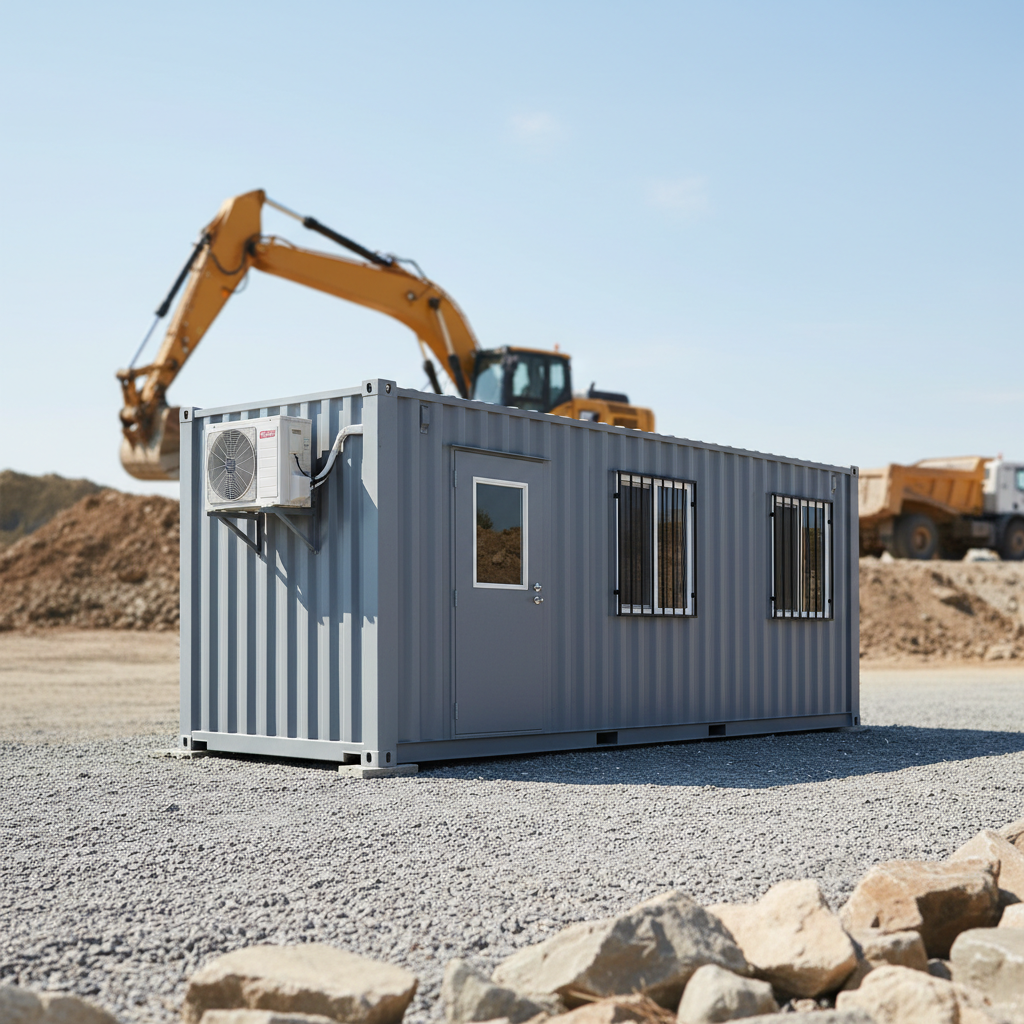
For general contractors and site managers in July 2026, the mobile office container for job sites cost is a critical line item in Q3/Q4 project budgeting. Unlike traditional wood-framed trailers that sit high on wheels, modern conex office for job sites offer ground-level access, superior security, and a significantly longer service life. With US infrastructure spending hitting new peaks, procurement teams are shifting away from high-interest rentals toward owned assets that can be depreciated over multiple projects.
Table of Contents
- 2026 Price Breakdown: Mobile Office Container for Job Sites Cost
- Why Ground Level Units are the Job Site Trailer Alternative
- Standard Portable Construction Office Specs
- Logistics and Mobile Site Office Delivery
- The Financial Impact of Modified Office Layouts: 20ft vs. 40ft ROI
- Hidden Variables in Operational Expense (OpEx) for Container Offices
- Security Upgrades and Technology Integration Costs
- Frequently Asked Questions
- Securing Your Assets for the Next Project
- Explore Related Products & Guides
2026 Price Breakdown: Mobile Office Container for Job Sites Cost
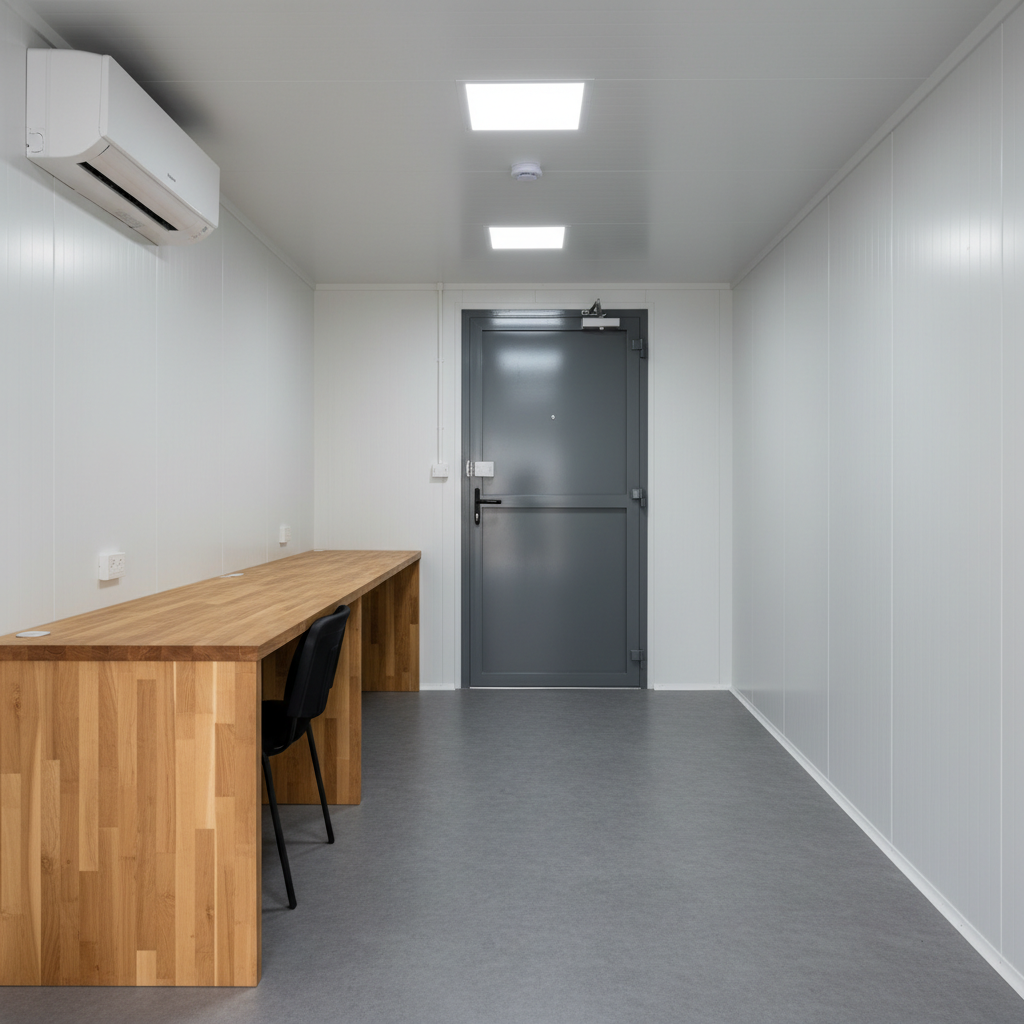
The total investment for a site office depends heavily on the 'tier' of the build—ranging from a raw 40ft new high cube shipping container that you modify yourself to a fully commissioned, plug-and-play unit. In the current market, ground level office container prices generally fall between $12,500 and $38,000 for standard configurations.
| Unit Type | Size | Estimated Price Range (2026) | Best For |
|---|---|---|---|
| Basic Storage/Office Split | 20ft x 8ft | $11,500 – $16,000 | Small crews, tool security |
| Standard Fully Insulated Office | 20ft x 8ft | $18,000 – $24,000 | Project Managers, Admin hubs |
| Executive / Multi-Room Office | 40ft x 8ft | $28,000 – $42,000 | Large scale commercial sites |
| Anti-Vandal Secure Store | 10ft x 8ft | $7,500 – $11,000 | Space-constrained metro sites |
Primary Cost Drivers for Site Offices
- Condition of the Shell: One-trip containers (essentially new) add a premium but offer 25+ years of life, whereas used 40ft cargo containers can save $2,000–$4,000 upfront.
- Insulation Package: Closed-cell spray foam is the gold standard for noise dampening and thermal R-value, typically adding $2,500–$4,500 to the build.
- HVAC Systems: Standard PTAC units or mini-split heat pumps for year-round comfort.
- Electric Pack: Commercial-grade conduit, LED overheads, and external 30-amp to 100-amp breaker panels.
- Interior Finishes: Industrial vinyl flooring (easy to mop) vs. basic plywood.
Why Ground Level Units are the Job Site Trailer Alternative
The traditional wheeled office trailer is increasingly seen as a liability on modern job sites. Because containers sit flush on the ground, they eliminate the need for expensive ADA-compliant ramps and skirting. Furthermore, heavy duty job site office units are made of 14-gauge CORTEN steel, making them nearly impossible to break into—a major factor when housing expensive blueprints, survey equipment, and server racks.
Tip: When calculating your mobile office container for job sites cost, remember that these units do not require a permanent foundation. A simple level pad of 3/4" crushed stone is usually sufficient, saving you thousands in site prep compared to modular buildings.
Standard Portable Construction Office Specs
To ensure your office meets the International Building Code (IBC) and local permitting requirements, you should look for the following baseline specifications:
- ISO 668 compliance for structural integrity.
- R-13 minimum insulation for walls and R-21 for ceilings.
- Steel personnel door with a high-security lockbox.
- Windows with integrated steel security bars or shutters.
- Commercial-grade flooring (VCT or heavy-duty vinyl).
- CSC plate certification if you plan to ever ship the unit overseas.
Logistics and Mobile Site Office Delivery
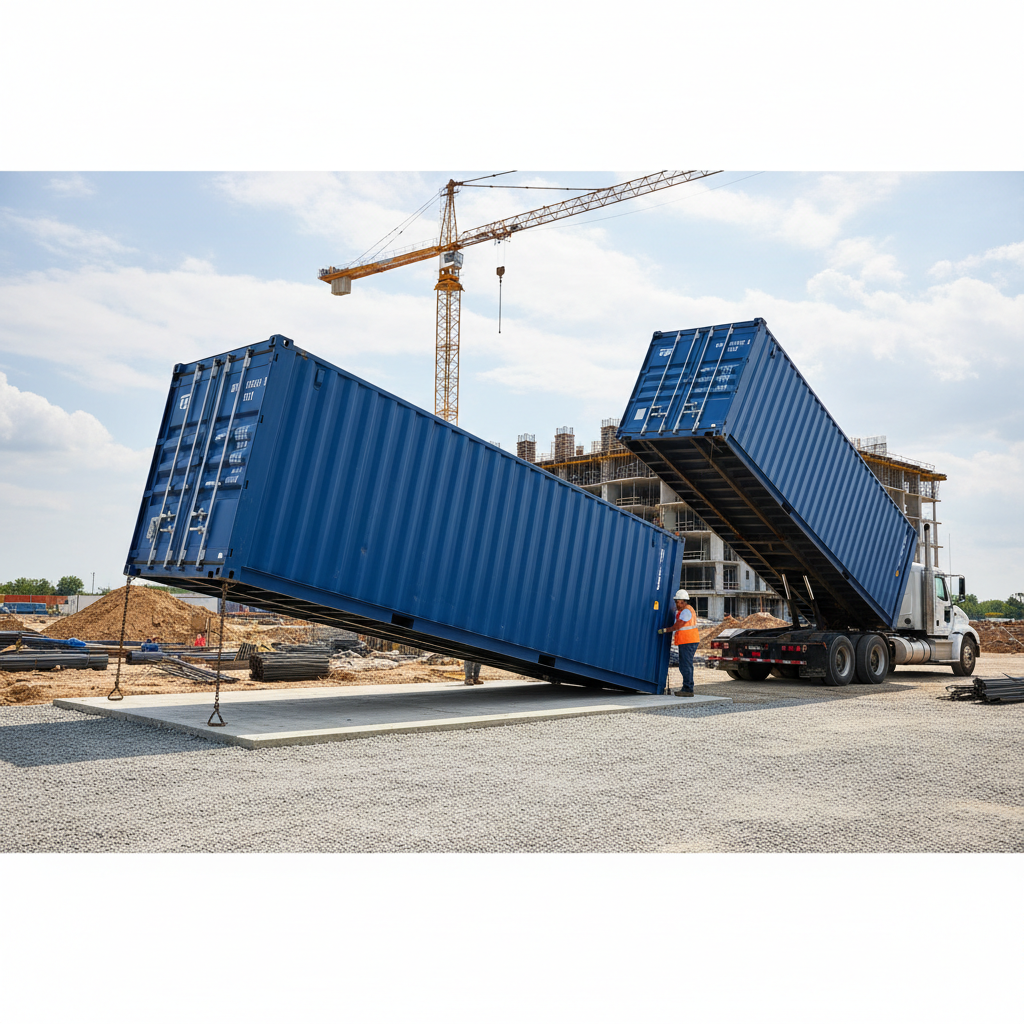
Buying the unit is only part of the equation. You must also account for shipping container delivery costs. Most site offices are delivered via a tilt-bed truck, which requires 60–100 feet of straight-line clearance to drop the unit. In 2026, expect to pay between $4.00 and $7.00 per mile from the nearest depot, with a minimum 'short-haul' drop fee usually ranging from $350 to $600.
Tip: If you are ordering a 40ft unit, such as our Open Plan Office conversion, verify that your site has a 'gooseneck tunnel' clearing. While most offices use standard heights, high-cube units provide an extra foot of vertical space—essential for recessed lighting and HVAC ductwork.
The Financial Impact of Modified Office Layouts: 20ft vs. 40ft ROI
When calculating mobile office container for job sites cost, many project managers default to the 20-foot standard. However, the cost-per-square-foot often drops significantly when scaling to a 40-foot High Cube unit. A standard 20-foot office provides roughly 160 square feet of space, whereas a 40-foot unit doubles that footprint but typically only increases the monthly rental rate by 30% to 45%. If your site requires a dedicated blueprint table, a break area, and a private superintended desk, the density of a 40-foot unit prevents the need for a second modular unit, effectively cutting mobilization and drayage fees in half.
Purchasing these units outright rather than leasing presents a different fiscal trajectory. For a long-term infrastructure project exceeding 24 months, the 'break-even' point on a used 20-foot office container usually occurs around the 18-month mark. Beyond this point, the unit becomes a liquid asset that can be depreciated over time or sold on the secondary market for 60-70% of its original value, provided the HVAC and electrical systems have been maintained. This is a stark contrast to traditional wood-frame trailers which depreciate rapidly and suffer from structural degradation during frequent transport.
| Feature | 20ft Standard Office | 40ft Combo Unit | 40ft Full Office |
|---|---|---|---|
| Avg. Purchase Cost | $11,500 - $14,000 | $16,000 - $19,500 | $18,500 - $24,000 |
| Avg. Monthly Rental | $250 - $450 | $400 - $600 | $550 - $850 |
| Personnel Capacity | 1 - 2 People | 1 Office + Storage | 3 - 5 People |
| HVAC BTUs | 8,000 - 12,000 | 12,000 (Office side) | Dual 12,000 Units |
Tip: If your job site has limited space but high personnel needs, consider a 'Combo Unit.' These provide a finished 15-foot office space with a 25-foot secure storage bay, allowing you to pay one delivery fee for two distinct site functions.
Hidden Variables in Operational Expense (OpEx) for Container Offices
Beyond the base sticker price, the total cost of ownership is influenced by regional climate demands and local code compliance. In Northern states or high-heat environments like Arizona, the standard R-13 fiberglass batten insulation found in basic containers may result in excessive utility bills. Opting for closed-cell spray foam insulation adds roughly $1,200 to $2,500 to the upfront cost but can reduce HVAC run-time by 40%, preventing the common issue of condensation buildup on the interior steel walls which leads to mold and equipment damage.
Electrical configuration is another area where costs fluctuate based on site requirements. A standard unit typically features a 60-amp or 100-amp load center with surface-mounted EMT conduit. If your project requires high-density computing, server racks for site security cameras, or large-format plotters, upgrading to a 125-amp service is necessary. Furthermore, the type of exterior siding or paint—such as a heat-reflective ceramic coating—can further mitigate thermal gain, extending the lifespan of the rooftop AC unit and reducing the frequency of maintenance calls.
- Site Leveling: Units must be placed on level ground or gravel pads to ensure doors swing correctly and internal drainage works.
- Electrical Hookup: Licensed electrician fees for hardwiring the unit to a temporary power pole (typically $500 - $1,200).
- Permit Fees: Municipalities may require 'Temporary Use Permits' ranging from $50 to $500 depending on duration.
- Furniture Packages: Rental of desks, rolling chairs, and plan tables can add $50 - $150 per month to the lease.
Important: Always verify if your site requires an 'Industrialized Housing and Buildings' (IHB) decal. In states like Texas or Florida, an office container without the proper state-level certification can be red-tagged, leading to expensive work stoppages.
Security Upgrades and Technology Integration Costs
One of the primary reasons contractors choose shipping container offices over traditional trailers is the inherent security of the 14-gauge corrugated steel shell. However, the standard padlock hasps are vulnerable to bolt cutters. High-security modifications, such as internal locking 'lock boxes' or heavy-duty steel personnel doors with deadbolts and lever handles, usually add $400 to $800 to the procurement cost. For high-value job sites, many firms are now integrating magnetic door sensors and cellular-based alarm systems that are pre-installed at the modification shop.
Data connectivity is the final piece of the modern mobile office puzzle. While some rely on hotspots, dedicated container offices often feature pre-wired Cat6 ethernet ports and external antenna mounts for cellular boosters. A 'Smart Office' container—equipped with LED lighting, motion sensors, and smart thermostats—typically commands a $2,000 premium on the purchase price but attracts premium subcontractors and helps meet LEED certification requirements for energy efficiency on 'Green' job sites.
- Evaluate the project duration: Under 12 months = Rent; Over 18 months = Buy.
- Check door orientation: Ensure the personnel door and the cargo doors are accessible based on your site's spatial constraints.
- Audit the insulation: Choose spray foam for extreme climates to avoid interior moisture issues.
- Confirm delivery access: A 40-foot unit requires roughly 100 feet of straight-line clearance for a tilt-bed truck to drop the container.
Tip: Used containers are graded by 'One-Trip' (like new), 'Cargo Worthy' (CWO), and 'Wind and Watertight' (WWT). For office conversions, always aim for One-Trip or CWO to ensure the steel hasn't suffered significant thinning from previous ocean service.
Container delivery near you
We deliver to every state in the lower 48 plus Alaska and Hawaii. These local pages list pricing, metro coverage and typical lead times for the areas we run into most:
- Shipping containers near me — how we source from the depot closest to your ZIP code
- Shipping containers in Georgia — pricing and delivery to Atlanta and Savannah
- Shipping containers in North Carolina — pricing and delivery to Charlotte and Raleigh
- Shipping containers in Washington — pricing and delivery to Seattle and Spokane
- Shipping containers in Colorado — pricing and delivery to Denver and Colorado Springs
- Shipping containers Houston — local yard stock and lead times
Frequently Asked Questions
Navigating the complexities of buying used shipping containers for office conversions can be daunting. Here are the most common questions our logistics team handles.
How much does a job site container office cost?
For a standard 20ft unit with HVAC and insulation, expect to pay between $18,000 and $25,000. Basic storage-combo units start lower at $12,000, while high-end 40ft executive suites can exceed $40,000.
What are the standard sizes for mobile office containers?
The most common sizes are 20ft (160 sq ft) and 40ft (320 sq ft). We also offer niche sizes like 10x8 ft secure units for dense urban sites.
Can I customize a construction site office container?
Yes. Customization options include partition walls, extra windows, data ports, built-in desks, and even customized paint to match your company branding.
How long does it take to deliver a mobile office?
In-stock 'standard' offices can be delivered in 7–14 days. Custom builds requiring specific shipping container transport options typically have lead times of 4–8 weeks.
Are container offices better than office trailers?
Containers offer superior wind ratings (up to 150 mph), better theft prevention, and ground-level entry which removes the need for expensive OSHA-compliant stairs and ramps.
What permits are needed for a job site container office?
Most jurisdictions treat site offices as 'temporary structures.' You usually need a temporary use permit (TUP) or a minor site plan approval from your local Authority Having Jurisdiction (AHJ).
Securing Your Assets for the Next Project
Choosing the right mobile office is a strategic decision that impacts crew productivity and asset security. By understanding the mobile office container for job sites cost upfront—including the hidden fees of delivery and electrical hookups—you can ensure your project stays under budget. If you're ready to compare inventory for your project, our team can pull matching units from our nationwide depots and provide a firm quote including freight to your specific site coordinates.
Explore Related Products & Guides
- Prefabricated container home floor plans with prices:…
- Planning a Custom Shipping Container Build Step by Step
- Shipping Container Transport Options and Site Rules
- Browse 10ft Containers
Frequently Asked Questions
How much does a job site container office cost?
A turnkey 20ft mobile office container for job sites cost typically ranges from $18,000 to $25,000 in 2026, depending on insulation type and HVAC specs.
What are the standard sizes for mobile office containers?
Industry standards are 20ft x 8ft and 40ft x 8ft units. High-cube variants (9'6" tall) are preferred for offices to allow for ceiling-mounted HVAC and lighting.
Can I customize a construction site office container?
Absolutely. Customizations include interior partitions, built-in plan tables, specialized security shutters, and custom exterior paint to match your corporate identity.
How long does it take to deliver a mobile office?
Standard units ship within 10-14 days. Fully custom builds usually require 6-10 weeks from deposit to delivery depending on current fabrication backlog.
Are container offices better than office trailers?
Yes, for security and longevity. Container offices sit on the ground (no ramps needed), are fire-resistant, and significantly more difficult to vandalize than wood-framed trailers.
What permits are needed for a job site container office?
Typically, you need a temporary use permit from your local building department. Since they are mobile, they are often exempt from standard foundation building codes.