Shipping Container Office: Complete 2026 Buyer's Guide
By Outback Container Experts · Published July 21, 2026 · Last updated October 18, 2026
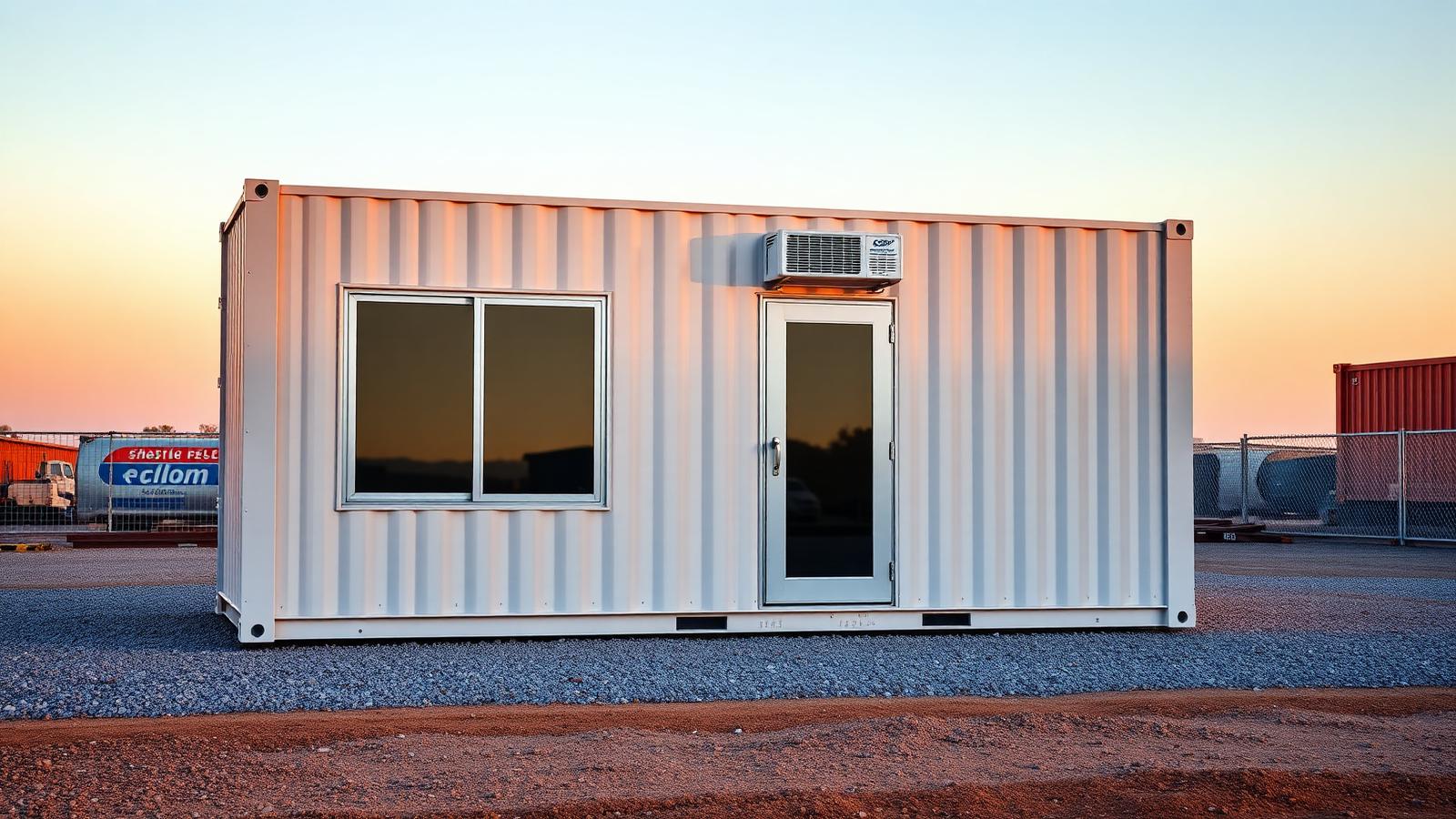
A shipping container office turns a steel intermodal container into a lockable, insulated workspace you can drop on a jobsite, in a yard, or behind a warehouse and start using the same day. It's the fastest way to add a real office without pulling a building permit for a permanent structure — and unlike a plastic construction trailer, it's built to survive forklifts, weather, and years of moves. This guide walks through every decision that matters: sizes, layouts, insulation, HVAC, costs, and the office/storage combo that most of our buyers end up choosing.
Table of Contents
- What is a shipping container office?
- Sizes: 10ft, 20ft, and 40ft
- The office/storage combo (the buyer favorite)
- How much does a container office cost?
- Insulation, HVAC, and climate
- Planning, delivery, and permits
- Common configurations and floor plans
- Frequently asked questions
What is a shipping container office?
A shipping container office is a standard ISO shipping container — usually a 20ft or 40ft high-cube unit — that's been modified with windows, a personnel door, electrical service, insulation, interior finishes, and climate control. The steel shell stays intact, which is what makes it different from a trailer or a stick-built modular building: it's still rated for stacking, still lockable to CSC standards, and still moves on a standard tilt-bed or roll-off truck.
For contractors, oilfield operators, farms, marinas, and municipal yards, a container office solves the same problem a construction trailer does — but it doesn't rot, doesn't get pried open in a weekend, and doesn't need to be towed away when the job ends. You buy it once and redeploy it. Compare a typical 20ft office to a 20ft office/storage combo on our container offices for sale page and the price gap is small enough that most buyers upgrade to the combo.
Sizes: 10ft, 20ft, and 40ft
Container offices come in three practical sizes. The right one is almost always driven by headcount and how much storage you also need on-site.
| Size | Interior sq ft | Typical use | Seats |
|---|---|---|---|
| 10ft office | ~75 sq ft | Guard shack, single-desk site office, ticket booth | 1 |
| 20ft office | ~150 sq ft | Foreman's office, small crew office, sales trailer replacement | 2–3 |
| 20ft office/storage combo | ~75 sq ft office + ~75 sq ft storage | Superintendent office with locked tool/plan storage | 1–2 |
| 40ft office | ~300 sq ft | Multi-desk office, break room, plan room, mobile HQ | 4–6 |
| 40ft office/storage combo | ~150 sq ft office + ~150 sq ft storage | Job trailer replacement with secure storage on the same footprint | 2–3 |
If you're deciding between a 20ft office and a 40ft, the honest answer is: buy the 40ft if you have more than two people on-site for more than a month. The delivery cost is nearly identical, the extra length gives you a real break area, and the resale value on 40ft units is stronger.
The office/storage combo (the buyer favorite)
The single most popular configuration we ship is the office/storage combo — one container divided by an interior partition wall, with a personnel door and window on the office end, and the original cargo doors preserved on the storage end. The office side is fully finished (insulation, electrical, HVAC, flooring). The storage side stays a bare steel cargo box with full-height double doors.
Tip: You get a real office and a lockable storage vault on the same 20ft or 40ft footprint, with one delivery, one permit conversation, and one asset to move when the job ends. On sites where tool theft is a real risk, the CSC-rated cargo doors on the storage end are dramatically harder to breach than a stick-built shed.
- 20ft combo: ~10ft office + ~10ft storage — ideal for a single superintendent plus locked tools and plans.
- 40ft combo: ~20ft office + ~20ft storage — fits a two-desk office, a small conference table, and a real tool crib on the storage side.
- Full-office variant: skip the partition and get the entire container as workspace. Best when a separate storage container is already on-site.
How much does a container office cost?
Prices swing based on region, delivery distance, whether the base container is new or used, and how heavily it's finished. These are 2026 ballpark ranges for turnkey units delivered in the continental US:
| Configuration | Typical price range | What's included |
|---|---|---|
| 10ft office | $8,000 – $15,000 | Personnel door, 1 window, LED lighting, 1 HVAC unit, electrical package |
| 20ft office | $12,000 – $22,000 | Personnel door, 2 windows, LED lighting, HVAC, electrical, insulation, interior finish |
| 20ft office/storage combo | $14,000 – $25,000 | Above, plus partition wall and preserved cargo doors on storage end |
| 40ft office | $18,000 – $32,000 | Full-length finished workspace, 2 HVAC units, upgraded electrical panel |
| 40ft office/storage combo | $22,000 – $38,000 | Two-room office plus 20ft of secure cargo storage |
Tip: Delivery is priced separately, typically $3–$7 per loaded mile with a minimum around $400. A tilt-bed truck sets the unit directly on the ground — you don't need a crane or a foundation for most jobsite deployments.
Financing is available on units and packages priced over $50,000 (usually a 40ft combo bundled with a separate storage container, or a container home). See our financing page for lender financing on container homes priced above $72,000, subject to lender approval.
Insulation, HVAC, and climate
A bare steel container is a thermal sponge — interior temperatures can run 30°F above ambient in direct sun. Every real container office is insulated. What varies is which system, and that decision is driven by climate.
- Closed-cell spray foam (recommended). 2 inches gets you roughly R-13, seals every seam, and acts as a vapor barrier so condensation can't rust the walls from behind.
- Rigid foam board. Cheaper up front, but requires meticulous sealing at every joint or you'll get condensation between the board and the steel.
- Mineral wool + vapor barrier. Fire-resistant and doesn't off-gas — a good choice for offices where welding or grinding happens nearby.
- Ceramic heat-reflective roof coating. Reflects up to 80% of solar radiation. Worth it in the Southwest; unnecessary in the Pacific Northwest.
For HVAC, a single 9,000–12,000 BTU mini-split handles a 20ft office comfortably in any US climate. A 40ft office needs either two mini-splits or a single 18,000–24,000 BTU unit. Window units work but drop efficiency fast above 95°F ambient — a real problem in Arizona, Texas, and Florida summers. See our insulated container office deep-dive for R-value tables by region.
Planning, delivery, and permits
Most jurisdictions treat a temporary container office on a jobsite as portable equipment rather than a structure, so you usually don't need a building permit if the unit is on-site for less than 180 days and isn't tied to a permanent foundation. That changes the moment you either (a) leave it in place long-term, or (b) run permanent utilities to it.
- Confirm zoning before ordering. A five-minute call to the local building department saves weeks. Ask specifically about temporary vs. permanent classification.
- Plan the pad. Level gravel or compacted dirt is fine for short-term use. For anything over 6 months, set the container on concrete blocks or a poured pad at each corner casting.
- Route power and data early. A 50-amp panel with two 20-amp circuits handles most 20ft offices. Pull data through the same conduit if you're wiring cameras or a Wi-Fi bridge.
- Book delivery 1–2 weeks out. Tilt-bed trucks book up fast in busy metros. Once the truck is on-site, the unit sets in under 20 minutes.
Common configurations
- Single-desk jobsite office (20ft): desk, filing cabinet, HVAC, one 4x4 window. Runs a superintendent comfortably.
- Two-desk foreman office (40ft): two desks, a small conference table, printer, and a mini-fridge. Common on multi-trade sites.
- Sales trailer replacement (20ft or 40ft): finished interior, upgraded flooring, better lighting, larger windows. Used by container home dealers, RV lots, and equipment rental yards.
- Security guard shack (10ft): single door, wraparound windows, small counter. Fits at the gate of a fenced yard.
- Office/storage combo (20ft or 40ft): the buyer favorite described above.
Container delivery near you
We deliver to every state in the lower 48 plus Alaska and Hawaii. These local pages list pricing, metro coverage and typical lead times for the areas we run into most:
- Shipping containers near me — how we source from the depot closest to your ZIP code
- Shipping containers in North Carolina — pricing and delivery to Charlotte and Raleigh
- Shipping containers in Washington — pricing and delivery to Seattle and Spokane
- Shipping containers in Colorado — pricing and delivery to Denver and Colorado Springs
- Shipping containers in Tennessee — pricing and delivery to Nashville and Memphis
Frequently asked questions
How long does a container office last?
The steel shell has a 25+ year service life if the exterior is kept painted and the roof drains cleanly. The interior finish (flooring, HVAC, electrical) has the same maintenance profile as a normal office — replace or refresh every 10–15 years.
Do I need a foundation?
Not for jobsite use. Set the four corner castings on level ground, gravel, or concrete blocks. For permanent installs, a small pad or footings at each corner is enough — the container's own structure carries the load.
Can I move the office once it's delivered?
Yes. That's the whole point. A tilt-bed can pick it up and redeploy it to another site the same day. Just secure the interior contents and disconnect the utilities first.
New or used container?
For an office build, new (one-trip) containers are worth the ~$1,500 premium — you get clean walls, no rust to grind out, and a straight roof that seals easily. Used units make sense for the storage half of a combo, where cosmetics don't matter.
What's the difference between a container office and a construction trailer?
A trailer is a wood-framed box on wheels, roughly 8x20 or 8x40, that you tow into place and level on jacks. A container office is a steel box on the ground. The trailer is lighter and easier to move by a pickup; the container is stackable, harder to break into, and holds its value on resale. On a five-year cost basis, the container almost always wins.
Ready to spec a unit?
Browse in-stock container offices for sale, or contact our team with your site address and headcount — we'll come back with a specced-out unit and a delivered price within one business day.
About Outback Container Experts
This guide was prepared by the Outback Shipping Containers team, based on the questions our customers ask us most when buying, modifying and taking delivery of shipping containers. Learn more about us.
Ready to find your container?
Browse our in-stock shipping containers, container homes and custom builds, or ask our team for a free quote with delivery to your site.